A CONVERSATION WITH NICOLE FARMER

Honest Sonnets: Memories from an Unorthodox Childhood in Verse by Nicole Farmer. Kelsay Books, 2023. $20.00

When I received not one, but two books from poet Nicole Farmer this summer, I was delighted to see that this was another woman poet over 50 hitting her stride. I dove right in to her newest, Honest Sonnets, a memoir composed in sonnets. That is the book I’ll talk about here.

I’m not usually a fan of poetry books that stick to one form, preferring the surprise of poems that meander through whatever form seems to suit them. This book changed my mind. In the author’s note, Ms. Farmer wrote, “I found the restrictions of having to tell a story in fourteen lines, in the structure of a sonnet both comforting and challenging. Something clicked, and for three months the sonnets flowed out of me…” The sonnet form allowed these poems to come together in just the right way, with the structure of each scene, each memory given its own little drawer. It made sense when I thought about the overall narrative: a childhood that lacked a solid structure to call home found its retelling in a poetic structure that offered all the boundaries a child who needed them could want.

Honest Sonnets shows us a girl who lived through tumultuous family dynamics that paralleled a tumultuous time in history. Ms. Farmer was a child of the 60s and 70s whose parents modeled a life of leaping into the moment: free love, drug use, back-to-the-land experiments, going wherever it felt right. The story begins with a child born with a damaged heart. The story then moves from that early trauma, surgery, and healing to the freewheeling existence that would define Ms. Farmer’s childhood. Maybe freewheeling is the wrong word. Maybe I should say freefalling. It felt like the kid in the sonnets was in freefall a lot, hoping for something or someone to catch her.

For me, this was not a book to gulp down in one sitting. I intended to do just that on my first read-through, but stopped halfway to absorb what I’d just read. The poems are intense, each sonnet/story its own little narrative bomb. There are always explosions, some small, some enormous, change the only constant. When I finished reading, I had the sense that this collection is only the beginning. With the life that Ms. Farmer has had, there will always be something to turn into verse, some twist to offer the world.

If I were to choose one poem from this book that is a good example of its scope, I would choose this one from page 27:

LOVE

I grew up with this confusing twisting in my stomach.
What did the phrase free love mean? I couldn't figure it out.
What was happening, when dad disappeared, and mom cried?
Where did he go? Why was mom kissing our family friend
late one night when I got up for a glass of water? The seventies
were a time where what I saw adults do didn't seem free
at all, it just seemed weird. Yelling and screaming,
throwing dishes and doors slamming, cars peeling out
in the night, or hand holding and rolling in the grass on family
picnics, laughing and kissing. Up or down, high or low with no
middle ground where you knew what might be coming.

Except with us. To us they were nurturing.
Never wanting us to see the turmoil; we felt it acutely.

It’s the phrase, “…no middle ground where you knew what might be coming,” that gets me. To grow up in such a state of uncertainty is to learn resilience or die. Resilience is exactly what saves us all.

Following is the conversation I had with Ms. Farmer about her work.

OMC: Nicole, thank you for the opportunity to talk about your work and poetry in general. When I read your author’s note in Honest Sonnets, I was immediately drawn to your struggle to define home. This is what so many of us struggle with for various reasons, both from the physical reality of a shelter to the deeper level of what we carry in our hearts. How many definitions of home did you move through as you wrote these poems? Have you found your answer?

NF:  Thank you, Kathleen, it’s a pleasure to talk about poetry with you on One Minnesota Crone. This is a question I could talk about all day. Home is a place that many artists talk about in both a spiritual and metaphysical sense as a source for their creativity and a place they have found peace and safety. For many people this evokes memories and deep feeling associated with a particular area geographically and the culture – food, speech, mannerisms, routines- which define them as “southern” or “Appalachian” for example. I grew up with a dad from Chicago, and a mom from upstate New York who carried with them many traditions from their Italian American, and British American roots.  Because I moved fifteen times in my first eighteen years, I really felt I had no home, was a constant outsider, except in the company of my immediate family. I grew to rely on them in ways that nomadic tribes experience.

Before I started writing this group of poems, I would have said my family was my home. To some extent that is still true, but because I started writing these sonnets just months after my father and mother died, they came from a place of searching, of true unknowing. I was lost. Only through the writing did I discover that many things make me feel at home, the first being books. Having the security of my favorite books to read, my favorite characters to visit, is as comforting as the familiarity of a church picnic in your hometown might be for some people. The other place I have always felt at home is among trees. A walk in the woods can calm me and inspire like no other place. Of course, whenever I am able to share the company of my husband, my sister, or my daughters, I experience a degree of familiarity like none other, and I know I am home. 

OMC: As someone who seldom works in strict forms, I found the choice of sonnets to be an interesting one. You mention in your author’s note that this is the form that just clicked for you, after starting some of these pieces as short stories and prose poems. What nudged you to try the sonnet form at all? Were there other poetic forms that might have worked for this collection? I notice that there are a few poems that aren’t in sonnet form tucked in the book that all ask what and where home is in very short verse, like little road signs. Can you talk about that choice as well?

NF: Good question! I was very surprised that the limits of a 14-line sonnet would be the form that finally clicked! I had taken a few memoir classes and felt really stuck as I had so few photographs to work from, the way Lois Lowry did in Looking Back, for example. I also had a very strict idea of what a Shakespearean sonnet with iambic pentameter, and rhyming couplets, should look and sound like based on my forty years in the theatre and my classical acting training at The Juilliard School. Then I read Diane Seuss’s frank: sonnets, and was amazed how she had blown the lid off the American sonnet and realized I could experiment to my heart’s content.

The short “interludes” in the book came thanks to my good friend and fellow poet, Kathleen Calby. She suggested I break up this dense collection into sections, and as I was deciding where to do this, I happened upon these notes regarding home that I had written in the margins. (I write everything in a notebook first and then type it up later.) They were throw-aways, but I was having fun connecting them to a mathematical equation that reflected the four of us – me, my mom, dad, and sister – and how our numbers changed depending on separations and moves. For example, on page 60, “Where did home go? My sister is traveling. Gone. Now I bounce between two states. 1 + 1 = 3”. In this instance the numbers describe the feeling of being with one parent and how it never seemed to equal 2 in my mind, because the other parent was an invisible presence in the room.

OMC: Your friend had a great suggestion about breaking the work into sections. That works really well. And I liked those little “interludes.” What was the most surprising poem you found yourself writing for this book? Does that same poem still surprise you or do you see why it showed up when you look at the body of work as a whole now?

NF:  Gorilla Acres.I really loved living on that farm in West Virginia and have told the story many times, so it surprised me when I reread it and realized that there was so much hidden rage – “fury under my fingernails” – in the narrative. In third grade I was finally old enough to be mad at my dad for an action that he thought was funny but caused me more alienation at school. I think it may be the only poem in the collection that has this kind of open criticism of my hero, my protector.

GORILLA ACRES

was what my mom named the place afterwards.
She hung a sign just beside the mailbox at the end
of the driveway, outside of Union, West Virginia. Our new
rental home was surrounded by a thousand acres of grazing land
and several hundred cows, a hillbilly paradise until a mob
of hunters descended on the old rock quarry with guns, beer
and chaw, all because a teenager had seen a "monster"
wading in the reeds the morning after he and his cronies
went to see "The Creature from the Black Lagoon." We 
were told to vacate, but dad thought it would be fun to play
a joke--sitting on the front porch in a rocking chair, buck
naked, he began to jump around and act like a gorilla, scratching
his ass, as they came over the rise! Fury under my fingernails,
I went to school with the hunter's kids the next day.

OMC: I can imagine how that would infuriate and embarrass a kid! How do you think the pandemic influenced your work on these poems? It was such a time of people reconsidering the homes they were now hunkered down in; did you find yourself reconsidering your definitions of home again at that time and perhaps reworking what you thought you knew?

NF: The pandemic was a very productive time for me. I was working from home as a reading tutor via Zoom.  I was grateful to not be traveling to a school and spending my days in the classroom, because it gave me more time to focus on my writing. It seemed to directly coincide with the fact that I had found the sonnet format for the poems and for three months they seemed to flow on to the page at the rate of two or three a day.

OMC: I have a handful of poets that I love to read when I’m trying to find my own right words, like Mark Nepo, Naomi Shihab Nye, James Crews, and Lawrence Ferlinghetti to name just a few. Were there any specific poets you returned to over and over while you worked on Honest Sonnets? Was there anything else that fed your work when you needed some sustenance?

NF:  Because my “past life” was spent on stage or directing in the theatre, I spent years reading hundreds of plays and hardly ever took the time to read poetry. When I did indulge, I fell in love with e.e. cummings, Rainer Maria Rilke, and Billy Collins. Now, and while writing Honest Sonnets, I read poetry voraciously, for breakfast lunch and dinner! My current sources of inspiration are Ocean Vuong, Margaret Ray, Sharon Olds, and Natalie Diaz, just to name a few. I also subscribe to dozens of literary magazines like Rattle, Missouri Review, The Pinch, POERTY mag, Ploughshares, Laurel Review, Lit. Mag., The Gettysburg Review, Chicago Review, Prairie Schooner, Iowa Review, Poet Lore, etc., and look for inspiration from new voices.

OMC: The topics you consider in Honest Sonnets could easily evoke strong emotions in other family members, but the best work often comes from a place of emotional risk. How important is taking risks in your poetry? Anything you’d do differently now that this work is out in the world?

NF: My parents died within six months of each other, and I began journaling again and writing poetry daily to manage my grief. Knowing that I could not offend or hurt them by telling the story of my childhood was a freeing realization. Thankfully, my sister has been very supportive. Telling the truth may not be easy, but I don’t feel I would do anything differently. I wrote this collection as a love story to my family. I don’t judge my parents or harbor any animosity toward them for some of their unique life choices. They gave my sister and I endless support and love, and for that I will always feel lucky.

OMC: Your book really is an outstanding story of how we love people no matter what their flaws and talents are as long as we feel loved and supported in return. This is what binds us to one another. What’s next for you?

NF: I have begun working on a new group of poems under the working title Open Heart. It started when a local reviewer asked me if I had any poems specific to western North Carolina, and I admitted I did not. My poems are usually centered around people and relationships.  I have been writing about the discovery that having open heart surgery at the age of three truly shaped me.  The way I rush at life, with trust and assuming the best, as if each day or breath might be my last. The way I have always loved fiercely and deeply, as if my existence depended on it.

OMC: I look forward to seeing that work in the future. Thank you so much for taking the time to discuss your work and share your insights.

BONUS POEM

The second book Ms. Farmer sent me was her chapbook, Wet Underbelly Wind (Finishing Line Press, 2022. $15.99). I read it after I started writing the interview questions for Honest Sonnets. As I was reading, this poem from page 9 seemed just right to share here at One Minnesota Crone.

SHIBUI LIST

Saying no.

Not caring when you laugh too long or clap too loud.

Realizing you're just as fabulous in Keds as stilettos.

Appreciating your friends and their ability to make you smile.

Knowing you look better without make-up, but never giving up lipstick!

Being just as happy with a quiet day in the garden and reading a good book, as you would with dinner and a show.

Taking nothing for granted.

Welcoming the idea of no longer being valued for your sex appeal alone.

Feeling weaker of body and stronger of mind.

Having a good chuckle over failure, instead of a crying jag.

Smiling when others cut you off in traffic.

Looking forward to your morning cup of tea.

Noticing tree blossoms.

Smelling the rain.

Enjoying the success of your children more than you enjoy your own.

The beauty of aging.

Find out more about Nicole Farmer’s work at her website, NicoleFarmerpoetry.com.

Photos provided by Nicole Farmer.


Labor Day Weekend 2023

I grew up in a union household. My father was a union member and civil servant, running the motor pool at Fort Snelling in Minnesota. He instilled in me the understanding that when people band together for the good of all, the results include reasonable hours of work, holidays, health insurance, a life outside of work that stands free of those for whom one works. He talked about what it was like before labor unions existed – exploitation of people, including children, fear, poverty in spite of hard work. I learned early what AFL-CIO stood for (The American Federation of Labor and Congress of Industrial Organizations). And, in Minnesota, we were the only state to have the DFL – Democratic Farmer-Labor Party. Still are.

My mother, too, believed in unions. She lost her job as a young woman after her boss learned she got married. Married women were not supposed to take jobs away from men who needed them to support their families. She talked about the woman who ratted her out, as she put it, after my mom had been keeping her marriage a secret because she needed the wages. I always wondered who my mom was angrier with: that woman who tattled or the boss who fired her. And, if you’re wondering, that was in 1935 when my then 18-year-old mom was a newlywed. I’m no longer sure what her job was, but remember her talking about working for the telephone company. She went on to work as an insurance agent and a factory worker at an arsenal right after World War II.

Things have changed a great deal since then, but the fight for workers’ rights never ends. I still believe strongly in worker’s unions, living wages, protections against child labor, benefits for all. Equity. Equality. Healthcare. Education. We can do better, especially if we quit making money the only reason to do anything – or not do anything – at all.

So, this weekend, I’ll be thinking about more than the end of summer, the last barbecue before school starts, and where all the Labor Day sales are. It’s deeply rooted in me to cheer for those who do the hard, dirty work of keeping things going, whether that’s serving food, fixing cars, repairing someone’s roof, teaching kids, or caring for someone in a hospital bed. It all matters.

That doesn’t mean I won’t pour myself a beer and toast this transition into fall. I’ll also toast workers everywhere, including my daughter who works in human resources and wants to make things better for all employees, and my son who both makes and teaches art with a distinct flair for social justice.

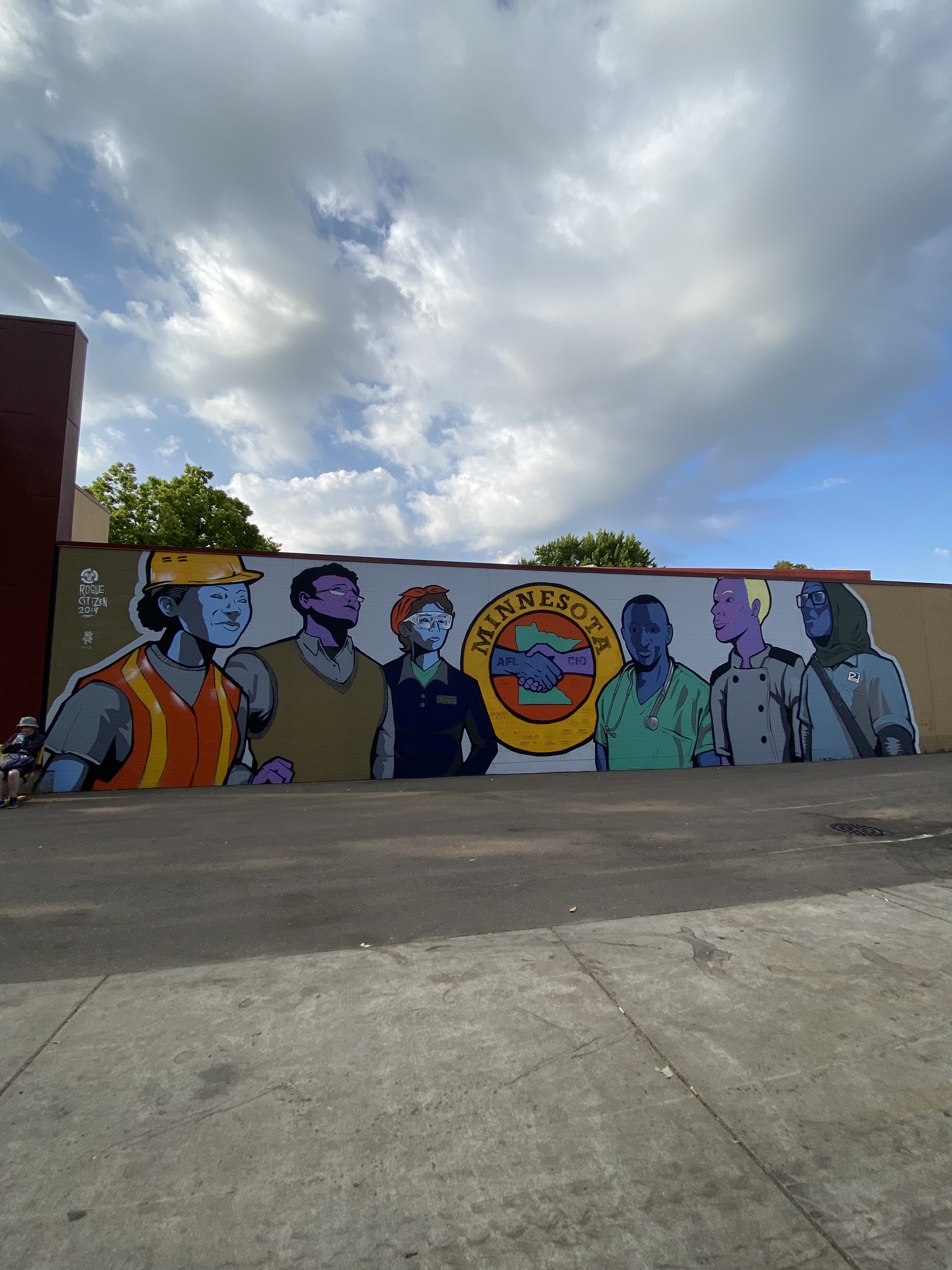
Here’s a piece of public art from our own Minnesota State Fair that my son and the art collective he co-founded created to celebrate Minnesota workers. I’m proud of him and his colleagues in the Rogue Citizen art gang who have a record of standing up for others.

Mural by Rogue Citizen, 2019. Minnesota State Fair, AFL-CIO building. Photo by kcmickelson 2023.

Happy Labor Day to all. Cheers.

August Languor

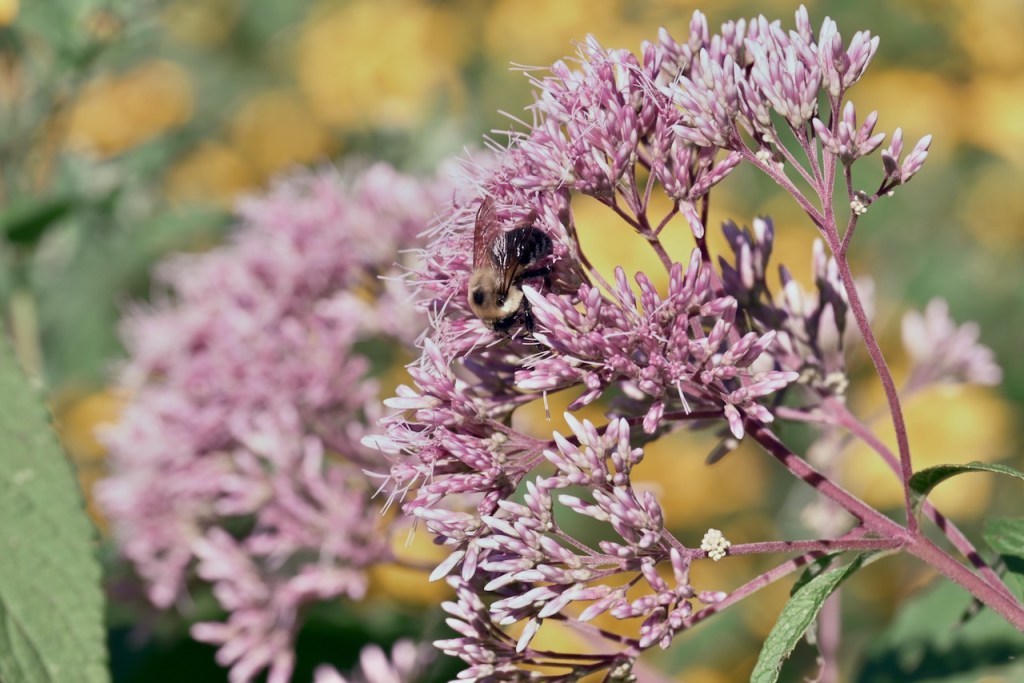
I love the word, “languor.” It’s indicative of everything I associate with late summer: the mood, the laziness, the inertia that always hits me about now, the desire to just lay around and do nothing. Or to meander around outside, listen, inhale, feel the calm of the overflowing garden, surprise a tiny bunny.

August’s lull is waiting to hold you. As for me, I’m going to take time away from the screen, pick up actual books, and settle in.

Coming up in September, I’ll talk about Nicole Farmer‘s poetry. Her book, Honest Sonnets, is on my desk as I write this. I’m happy to learn about another woman poet over 50!

Until September. Go enjoy some languor.

all photos by kcmickelson 2023

Oregon, Ocean, Mother-Daughter Time

Above my writing desk hangs a magnetic bulletin board on which I have photos of my kids, grandkids, partner, friends. One of my favorite pictures is of me with my daughter Abby when we went to New York City after she graduated from high school ten years ago. In the picture, we are each holding a ticket for the Cyclone at Coney Island, the famous wooden roller coaster that opened in 1927. I remember being both scared and thrilled on that ride, involuntarily screaming as the roller coaster went up, down, around. I kept wondering how strong the old wooden structure really was, if I could feel it swaying just a little as we were catapulted through space. Pretty sure my fingernails dugs into the seat I was in. And then, just like that, the ride was over.

How much that feels like parenthood. Up, down, around. And then, suddenly, the kids are adults and you wonder how that happened so damn fast. Too fast, often, to shut off your parental-advice-dispenser in time to escape the wrath of your now-perfectly-capable adult child. You don’t want to believe you’re no longer needed.

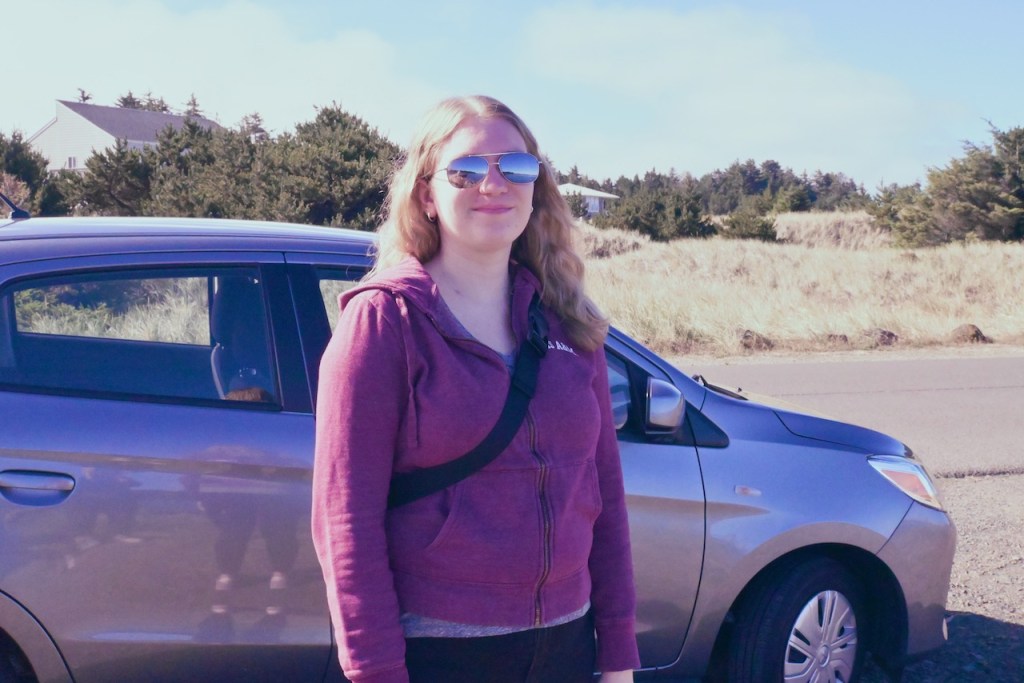
Thus, a chance to travel with my daughter to Oregon for a few days in July was an incredible gift, one that I decided would be exclusive. By that, I mean that I didn’t even tell friends who live in Oregon that we were going to be there. My focus was my daughter and our time together, a chance to hang out by the ocean that we both love, and not be stressed about anything.

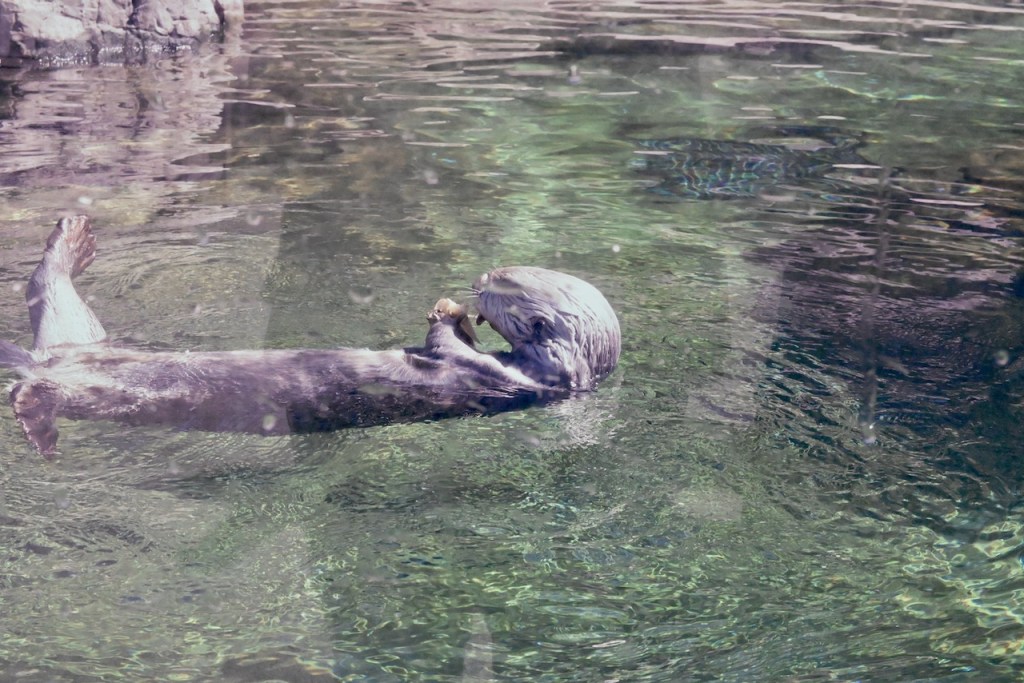
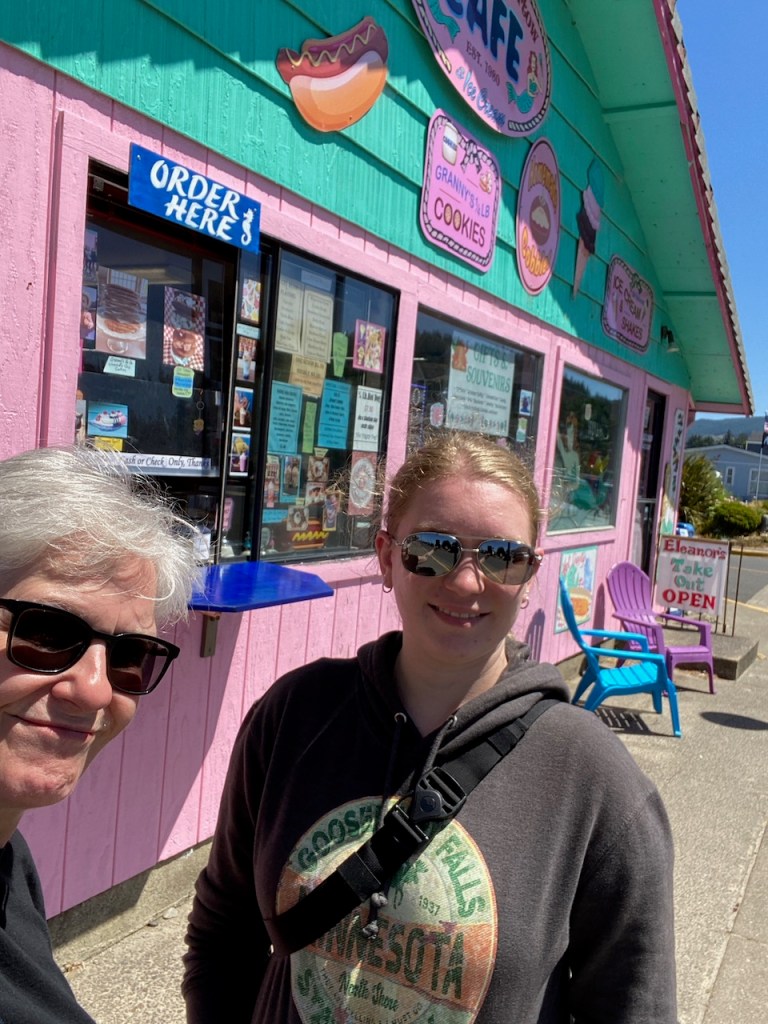
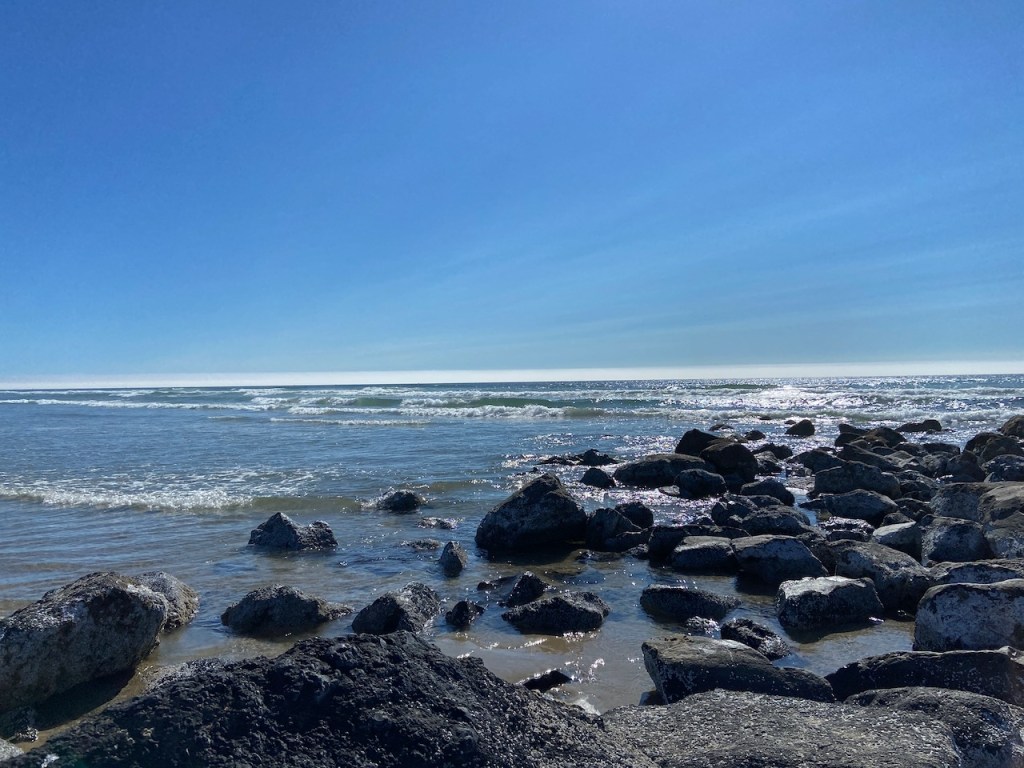
It was a good choice. We meandered, shared food, soaked up sun and salty air, were quiet much of the time. A visit to the Oregon Coast Aquarium offered Abby’s favorite sea otters. A stay in Newport allowed us both our fill of seafood: clam chowder, calamari, shrimp, crab cakes. A hotel with beach access nudged us to sit on the sand and watch the sunset, notice all the couples from a wedding party doing the same. A tiny rented Mitsubishi Mirage made driving easy, parking a cinch. We stayed clear of Portland until we had to show up for our flight home, arriving the night before, which gave us just enough time to go to Powell’s Bookstore.

I delighted in watching my daughter relax, tilt her face to the ocean, linger over tide pools, watch a whale feed in a kelp bed. We bought a few t-shirts, took a few photos. It was all over so soon, and yet it was just enough.

Here’s to mother-daughter trips, Oregon, ocean. Here’s to making exclusive time for adult children, relishing in who they’ve become, letting them ask you if you’re doing okay and being able to say yes with all your heart.

All photos by kcmickelson 2023

Under Lake Superior’s Spell

A summer weekend in northern Minnesota is a time-honored tradition. There is always a lake nearby, with Minnesota’s more than 10,000 lakes. Lake Superior is my favorite, its water never completely still, its laps against the shore the best kind of late night lullaby. Loons call to each other, their eerie songs blending in with early morning light or late night campfire sparks. Boats, small and large, appear on the horizon, look to be headed toward the end of the earth on a lake so large that the other shore is not always visible. The spell of Lake Superior affects everyone who gets near her.

Lake Superior is the largest freshwater lake in the world with a surface area of 31,700 square miles. She is always cold, causing a shiver to anyone who dips their toes into her. Tides move the water, waves sometimes big enough for surfing. She tosses rocks until they’re smooth as glass, rounded and perfect for someone’s pocket where they become a reminder of the big lake’s power.

Respect is a must. Lake Superior is not a lake to go boating on unless you know what you’re doing. She reaches down as far as 1,300 feet and her sudden storms can be violent. In winter, ice shards get pushed up onto the shore and wind howls, helping to coat nearby trees and bridges in ice. In summer, her morning calm can be deceiving. Fog softens her.

Lake Superior has many names. The Ojibwe call her Gitchi-gami. Henry Wadsworth Longfellow called her Gitche Gumee. So did Gordon Lightfoot. Early French explorers called her Le Lac Superieur. I call her Magnificent. I call her Powerful.

No matter what, she is beautiful. On a perfect summer day, Lake Superior’s magnetism is strong, and this year, I heeded her call.

All photos by kcmickelson 2023

Breathless in July

And here we are, within reach of July 4, fireworks, picnics, swimsuits, ice cream dripping down our chins. At least, that’s the summer image many of us come up with once July arrives. I tend more toward languor, slow movement for warmer days, time to linger near blooms full of bees or water lapping at a shore, family members nearby, shared drinks and stories as the sun slides down the western sky.

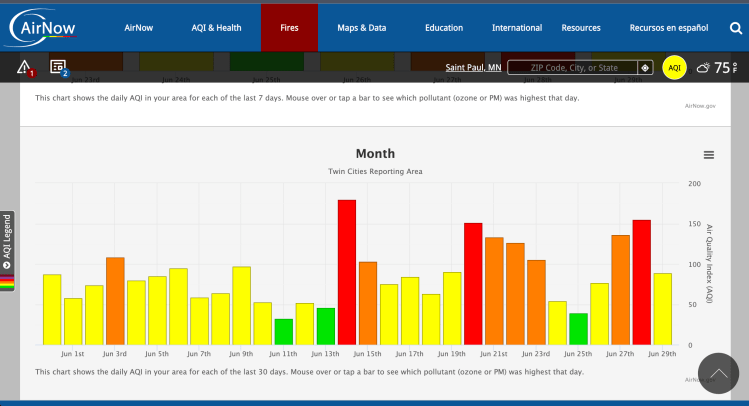
But this summer has not been typical in Minnesota and I’m not spending as much time outside as I’d like. The nearly 500 Canadian wildfires now active are sending carbon dioxide, carbon monoxide, fine particulate matter, and other not-great ingredients into the atmosphere, affecting the breathing of millions of people as weather patterns carry smoke well beyond its point of origin. Most of my family members are having breathing troubles, asthma flare-ups, scratchy throats, and an overall yucky feeling. Here in the Twin Cities, we average one or two days of poor air quality by this point in the summer. This year, we’ve had more than 20 days of air quality warnings, with more to come in this summer of smoke. The entire past week smelled like an old camp fire. And we’re still better off than New York City was on the recent days when their air turned orange.
Screen shot of air quality in my area for the month of June as reported by AirNow.gov, which is a good AQI resource for anyone in the US. They also show air quality data for Canada and Mexico. The good air days are in green. That’s right, there are only three of them.

Given the crappy air, I’m surprised that so many local municipalities are going ahead with fireworks for the Fourth of July. Minneapolis is doing a laser light show instead, which seems like a great idea. Fourth of July festivities aside, it’s terribly sad that our summer days are nose-wrinkling, phlegm-producing events. And I’m quite sure there will be more fires on both sides of the international border as we experience another abnormally dry season. Grass on nearby ballfields is brown, our garden is struggling, lakes are low.

I’ve been waking up a lot in the middle of the night, breath a bit short, a little headachy. That’s when I worry uncontrollably about my granddaughters and what their futures will feel like. Will they be able to breathe without assistance? Will anyone? What will be left of our air, our water, our food supply? What will summer mean then?

Later, in the now-hazy light of day, my thoughts are reined in a little, but the question remains: What to do? Tread as lightly as possible, I think. Consider what it is we each do that contributes to the climate change now driving these dry, fiery summers, whether it’s our use of fossil fuel or our tendency to eat food that has to be trucked to us from somewhere far away or an addiction to conveniences wrapped in plastic. All of it matters.

All of it.

Fireworks photo courtesy of Jill Wellington at Pixabay.com. Ice cream at the beach photo courtesy of Alexas_Fotos at Pixabay.com

I Wonder. What if? Let’s Try.
Lately, I’ve been exchanging poems once a week with my friend Connie. These are not poems ready for public consumption; these are whatever I’ve generated over the previous week. Our agreement is to produce seven poems each and send them to each other every Wednesday. No worries about how raw they are, no pointing out unrefined phrases or grammatical errors to the other. Just generate verse, send it off, comment for each other on what’s working, what’s interesting, what questions come up as we read these drafts. We give each other permission to muck around and then point at the diamonds in the rough as we find them.

I hatched this idea a couple of months ago. I had a lot of reasons for it: generate ideas, have a regular connection with my friend, re-awaken some sleepy poetic sensibilities, create a body of material to work with in a year or so. But just playing has turned out to be one of the greatest reasons for doing this exercise. I’m grateful that Connie agreed to do this with me.

It’s incredibly hard for me to stay focused in the summer. The call of the garden, nearby hiking trails, anything that looks good through my camera lens is too strong to resist. Coffee at the beach on hot mornings. Sun shining through our birch trees in the evening. I can’t stand to be in the house chained to my computer on a summer day. Creative play allows me to keep that summer mood going; I can write these kinds of poems by hand almost anywhere I happen to be. Transcribing them to the computer then allows a first-round edit so that I am, at the very least, sending out a coherent piece. I suppose Connie could say otherwise about my coherence, but so far, so good.

This week, I produced my usual free verse along with several haiku/senryu and a haibun. The haibun was a complete surprise that flowed from the haiku exercise. I found myself thinking of my old friend Zola, who loved to write haiku and often did. My sensibilities about what works in Japanese short forms are pretty rusty, but I was reminded of the twist in thought that has to happen in a good haiku, senryu, or haibun. And I remembered why I like haibun so much: prose poem followed by haiku allows for that refined connection between two kinds of verse that spills over into how we work with a body of poems, how we get them to “talk” to each other.  And that, in turn, can nudge a poet like me to think about how other kinds of art connect, what a conversation between other kinds of work looks like.

Okay, reeling it back now. A little play opens up a lot of potential just by shaking up current thought patterns, pushing whoever is playing to consider this, that, the other thing, and whatever hasn’t been in the picture at all till now.

My not-quite-two-year-old granddaughter Maeve watches Sesame Street and sings along to a song that says, “I wonder. What if? Let’s try.” That’s how I feel this summer. If I wonder about it, I’ll write it and see what happens.

cover photo by kcmickelson 2023

For the Love of June

Welcome, summer! Yes, I know the summer solstice is still a few weeks away, but Minnesotans are in full summer mode. The gardens are bursting, the school year is wrapping up, we’ve put chairs outside so we can plop down and linger anytime we want. There’s nothing like living in a place that includes winter to make one appreciate these June days and their gentle offerings.

As I settled in to write this post just yesterday, I realized my poppies were starting to open. I wait for these giant flowers every year, adore their deep orange ruffly petals. My mother loved this particular kind of poppy, too. She had some planted alongside our house in Northeast Minneapolis when I was very small. One of my earliest memories is how she, too, waited for them to bloom. I think it’s no coincidence that the color of the walls in my office is poppy orange.

There’s a passage in one of my favorite gardening books, Mrs. Greenthumbs: How I Turned a Boring Yard into a Glorious Garden and How You Can, Too by Cassandra Danz (New York: Crown Publishers, Inc., 1993), in which the author said of June, “This is the month that I dream about all year, the month that rhymes with spoon and moon, the month of flowers, the month of mid-summer madness, the month of ecstacy. June. Yippee.” (p. 113). This was one of the first gardening books I ever read all the way through. Danz was an entertaining teacher (she passed away in 2002), enthusiastic about all things gardening. I remember what she said about the month of June every year as I walk through our gardens looking for new blooms.

During those daily flower walks, I find myself feeling grateful over and over. Grateful for the wheel of the year that offers such variety, so many examples of how life unfurls, grows, recedes, then offers its remainders for the next cycle. The smallest piece of earth contains multitudes and we are stewards of so much more than we realize.

Happy June. May you have many blooms.

Photos by kcmickelson 2023.

Sharing Mother’s Day

This year, my granddaughter Camille’s twelfth birthday fell on Mother’s Day. My son Shawn hosted a brunch to celebrate both the birthday and all things mother-related. All this mother/grandmother needed to do was show up with some breakfast sausage. And Camille’s birthday present, of course.

In my head, Camille’s birthday got first billing. I’ve been a mother for over 40 years and, even though being honored never gets old, a kid only turns 12 once. It’s her last year of real childhood before teenage years throw her into a hormonal whirlwind. What I really wanted for Mother’s Day was for her to be deliriously happy.

Being a mother means never losing the desire to care for these other people who have popped up in my life – my son, daughter, two granddaughters, daughter-in-law, son-in-law. That desire hangs around regardless of a kid’s development into an adult, into an independent person who can take care of themselves. I hope my kids know this about me. I knew it about my parents, especially when they showed up at my house with things they thought I could use, like when my dad showed up with a bunch of paper towels because they were on sale and who can’t use paper towels? That still makes me laugh.

I loved my Mother’s Day. Sharing it – not just with Camille’s birthday celebration but also with my daughter-in-law – was perfect.

Lately, I’ve been keenly aware of another type of mother – mothers who have feathers. We have a wren family nesting nearby, just as we did last year and the year before that. Those wrens never stop singing before their babies hatch. Here is one of them, singing at the very top of its little bird lungs:

Motherhood is not only something to celebrate with brunch and birdsong. It’s also something to write poetry about. Two of my poems, “What I Love About Mondays in the Spring” and “Mothers Understand Each Other”, appeared at ONE ART: a journal of poetry on Mother’s Day. Have a look if you get a chance. Thank you so much to editor Mark Danowsky for choosing my work!

  • Read What I Love About Mondays in the Spring HERE
  • Read Mothers Understand Each Other HERE

photos by kcmickelson 2023

Diary From A Restless Spring

[Thursday]

I’ll admit straight up that I’m not inclined to write or sit in front of a computer once winter leaves us. If you’ve read my work for a while, you already know this about me.

But here I am, sitting at my kitchen counter (great lighting, plants nearby, jazz on the radio), wringing words from my laptop, fingers hitting the keys with determination. This is what daily practice looks like.

All of us have something that we practice: exercise, hygiene, caring for someone else, managing a career or searching for one, spiritual expression, art, or the very basic getting out of bed on time. We have to practice whether we have motivation or not, not counting planned breaks. We all know we can’t just stop most of these things (like hygiene), but careers and art come and go.

Every so often, I wonder if writing is still the main path for me. It’s one way I make sense of the world, but it’s not always the one that makes me most happy. On warm days, I’m most happy outside, away from lots of people, with a camera in my hand and hiking shoes on my feet. If someone in my family is hiking with me it’s a bonus. If I can’t hear traffic noise, it’s another bonus. It’s been a long, long winter and I’m restless. This past week, that restlessness has hit a fever pitch. Sitting in a chair in front of a screen is excruciating. Still too cold to hang around outside while I drink my morning coffee, I’m thinking of trails to walk, places my partner Mick and I haven’t been to yet, watching which trails are flooded now that the snow has melted into the lakes and rivers. I pace around the house trying to figure out what to do with myself because all my usual indoor pursuits do not hold my attention.

These are the sorts of days that make me want to pack a bag and shut down my blog and all social media for an undetermined length of time.

[Friday]

A rainy day. I’ve been cleaning my tiny art studio that is crammed into a space in our laundry  room. I have a stainless-steel table on wheels right in front of a window that is cracked open for ventilation while I type. I just got done coating four tiny paint pours with varnish. Three of them are from a series I did last spring and the fourth is my favorite from this spring’s series. All of them were done for consideration as covers for Gyroscope Review at the invitation of my friend Connie. Connie and I started Gyroscope Review together in 2014, with our first digital issue in 2015. Since then, the quarterly poetry journal has taken off, made a name for itself. I’m really proud of the work I did there, especially being part of launching the now-annual fall crone issue.

I rotated off the staff in 2020, just as everything shut down because of COVID-19. Had the shutdown happened six months earlier when I was thinking about whether to leave, I would have stayed. I think. After five years of editorial work, I was restless. I wanted very much to turn my attention to other things. A pandemic is a tough time to make career changes, but editorial work is a hard thing for me to pair with the fluid time schedule I want for creative exploration and travel.

This restlessness is a pattern that I recognize in myself. I have about a three-to-five-year attention span for big projects and full-time jobs. I can point to past job changes and see that pattern quite clearly. Once I get bored and restless, I can’t stop myself from casting around for something new. There is very little that the old job/project might reveal that will hold my attention.

I think about all that now as I work through this antsy feeling that keeps me from sitting still. Bringing my laptop down to my art table has helped today, a change of place that shakes up how I write. I love this weird little space with my swivel stool from the automotive department at Menard’s; the collection of empty Ball jars and old yogurt containers that holds brushes, popsicle sticks, scissors, an X-acto knife, toothpicks, straws; the ball of kitchen twine by my right elbow; kitchen cooling racks repurposed to hold paintings while they dry; silicone pouring cups that were a gift from my son. I feel better in a space that does not look like an office.

How many of us like being defined as some specific thing – editor, writer, parent, grandparent? There are so many things to be, to do. Does being defined as one or another close off possibilities? It shouldn’t, but it sometimes does.

The older I get, the more I want to expand my possibilities. I’m not done yet and I’m annoyed with anyone who thinks I am. There is so much that hasn’t flowed through me yet.

[Later]

Even on a rainy day, I have a space outside where I can be without getting soaked. I took an overgrown African violet to that spot today, set it on the old baker’s rack up against the back of our garage. The baker’s rack, which used to live in my friend Suzannah’s kitchen before she moved to San Francisco, makes a great repotting station for our plants. I shook out the roots and broke the violet apart into three pieces. The oldest piece is now back in the original pot with new dirt and some fertilizer specific to African violets. Its two babies are each in a pot of their own. All of them are in the north-facing window in the laundry room/art studio. I’m crossing my fingers that my propagation skills work.

Working with plants is as much of a balm as mucking around in my art space. Something green, something alive that I am responsible for forces me to pay attention. While I repotted everything, the birds in our back yard called to each other. It was a cacophony. It won’t be too long now until Mick and I can be outside to plant new dogwoods where our sick spruce was taken down, install a new native plant garden in the front yard, turn compost that formed over the winter.

I like the idea of turning compost as a metaphor. I’m turning myself over this spring, over and over come to think of it, and finding what changed over the last several months. What works now? What doesn’t? What has broken down into rich dirt for new growth?

It’s time to recognize those new shoots and give them some love. Growth is the best antidote for restlessness that I can imagine.

cover image courtesy of Prasenjit Haldar at Pixabay.com