Of Birds and Warm Weather

By the time this post is public, it’ll be chilly again here in Minnesota. We are in the midst of a heatwave as I write this on a Thursday afternoon, temperatures in the 80s with small piles of snow lingering in shady, hidden places. Two weeks ago, family from Wisconsin arrived on our doorstep; when they went home two days later, we had to dig their vehicle out of the snow in the driveway. Today, my partner Mick and I inspected little purple scilla that appeared in the front lawn, and we attached a bee house to the backyard fence.

Right now, I’m sitting in the front of the open patio door listening to birds chatter and twitter outside. There is a particularly noisy crow who seems to have something important to say. This extraordinarily warm day (for Minnesota in April) feels like a forbidden luxury. Perhaps it is.

I was determined not to waste this bit of sunshine and warmth, so got up and out the door around 7 a.m. this morning with my camera. Mick brewed some coffee to take along. We headed to Kaposia Landing in South St. Paul along the Mississippi River. I’d wanted to go a month ago when the eagles were moving along the river, but our fierce winter would not cooperate. So today became birdwatching day.

There is a heron rookery across the river from the Kaposia Landing. We had a clear view of the herons in their nests, albeit from far away. They are magical to watch – huge wingspans, feet out behind them as they fly, distinct outline.

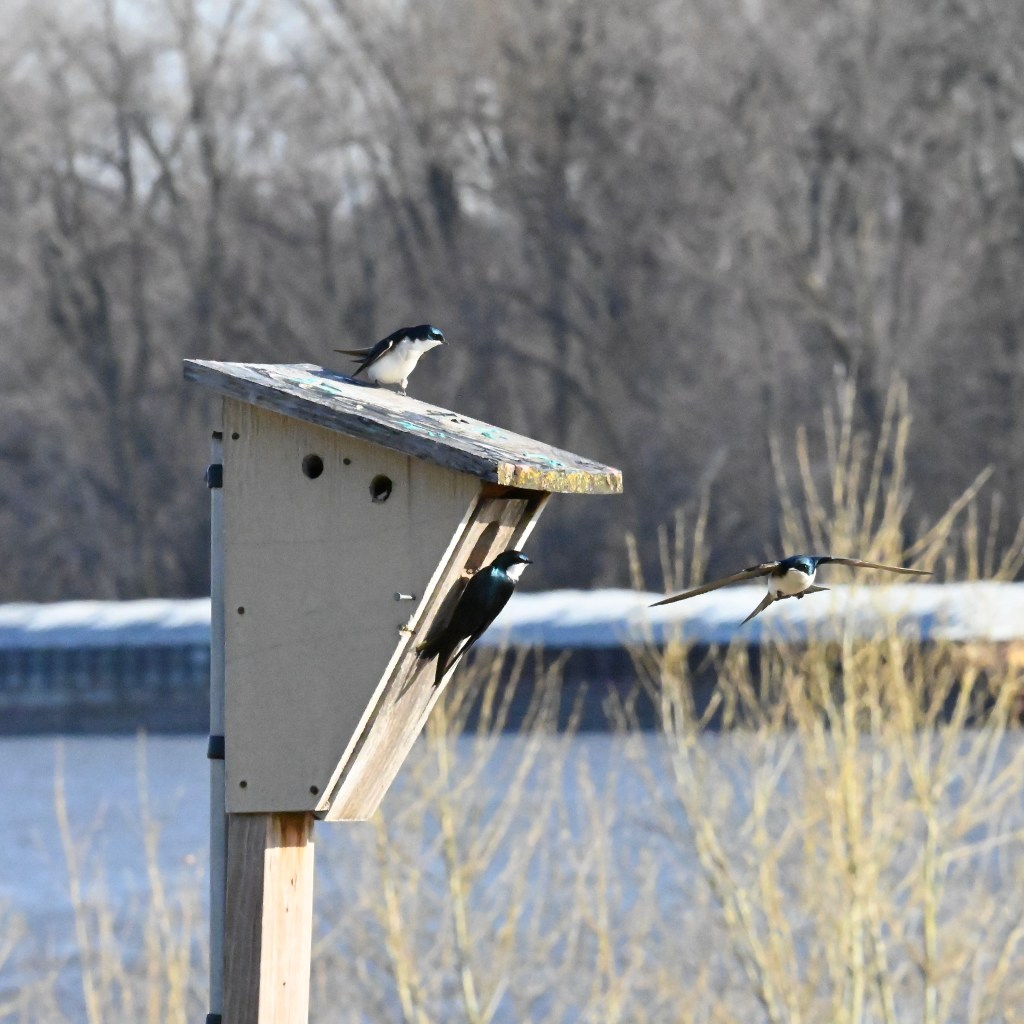
There were also tree swallows checking out the nesting boxes that we thought were for bluebirds. When we researched those bird nesting boxes, we learned that tree swallows will compete with bluebirds to nest there.

The place was also rife with red-winged blackbirds, all of them singing their hearts out.

After a long, nasty-ish winter, being outside among birds alongside the Mississippi felt like a tonic. A soul-soothing, heart mending kind of tonic that reminded me there is always a balance. Life finds a way.

All photos by kcmickelson 2023

Before you go….

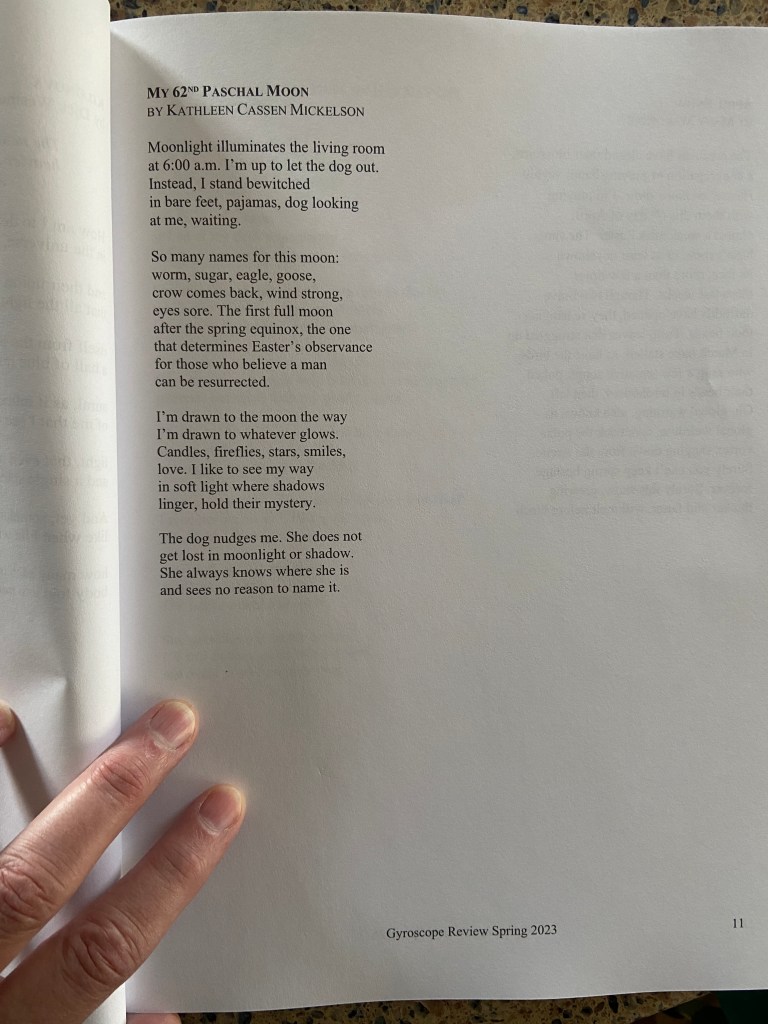
I have a poem in the latest issue of Gyroscope Review and the cover art is also mine. Since it’s National Poetry Month, here it is! I’m honored to be in the company of many fantastic poets.

Talking About On Shifting Shoals with Poet Joanne Durham

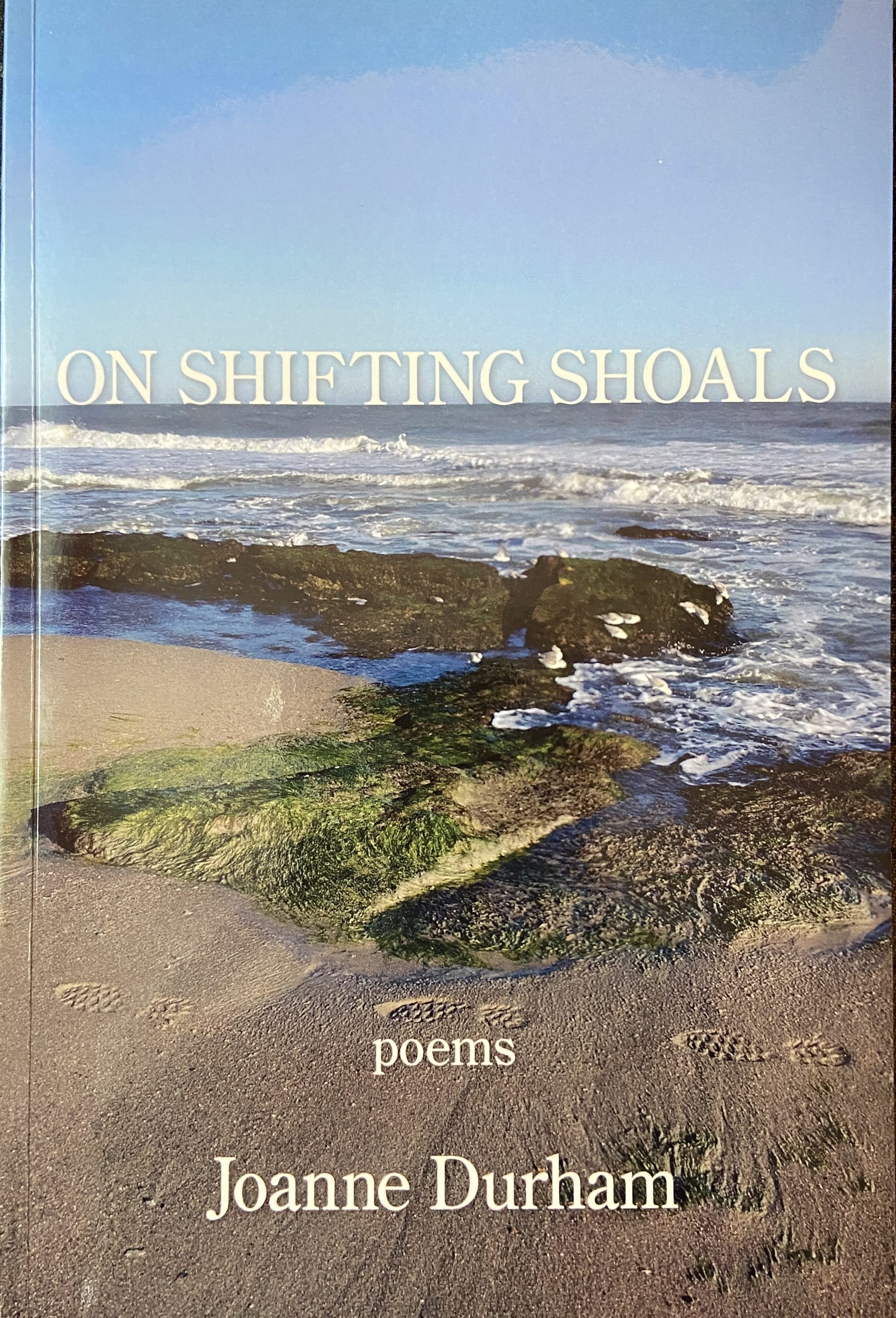
On Shifting Shoals, poems by Joanne Durham (Kelsay Books, 2023). Chapbook, $17.00.

I recently had the pleasure of reading another poetry collection by Joanne Durham: On Shifting Shoals, her new chapbook published by Kelsay Books. Joanne agreed to have a conversation about the work for One Minnesota Crone. Here is that conversation, with OMC standing for One Minnesota Crone, and JD standing for Joanne Durham. I think this is a perfect kick-off to National Poetry Month. Enjoy hearing from a poet that I hope you come to love as much as I do.

OMC: I noticed that this collection contains little shells of poems, short shimmering pieces that hold large thoughts with few words. You’ve indeed chosen your words wisely, a topic of one of your poems, “Word Matter: Choose Wisely.” In your 2022 book, To Drink from a Wider Bowl, the poems were longer, the scope evolved from family ties. On Shifting Shoals has a more environmentally-based focus, centered on the coastal area where you now live, and it offers all of us those deep waters and oceanic currents that push and pull.

As I read your work while sitting at my dining room table here in Minnesota, it rained a cold March rain that chilled to the bone. That rain eventually turned to snow. We are far from the ocean, and yet you brought it to me in this chapbook. I could feel the pull, hear the waves, see the far-off horizon. Being on the coast offers a long view, an understanding of how tides change and cleanse. It shares eternal and universal metaphors for poets to work with.

What do these feelings from someone like me, a reader who lives in the middle of the continent, tell you about the reach your coastal poems have? 

JD: First, thanks for talking with me again, and for your thoughtful considerations about the poems. I think the ocean has an almost universal effect on people. I watch the tourists who come for a week, and they relax and play and laugh and move in ways I’m sure they don’t do most of the time at home. So many poets have written about the ocean, and yet we don’t really get tired of it. Its expansiveness, its constancy and yet its constant changes, its power and its beauty draw something inside us to the surface. I felt that I just had to watch, listen, and record – the poetry was already there. 

OMC: Tell me a little about the creation of these pieces. Were they largely a result of pandemic isolation or was there a broader timeline in their creation? Was there one spark or many?

JD: My husband and I moved to the beach a decade ago. I started walking on the beach most every day, and riding my bike around our small town, and I just quite naturally started taking pictures of things I saw – weddings on the beach, young girls dressed up as mermaids, the way kids run to the ocean the moment they get to the beach, and things in town – the carnival, the boardwalk, the butterflies that all of a sudden swarm one day, dragonflies another. The photos helped me to write the details that I might not have noticed otherwise. And then, of course, the changes with the weather, dealing with the annual threat of hurricanes, the strangeness of the snow that fell at high tide and left a path of sand to walk through. Living at the beach is an immersion in the natural world and it has an impact on everyone who is here. So, I also found the relationships between the people and the landscape fascinating. Really most of the poems in the book are about how people interact with this environment, for better or worse. There are new sparks of that every day. 

OMC: I noticed the title was pulled from the poem, The Hunt. Do you consider that piece the anchor of this collection? Can you expand on your answer a bit?

JD: Yes, I think “The Hunt” holds strands of most of the themes of the book, both human relationships and our relationships with nature.  On Shifting Shoals to me expresses the complexity, the mystery, the changes and destruction that are all so much a part of the ocean, and of us as human beings. “The Hunt” was one of the first poems in the book that I wrote, when I was still quite new to living at the beach. I think it captures some of the awe of the novice that I still feel, and suspect I always will, next to an ocean that’s been around for about 180 million years. 


THE HUNT by Joanne Durham

Walking along the shoreline
in January's cold clarity, my friend Sandy
spies a shark tooth, coveted treasure
of every beachcomber. Its smooth shine
catches her practiced eye.

She gives it to me, a novice
at these things, though my students
and I have read plenty about sharks,
how they occasionally mistake
a wave-riding human
for a creature of the sea, while we stalk
and slaughter millions of them, cut
prized fins from live bodies, toss
butchered remains into bloodied waves.

I tell her how eight-year-old Elmer cried,
That's not fair! No wonder they attack us!

Sandy thanks me for this shard of child sense
that hunts for justice through shifting shoals.
She tucks his words into her mind's pocket,
as I roll the hard edge of my fossil
between the warm fingers of my gloves.

OMC: Where can readers find copies of On Shifting Shoals

JD: I’m selling signed copies from my website, https://www.joannedurham.com/. The book is available from the publisher, Kelsay Books at https://kelsaybooks.com/products/on-shifting-shoals, and on Amazon and Barnes and Noble. My local bookstore in Wilmington, NC, Pomegranate Books, carries it as well. 

OMC: Any final words on the inspirations you take from the ocean/coastal habitat? 

JD: I’ve always loved the ocean, been drawn to it on the east and west coasts of this country, and everywhere else I’ve travelled I always gravitate to the sea. But living here has allowed the ocean to settle inside me. I hear it as I go to sleep and awaken to how sunrise over it surprises into a new day. It bathes me in gratitude for its generosity, while I’m fully aware of its potential treachery and how we might find our home washed away in the next hurricane. Permanence and change, immensity and smallness, safety and fear all mingle together here and make contradiction such a clear reality. Life lessons just wash up on the shore every day. 

OMC: I love your answer here. “Life lessons just wash up on the shore every day.” This is a thoughtful collection of work and I sense that you have many more books that will emerge from your proximity to and interaction with this constantly changing coastal place. 

And now for something completely different – what are your plans for National Poetry Month?

JD: I’m going to get new ways of seeing from National Poetry Month – I am having cataract surgery on April 3! So I hope it will bring new insights and out-sights. I’m not someone who can or really wants to write a poem a day; in fact, I think I will slow down a little in April, go back among my journal entries and try to turn some of the things I’ve jotted down into poems. When I was a teacher, my students and I shared poetry every day, so Poetry Month wasn’t really any different. Now that I’m retired and live by the ocean, I’m so lucky that every day can be poetry day all year long. 

OMC: That is spoken like a practicing poet. Yes, poetry is all around us every day if we just take time to notice it. Thank you so much for being in conversation with me about On Shifting Shoals and its conception. And, good luck with the cataract surgery. I look forward to learning what you see differently.

When Making Lasagna on Sunday Afternoon Feels Miraculous

The never-ending snow floats past the bay window where our houseplants hang out, clean our indoor air, and provide respite from the white landscape of a Minnesota winter. The last time I checked, the snow pile outside the front door formed from our many winter driveway clearings is taller than I am. Some of the flakes hitting the driveway right now melt on contact. 

In our kitchen, I open two cans of whole peeled tomatoes, empty them into a strainer over a big bowl. I break them open with my hands, one by one, to take out the fibrous core bits. Juice drips into the bowl thick and red. A bit of juice erupts from a tomato between my thumbs, squirts onto my sweatshirt. The sweatshirt is old anyway, so it doesn’t much matter. When each tomato has been squished open, forced to bleed into the strainer and bowl, I turn my attention to dicing an onion, mincing garlic, heating olive oil in a large skillet. 

I’m making marinara sauce on this Sunday afternoon, which will be followed by roasting zucchini, steaming spinach, and assembling vegetable lasagna for our dinner. There is nowhere else I’d rather be than here, working with my hands, engulfed in the aromas of vegetables cooking, spices offering their assorted notes. 


Daylight savings time kicked in overnight. This is the first year in a long time that I didn’t feel grumpy about the time change. Usually, it irks me that we move our clocks back and forth so people can be more comfortable with the available light at the end of the work day. Time is a construct, an organizational tool; it doesn’t change the actual amount of daylight. The sun and moon and stars will move how they’ve moved for millions of years no matter what we do. But, somehow, we’ve convinced ourselves that moving the clock around to a new time is what we need to do to get the most out of the length of our days. In a society that offers flex time and remote working and never really seems to stop, this no longer makes the sense it once might have. But I’ve stopped caring. I’ll do what I’m going to do no matter what time it is.


There is a pot of flowering bulbs amidst the plants in our bay window in the living room. It was a gift from our neighbors across the street after we kept their driveway clear of snow and picked up their mail while they were away last month. There are pinkish-purple tulips, tiny yellow daffodils, purple hyacinths that scent the whole living room. The daffodils, first to bloom, lean into the sunlight; if I turn the pot around, they lean the other way. I find it fascinating when plants do this, that they know exactly which way to turn to get what they need.


The marinara sauce turns out thick, chunky, and rich. I give the sauce a whirl in the food processor, put it back in the pan, add basil, olive oil, salt, pepper, and sugar. I cover the pan, leave it on the back of the stove until I need it. 

There is something about working with vegetables in the winter that feels miraculous: bright green zucchini in my hands, yielding beneath my knife, turned into perfect little half-moons that I toss with olive oil, spread on a parchment-covered baking sheet, slip into a 450-degree oven. It roasts until tender and browned in spots. Meanwhile, I put an entire package of baby spinach into a steamer, wait for it to wilt, run it under cold water, squeeze the water out, chop it up. That these plants, which I could not grow in my yard right this minute, are here in my kitchen really is a miracle even if we don’t usually think of it that way. Who goes down the aisle of the grocery store and tallies up the miracles? Maybe we all should.

Once the lasagna is assembled, I take my time washing all the dishes and utensils I used to make it, wipe the counters, pour a glass of wine. I put the foil-covered lasagna in the oven at last, its finish time expected somewhere after 6 p.m. I sit at the dining room table facing the window, watch the sky shift from sun almost coming through the clouds to a dull gray. Wind huffs through the pines in the backyard, snow shaking loose from a few branches. All winter, I’ve looked out back for the owl that used to hang out in our neighborhood; I haven’t seen it anywhere. A Prince song comes on the local radio station I’ve been listening to all afternoon: When Doves Cry. No doves in the backyard either.

The oven timer sounds. I take the foil off the lasagna, put it back for a few minutes to brown. The aroma wafts up into my face: tomatoes, cheese, spices, zucchini, spinach. A medley. In the next half hour, my partner Mick and I will sit down together, savor this food, this house, this life here in Minnesota. 

And we will know that what we have is good. Very, very good. Miraculous.

cover image courtesy of Hansuan_Fabregas, Pixabay.com.

Frozen

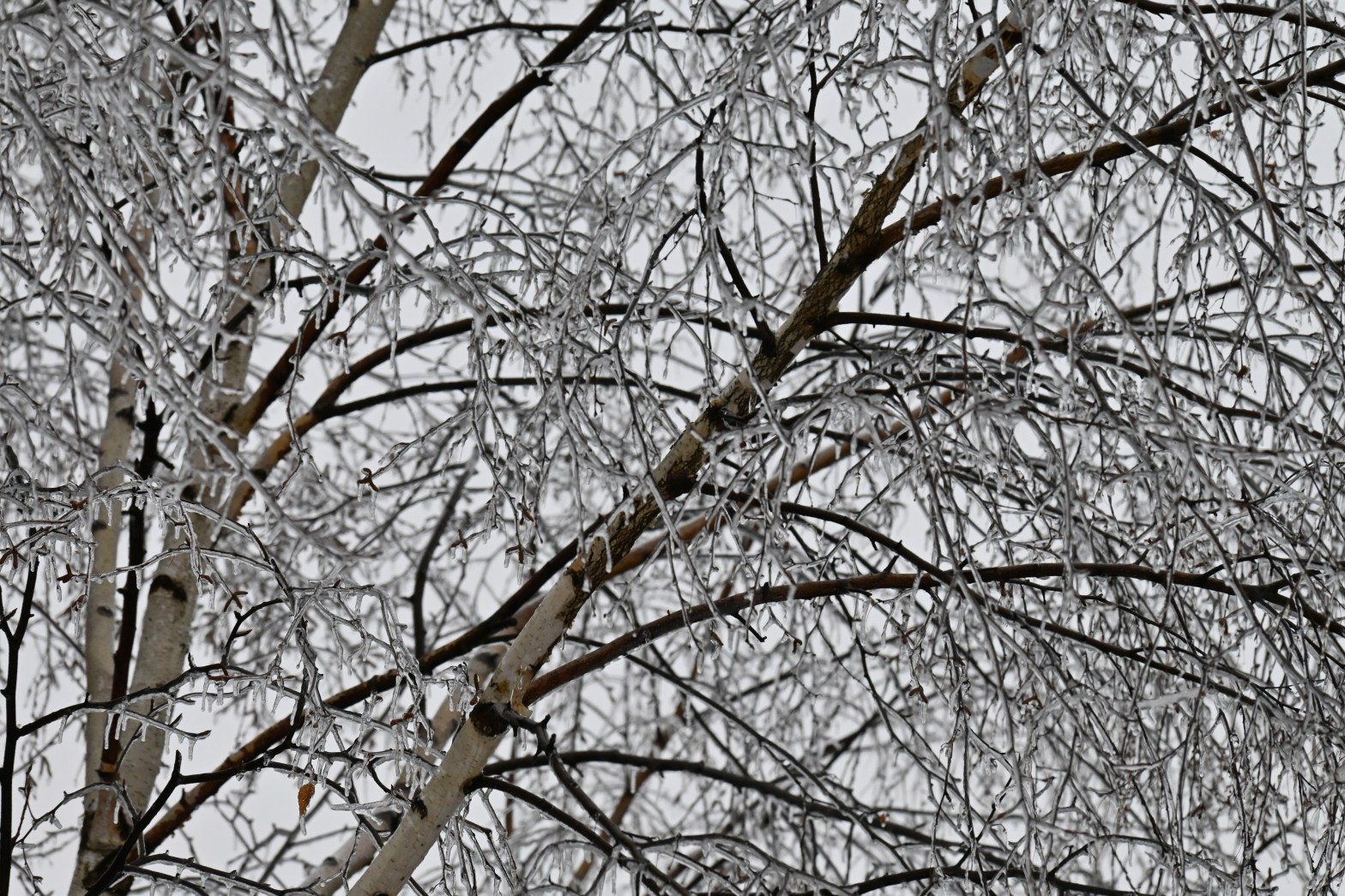
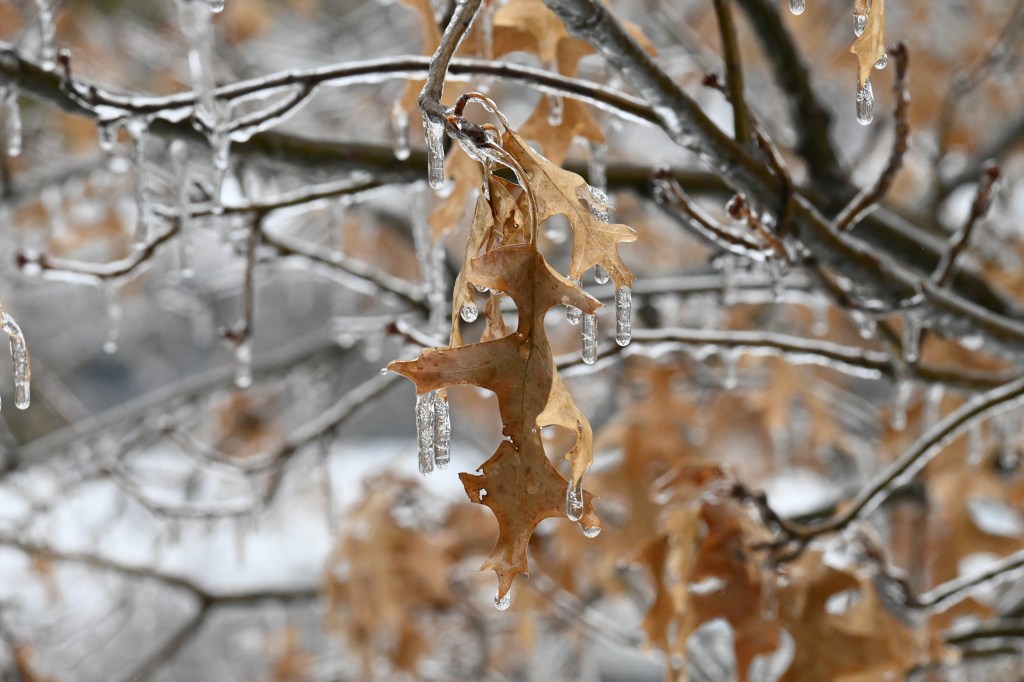
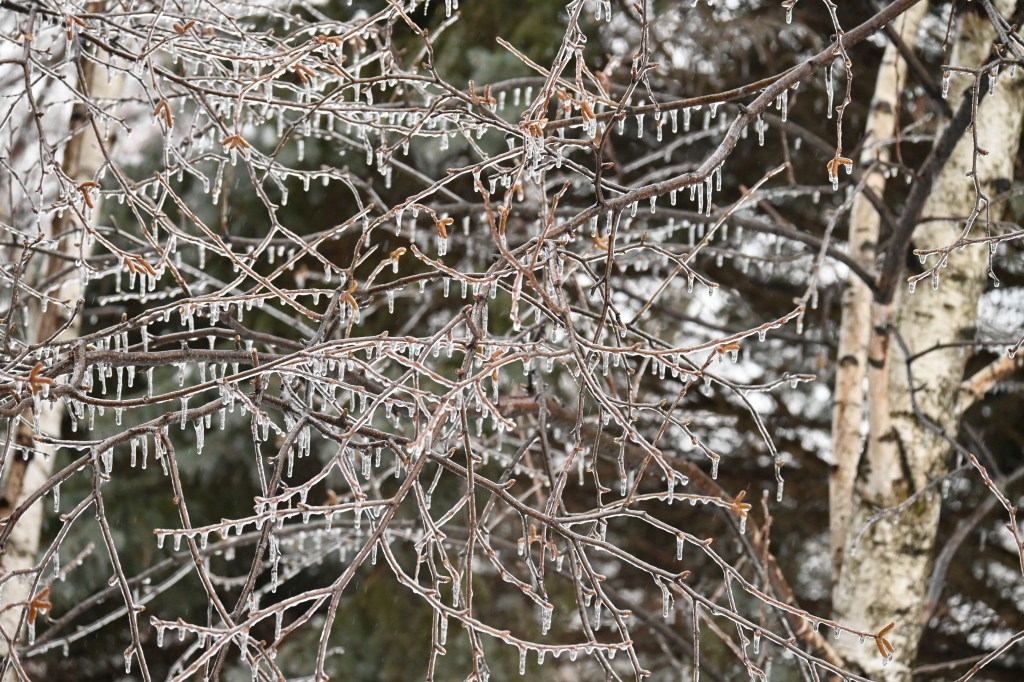
This past week, a coating of ice dressed up every tree around here. It coated the streets and sidewalks, too, but I still found it beautiful.

Oak leaves bejeweled.
Icicles on every oak branch.
A fairy-tale crabapple tree.
The birch tree in an ice garland.
White pine needles like spun glass.

While we wait for the spring equinox this month, winter gives us a little reminder that it, too, offers delicate, temporary beauty.

Happy March.

all photos by kcmickelson 2023

Unacceptable

As I type this post, it’s Valentine’s Day. I spent the day caring for my baby granddaughter Maeve. It’s raining and raining, damp and chilly and gloomy. Meanwhile, I’m sitting in front of our fireplace, my partner gone to band practice for the evening, and thinking about what an un-Valentine-y day it felt like.

It wasn’t the childcare or the non-stop rain or that Mick’s band really needed to keep their weekly practice on the calendar (upcoming gig) that made this day feel un-Valentine-y. It was the pall cast over this sweet day by Monday night’s shooting at Michigan State University. Another shooting. More lives lost. Another story that should horrify us all. The knowledge that nothing is going to change right this minute, no matter how ridiculous it is that the United States is locked into its love and defense of the right to carry guns.

I try to remain hopeful, to carve out sanctuaries with art and literature and family time, and to support efforts to change the national conversation about Second Amendment interpretations. All the bloodshed that has occurred in just the last 10 years alone should have sparked significant change in our laws, but that didn’t happen.

What the hell is wrong with us? The way that people line up on one side or the other of this whole issue, digging in and refusing to think beyond their own little cranial cavities, puts us at a stalemate. Meanwhile, people die every day from guns in this country. According to the Sandy Hook Promise website, 12 children die from gun violence in America every single day. That comes to 4,380 kids a year. Teachers die. Parents die. Co-workers die. Bystanders die. All of these people were loved by someone.

My last post talked about keeping One Minnesota Crone a sanctuary, but today I just couldn’t. There has to be a way out of this vise-grip of an idea that America’s freedom is entwined with the ability of every single person to have access to firearms. It has done us no good. Violence is not going to be solved by the ability to carry concealed weapons so that the bad guys will be deterred (news flash: they won’t), and we are numbed to the scale of what is happening here. Eye-for-an-eye thinking just ramps everything up.

Every day I worry about my son, who teaches at an alternative high school, and about my daughter-in-law who teaches at a charter high school, and about my daughter who works in HR at Target. All of them are potential targets. I worry about my oldest granddaughter who is now in middle school. And then I have to do something with all that worry, which is why I write, paint, take photos, meditate.

But I have to do more than that. I was on Facebook earlier, commenting to a friend who is on the faculty at Michigan State, about taking my anger and concern to the voting booth, using my dollars to support those who are able to shift the national conversation around gun access. But that doesn’t feel like enough in this moment either. Mick and I marched at the Minnesota State Capitol after the Parkland shootings, listened to others who were victims of gun violence, felt hopeful that something would happen. That was five year ago. Five years. How many lives have been lost since then?

CNN reported today that there have been 67 mass shootings (meaning 4 or more people shot in one attack) in the United States so far this year. That’s more mass shootings than there have been days so far in 2023. In checking the Gun Violence Archive, I discovered that there were two mass shootings today and another one yesterday that I wasn’t even aware of. And as for my question above about how many lives have been lost to gun violence in the past five years? The answer is 91,247, not including suicides (source: Gun Violence Archive).

This is unacceptable. On this rainy Valentine’s Day, my heart hurts.

My Creative Spark Journal

Prologue: As I got this post ready, I was keenly aware that I was not going to address what is going on in the United States – and the world – right this minute: multiple mass shootings, another Black man killed by police, the loss of women’s rights on 50th anniversary of Roe v. Wade, the continued assaults by Russia on Ukraine, and so much more. All of these things flow into whatever art we make, into the statements we put out into the world as creative people. I thought about how One Minnesota Crone can offer a refuge and it felt like that’s exactly what was needed right now. A refuge. A reminder that our creativity matters, that our voices will do what they need to do at exactly the moment when it’s right. A thoughtful piece of art that has taken time to craft will have its impact.

My creative spark journal

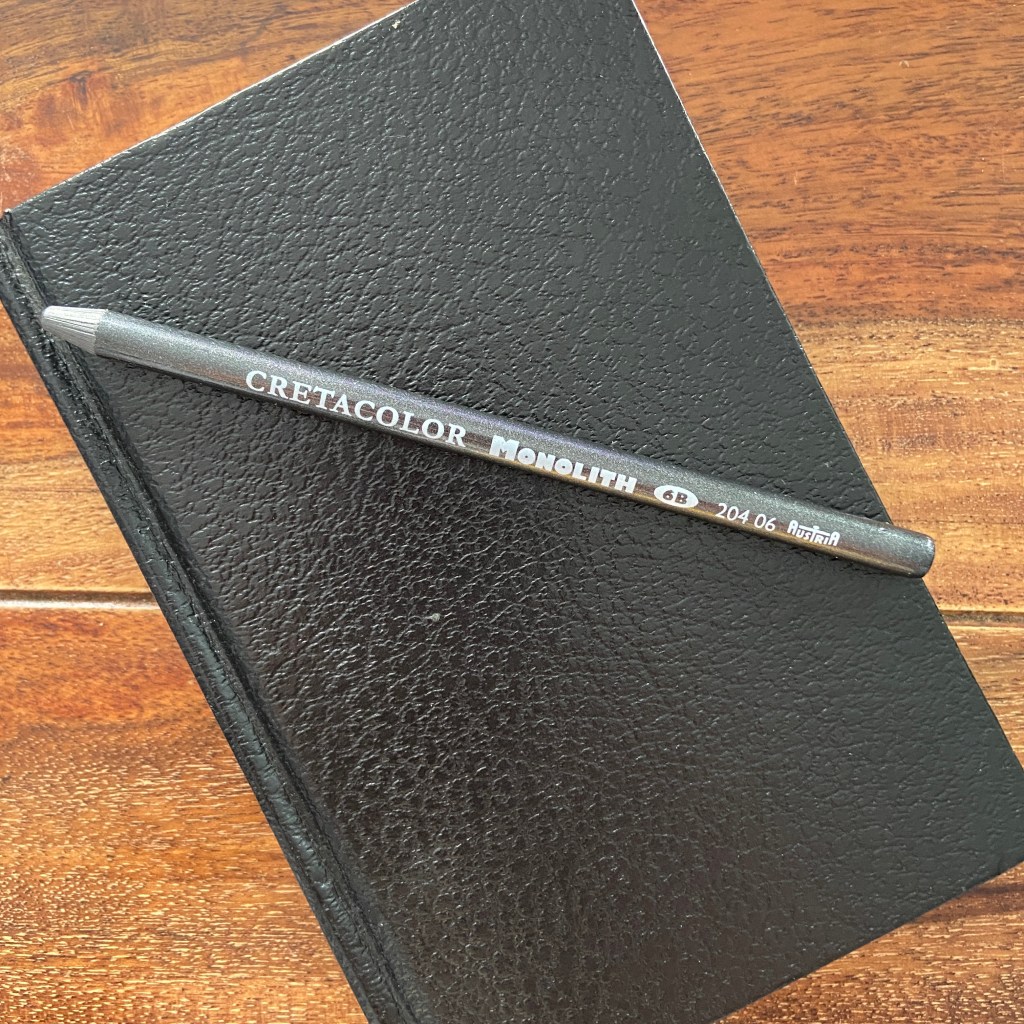
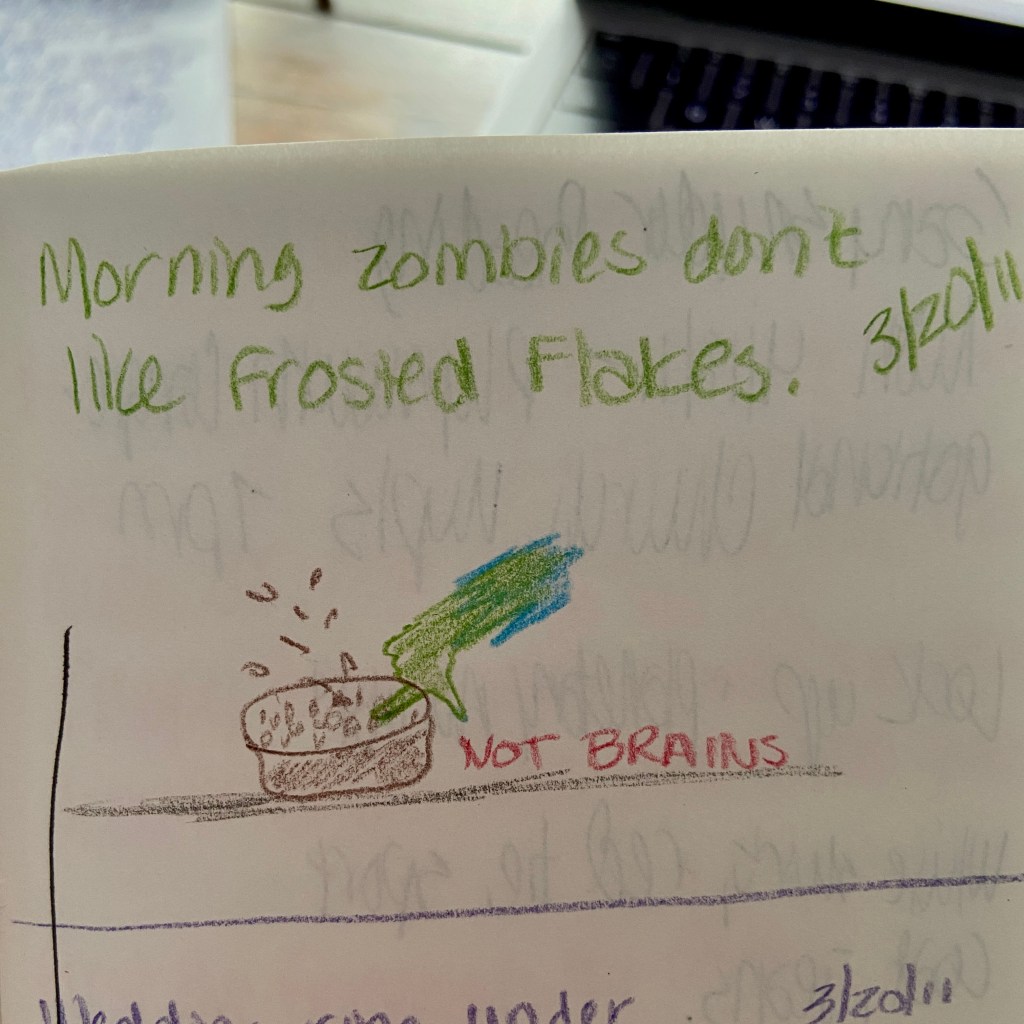
I have a 4X6″ Canson sketchbook, black covers, heavy paper with a little tooth to it, binding loosened from years of use, that lives on my writing desk most days. Inside this sketchbook are sketches done with words: quotes, memories, flashes of thought scribbled in my favorite Cretacolor Monolith 6B pencil, quick-writing pens filched from credit unions and dental offices and veterinary clinics, Flair markers in assorted colors, colored pencil. The first dated entry – and they are all dated – is 3/20/11; it’s a six-word story about zombies (yeah, I know – what the hell was that?). I have scribbled in this book off and on for 12 years. The one requirement for anything that gets put onto these pages is that whatever it is, it has made me stop, inhale sharply, caused the word “wow” to erupt from my lips, or ignited a cascade of images that light up my mind. The zombie thing was absolutely image related. I even drew a little monster hand pointing to a bowl of frosted flakes. Must have been breakfast time.

The first entry in my old sketchbook makes me laugh every time I see it. I’ve never done anything more with it.

Words and ideas that matter to me used to be picked apart on the pages of journals that I kept for years. I’ve seldom done daily journaling, but frequent journaling was a huge part of what I thought I needed to do as a writer. I processed everything in those journals – parenthood, politics, religion, sex, love, travel, anger, grief. Those pages were for my eyes only. Once I got the little sketchbook, the shift away from frequent journaling began its slow drift. It made more sense to me as a poet and essayist to have fragments from which to work; their succinct nature suited me and gave the next thoughts broad leeway. If someone read my sketchbook out of curiosity, it wouldn’t be a big deal. I didn’t need to process everything as much as I needed to understand there are a lot of paths to creative work. And there are a lot of creative mediums in which to muck around.

Biology often shows up in my sketchbook.

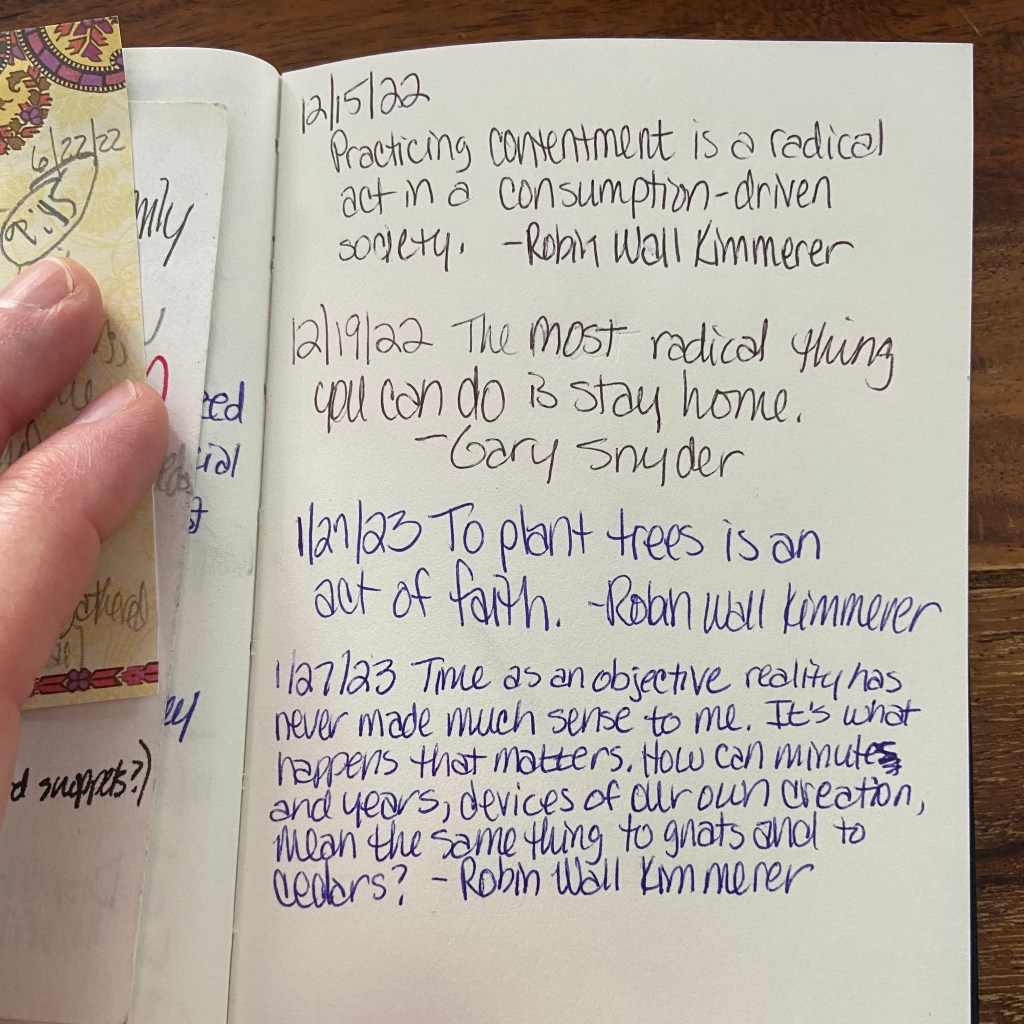
Lately, I’ve been scribbling a lot of fragments in the little sketchbook as I’ve read Robin Wall Kimmerer’s Braiding Sweetgrass. I started the book months ago, knowing as soon as I began it that it was a text for which I would have to slow down. I read several other books concurrently, but none of those nudged me to copy quotes and thoughts into my sketchbook. Braiding Sweetgrass did. Over and over, I found myself putting my finger on the page, looking out the nearest window, and thinking about how I take care of the earth. Then I would have to scribble something down, think about what to do with this bit of wisdom, that piece of the story of how the United States came to be, or some scientific fact about fungi and algae and symbiosis. The little sketchbook had been sitting on my desk for weeks, unopened, and then boom – there was much to add.

Quotes from Robin Wall Kimmerer have hit home too many times to count these past few months.

I love that this is how the creative process works: we move along looking around, reading, watching, asking questions, listening, and then there it is, the piece of art or literature or fact that we cannot resist engaging with. The thing that we turn over and over in our heads. The one that our partners get tired of hearing us talk about, so then we must stop talking and start making something. Craft our response in whatever form works that we then send out into the world to see if anyone else engages. Even if no one does engage, we’ve still had our own epiphany that might change how we inhabit the world. We’ve still learned something.

Creative work is never wasted. I’ve had moments when I’ve questioned the value of making a poem that maybe three people might read, or a painting that is destined to either live in my basement or get painted over, but not anymore. It all affects the next project and the one after that and the one after that. Ultimately, it affects how I live in the world and the excitement with which I welcome each day. 

I don’t miss my old habit of frequent journaling at all. My little old sketchbook is a great collection of sparks and memories and ideas. It’s almost full. I have a new one, the same kind of Canson 4X6″ sketchbook, ready to take over. The new one sits on the windowsill above my painting table, its stiff binding waiting for its invitation to loosen up and let the covers flop open to reveal clean pages that beg for their turn to hold a spark. I have no doubt there’ll be plenty to put in there. 

The new journal, hanging out in my art space, waiting its turn.

New Year, New Energy

As I type this post, I’m relishing having time for creative work of all sorts. I spent a few hours this week playing with poster design for a friend’s band – the one in which my partner Mick plays saxophone. I’d forgotten how much I like doing this kind of thing, playing around with page layouts and borders and fonts and soft edges on photos. My challenge is always not to overdo any special effects, to remember that one font is all that should be present and it sure as hell shouldn’t be comic sans. My son the artist has made sure I know these things.

This cover was a collaboration with my friend Constance Brewer. I did the background painting, she did the overlaid print and text.

My friend and off-and-on poetry/art collaborator Constance Brewer and I have also renewed our commitment to working together on some poetry this year. Somewhere along the way during the pandemic, my desire to work on poetry left me and I knew it was time to just let it be. That was a good decision; this is a welcome shift at what feels like the right time. I’m a big fan of taking breaks to regain/realign perspective and refill my creative reservoir. And I’ m grateful for other creative friends who understand the way creativity ebbs and flows.

What do others do to fill that reservoir? In the past, I’ve recharged with travel, reading, hiking with my camera, cooking, going to the movies. Sometimes a long conversation will do it, but not always given my tendency to be quiet when I need to recharge. Often, time just sitting outside somewhere without people is enough.

That said, I’ve been thinking about what 2023 might look like for creative practice and inspiration. Where to get it. How to keep it going. Doing band posters and collaborating with Connie are a start. There are already two trips on my 2023 calendar, one to Seattle and one to France. I got a new camera in the fall, so am thinking about where to hike when the weather is warm enough that cold fingers aren’t an issue. And there are assorted art surfaces in my basement waiting for me to put paint on them. There are ample opportunities to learn and create.

This is as close as I ever get to anything designated as a resolution.

In other news, I was invited to contribute a poem to a SongSLAM team in the SongSLAM Minneapolis that took place at the Ice House on January 6, 2023. Twin Cities musicians/composers Melissa Kristin Holm-Johansen, Scott Senko, and Bryon Wilson chose the poem Fall Farmers Market from my chapbook, How We Learned to Shut Our Own Mouths, as lyrics for their composition.

Here’s the poem:

Fall Farmers Market
by Kathleen Cassen Mickelson

Splotches of red, green, purple, orange and yellow 
Monet together until I put my glasses on,
grocery list in hand, morning air crisp, clear.
Farm trucks form two parallel lines,
back ends facing each other,
tables straining beneath this morning’s harvest.

I can’t resist the warty pumpkins
even though Halloween is over a month away. 
Nor can I pass up perfect purple eggplant, 
cherry tomatoes of red and gold,
shiny orange peppers,
earthy inky beets with bits of dirt
still stuck to their skins.

I dream of baba ghanouj, vegetable kebabs,
sheet pans of roasted goodness.
In this moment, pandemics seem far away, 
cruelty impossible in the face of such abundance. 
All I want is to cook for everyone,
show them the many colors of love.

And here’s an audio from the rehearsal:

The team placed third in the competition. How cool is that?

Not a bad start to 2023.

Happy New Year!

One year ago, I launched One Minnesota Crone, broadening the focus I honed at One Minnesota Writer to include other art forms and celebrate mature creative women who are doing exactly what they please.

Thank you for coming along on this journey, celebrating the many gifts that crones bring to the world, and, just maybe, gathering ideas for yourself. Perhaps you’ve even changed your mind about what the word crone really means.

All that said, I wish for you all a 2023 full of whatever you love in the company of whomever you love.

Here’s a poem for this first day of 2023:

I AM GOING TO START LIVING LIKE A MYSTIC
by Edward Hirsch

Today I am pulling on a green wool sweater
and walking across the park in a dusky snowfall.

The trees stand like twenty-seven prophets in a field,
each a station in a pilgrimage--silent, pondering.

Blue flakes of light falling across their bodies
are the ciphers of a secret, an occultation.

I will examine their leaves as pages in a text
and consider the bookish pigeons, students of winter.

I will kneel on the track of a vanquished squirrel
and stare into a blank pond for the figure of Sophia.

I shall begin scouring the sky for signs
as if my whole future were constellated upon it.

I will walk home alone with the deep alone,
a disciple of shadows, in praise of the mysteries.

– from 180 More Extraordinary Poems for Every Day selected by Billy Collins, New York: Random House, 2005.

– cover image by Geralt at Pixabay.com.

– winter scenes by kcmickelson 2022.

Tilting Toward the Solstice

December, my friend, thank you for your long, dark nights. The way the stars twinkle in the black sky. Silence. How snowflakes glisten when light hits them. The crunch of hard-packed snow beneath my boots. An owl’s early-morning hoot. Crows gathered in trees, their chorus drowning out everything else. My breath made visible as I exhale.

December, your gifts go beyond beribboned packages and boisterous holiday parties. Your cold arms nudge me indoors to hibernate. Your special offering of sustenance is rest. You know best. Just look at the way the garden slumbers beneath its white blanket.

And so I welcome the Solstice. The opportunity for rejuvenation. Moments of awe over pretty lights in dark nights, both man-made and natural. The quiet space that feels safe. The place from which I’ll emerge with new energy for a new year. 

Look for miracles. They’re everywhere.

Happy Solstice.

all photos by kcmickelson 2022

Hello, Winter

I’m writing this on a Tuesday, late in the afternoon. My granddaughter Maeve has gone home for the day. We spent a lot of time today standing in front of the windows watching snow fall, birds gather at the feeder, trees cradle all those white flakes. Snow piled up in the driveway, covered the three heart-shaped markers for our old dogs beneath the crabapple. The world as we could see it transformed into a clean, pure landscape of new possibilities. By the time my son Shawn came to pick up Maeve, we had a good six inches of new snow. Maybe seven, judging from the first cut of our snowblower just a little bit ago.

These first storms of the season here in Minnesota always bring traffic troubles, spinouts and cars in the ditch, people late no matter where they’re going, schools closing early or not opening at all. People sometimes have trouble digging out, depending on whether they own a snowblower and are physically up to the demands of moving snow. Weather forecasters get their moment in the spotlight, gesturing over maps of storm tracks and sharing snowfall totals from all over the state. It’s all part of winter, of life in a climate where snow is a certainty every year. 

I love winter in spite of its challenges. I’ve lived in Minnesota my entire life, learned very early that preparation was key to being safe and able to show up to work or school. I’ve also learned winter gives us opportunities to slow down that we should take advantage of whenever possible. During the summer, I am loathe to sit in my office and write when I could be outside. But now, with the snow coating everything and the temperature dropping, my office is inviting and warm, the light through the south-facing window bright. It’s time for all the thoughts I carried in my head all summer to be put into writing or poured into a painting. It’s time to think about creative projects I put on the back burner while I hiked in the woods, pulled weeds, photographed birds. And it’s time to rest: early nightfall, cozy blankets, red wine, good books, and a simple delight in that fairy-tale falling snow. 

Speaking of books, I’ve been reading Robin Wall Kimmerer’s book, Braiding Sweetgrass, in tiny bites over the past several weeks. Mick gave me this book the Christmas before last; it took me until now to feel like my head was in the right space to read it. And I feel rewarded for waiting: this is one of the most beautiful books I’ve had the pleasure of reading. Kimmerer’s combination of plant science and indigenous knowledge is so well communicated and so thoughtful that I don’t want to rush through this text. I don’t want to miss anything important. My years of gardening with Mick have taught me how important it is to pay attention to what is going on in our own little piece of earth, to be patient and wait for it to show us what works. Kimmerer’s book reinforces that idea and expands beyond it to what stewardship of this earth really means. She talks about the disconnection between most of us and the natural world. That disconnection is not a good thing as it keeps us from understanding the very life forces that sustain us all. I’ve felt that disconnection dissolve just a little when I’ve sat in my own garden for solace. I’ve also felt that disconnection dissolve when I’ve watched the falling snow and given in to the invitation to slow down and rest. 

Early on in the book (I’m halfway through), I was struck by the stark differences between a gift economy and a market economy, and the idea of responsibility for the gifts we share versus the greed that develops alongside what we think we can just buy. These are ideas I’m thinking hard about at this time of year when every single retailer has a sale designed to make us buy more and more and more with no regard for what that means in terms of having too much, of wasting resources and tossing things out because we no longer use or need them even though they’re perfectly functioning things. I’m thinking about what that does to our inclination to appreciate what we already have. And I’m thinking about the legacy we leave our grandchildren when we are hellbent on acquiring more stuff instead of taking care of our little spot on this planet and each other. It’s hard to buck an entire culture built around money, but there are plenty of small things that shift the focus to other kinds of wealth. The more time I spend outside, quiet and observant, the more I feel that shift.

I’ll be reading Braiding Sweetgrass for a while longer, little bits before I go to sleep at night. I enjoy the way Kimmerer weaves plant information and ecology into stories about people and connection. I want to linger over this book, absorb its wisdom, and carry it forward.

It’s a perfect winter read. 

Cover photo taken at Old Cedar Avenue Bridge Trailhead, Bloomington, Minnesota by kcmickelson, 2021.