One of the greatest things about being an older adult is the time to settle into whatever season it is, which is extra lovely in the summer. As I write this, I am in a chair outside my front door, gardens bursting with blooms in front of me, a little humidity in the air, birds singing and singing and singing. There is nowhere else I have to be in this moment, no child demanding attention, no boss pushing a deadline, no Zoom call forcing me to choose whether to be on camera or not. My partner is off playing softball and I have time to myself.
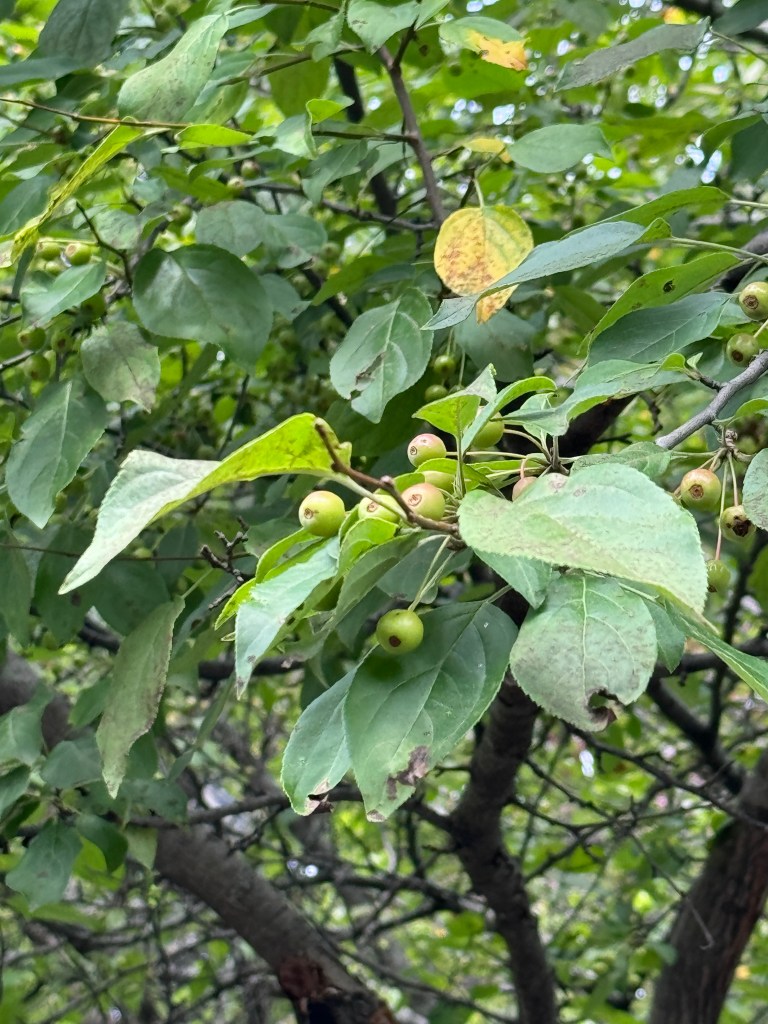
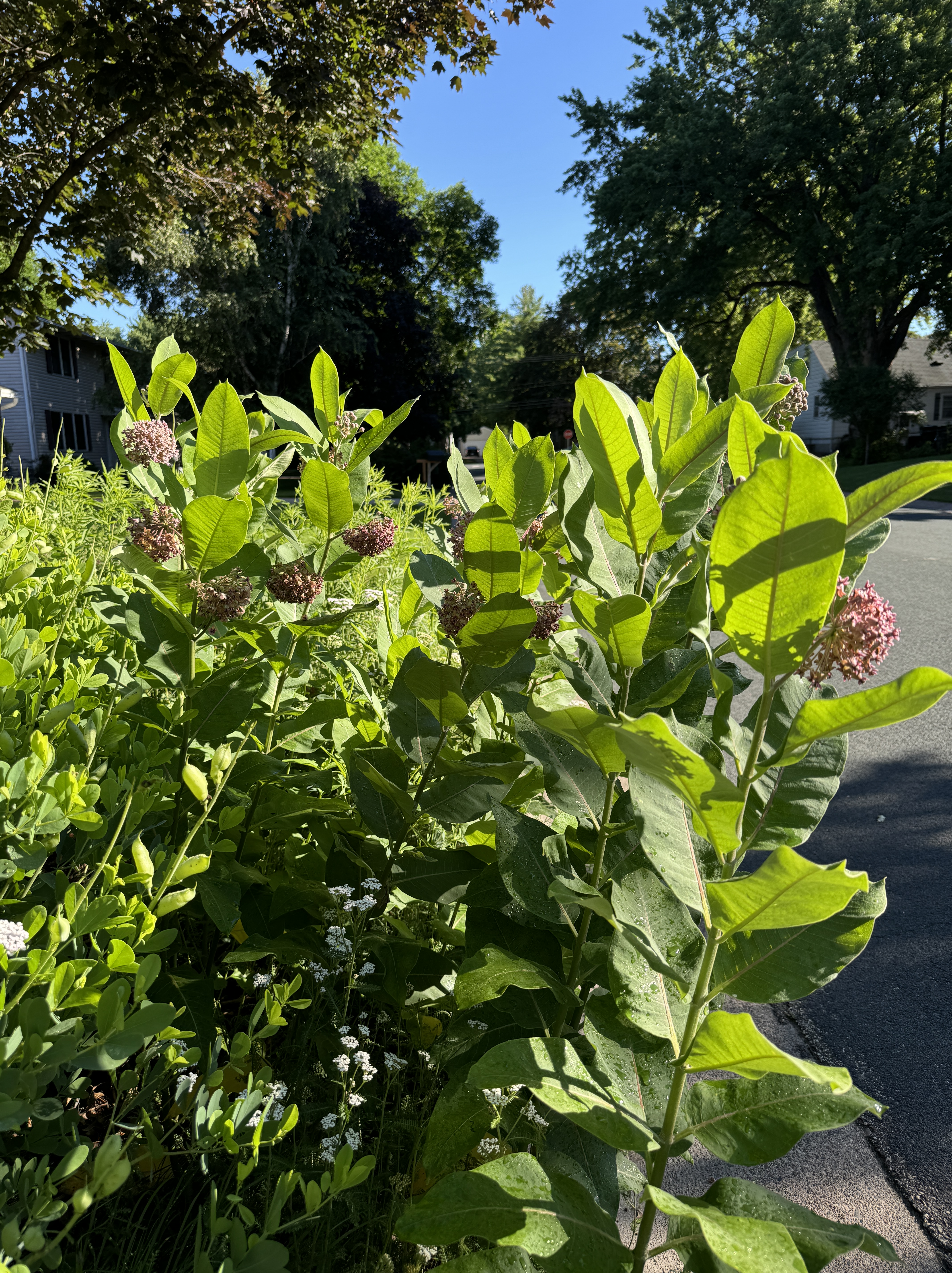
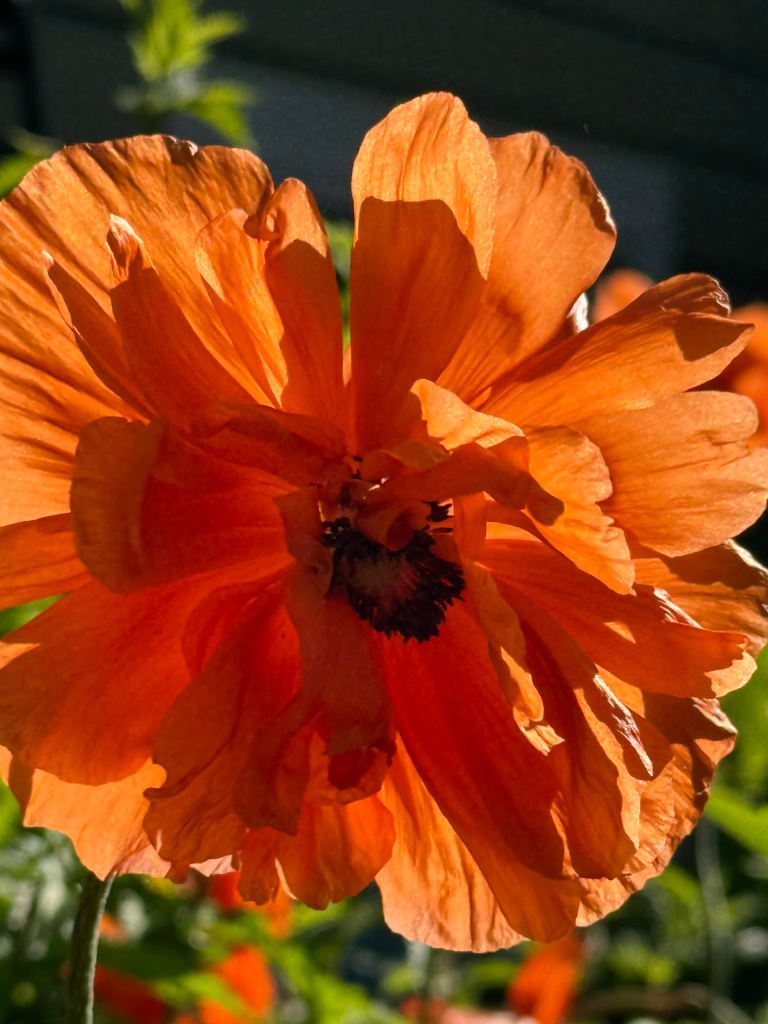
And so I am here with a mug of ginger tea and a laptop that allows me to write anywhere. I keep pausing while I write so I can look up at the sky where clouds are gathering in advance of tomorrow’s predicted rain, or at the crabapple where fruit is just beginning to form hard green orbs. I can wave to my neighbor across the street as she goes off for her daily walk. I can watch bumblebees explore the coreopsis, yarrow, lavender, and Indian physics all brushing their blooms against each other alongside our driveway. I can admire the intense red astilbe that have erupted just in time for the fourth of July.
The view from my front step, a perfect place to write on a summer morning.
This past week, Mick and I went to Age-Friendly University Day at the University of Minnesota, an annal event for mature alums to explore all the things our later years can be: healthy, active, productive, and agism-busting. One of the sessions we attended discussed how healing it is to be outside, how good for our health it is to sit with the natural world on a regular basis. Mick and I were pleased that this is something we already do and have been doing for a long time. The way I feel today after spending the morning in my own garden is proof: I am deeply happy to be here, content and unrushed, my attention not shattered into a million shards. I am a terrible multi-tasker, something I’ve come to understand much better in the last few years. But I’m really good at sitting outside, listening.
This makes me think I had it right when I was a kid, wiling away afternoons with a book I loved while laying around in our yard. Kids naturally know when to stop, be still, and regroup if they are left alone long enough to find that out for themselves. I had parents who did not schedule things for me in the summer. They assumed I would find plenty to do on my own. The only thing they planned in the summer months was a block of time to take our annual road trip, which was itself barely planned: get in the car with our suitcases and head out for two or three weeks. We knew where we were going when we got there. There were plenty of stops along the way to check out something that we stumbled on, usually a natural attraction: a park, hiking trail, mountain, dirt road in the middle of nowhere. My father always brought binoculars along, put them into use so he could scan the countryside at each stop. We got lost all the time, found our way somewhere that offered a motel room for the night. That kind of childhood primed me well for this latter part of life when activity levels are different, when we can choose how busy to be or not to be, and when we can let ourselves find little bits of awe along the way.
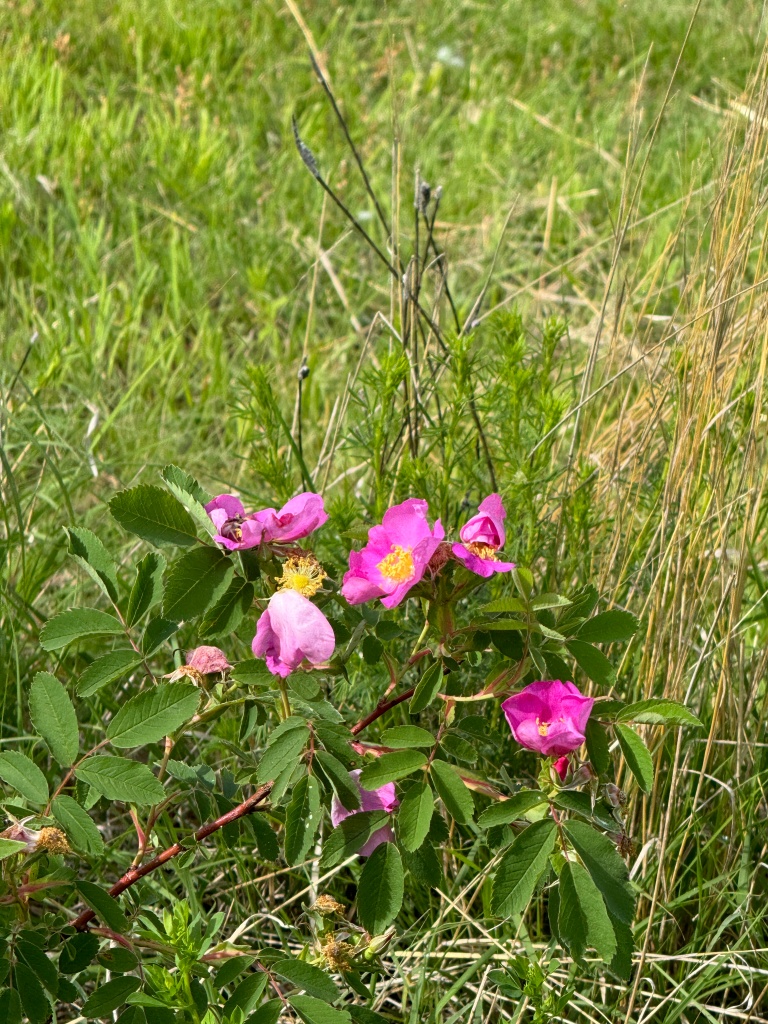
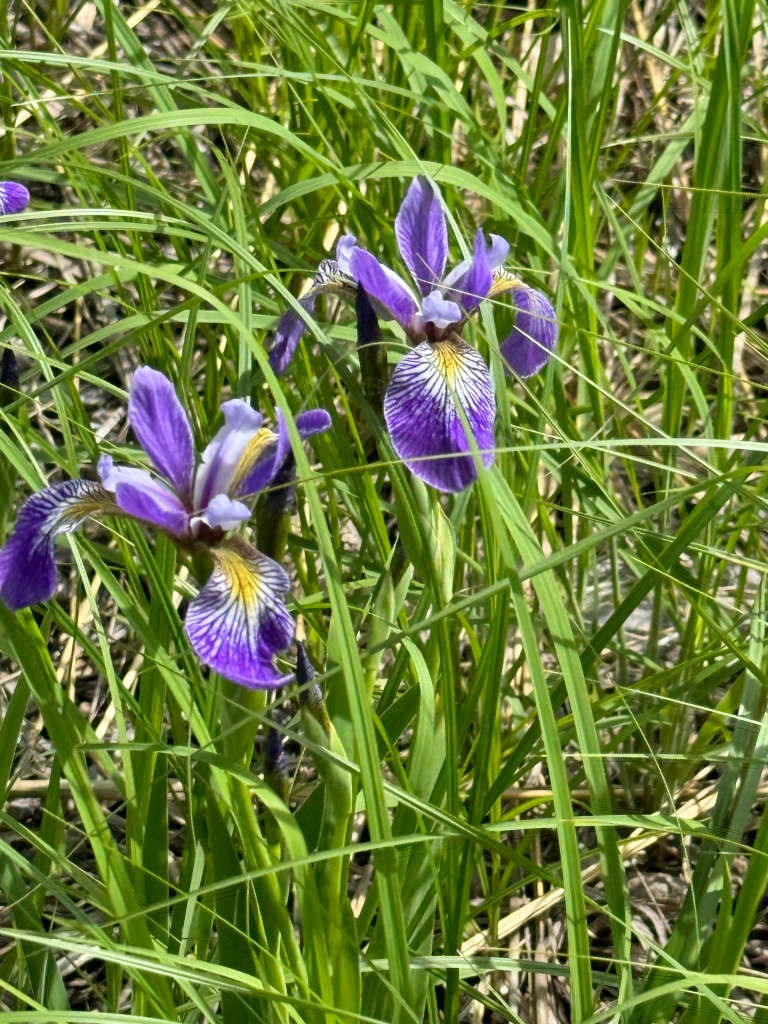
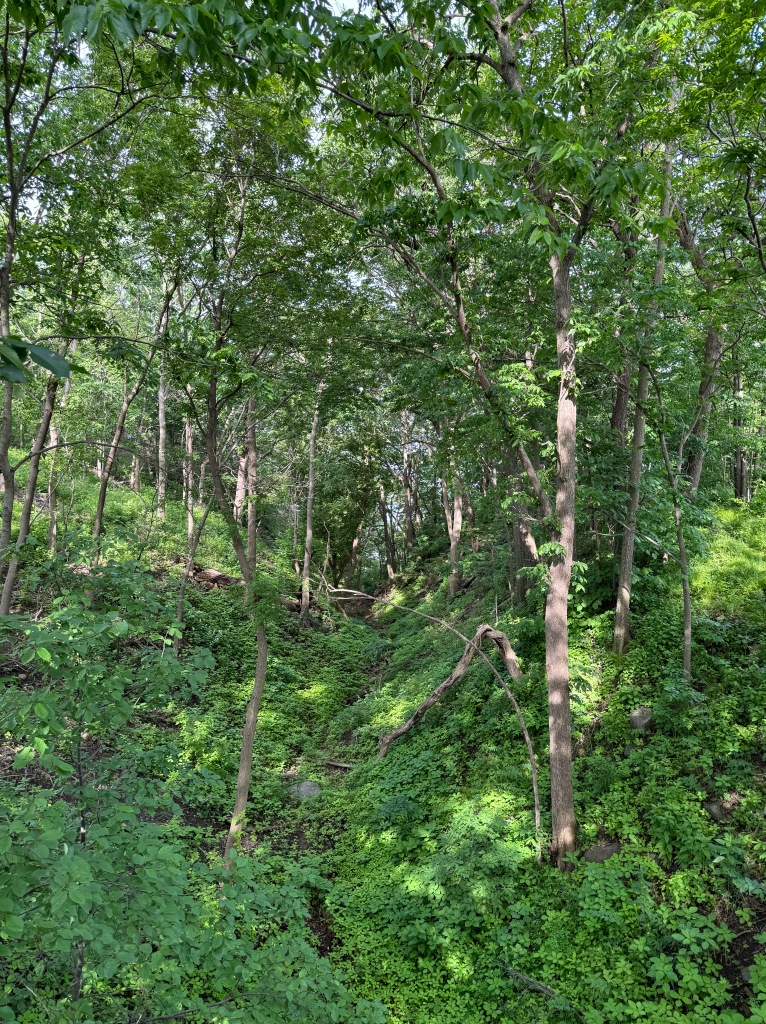
July is a great time to find some awe in Minnesota. Warm enough to get outside unencumbered or stargaze in the middle of the night. Light enough late enough to take long walks after dinner. Sultry enough to feel your body slow down, pause for a moment.
Don’t wait to pause for that awe. Summer is now. We are in the thick of it.
Remember when you were a kid on summer vacation and warm afternoons felt endless?
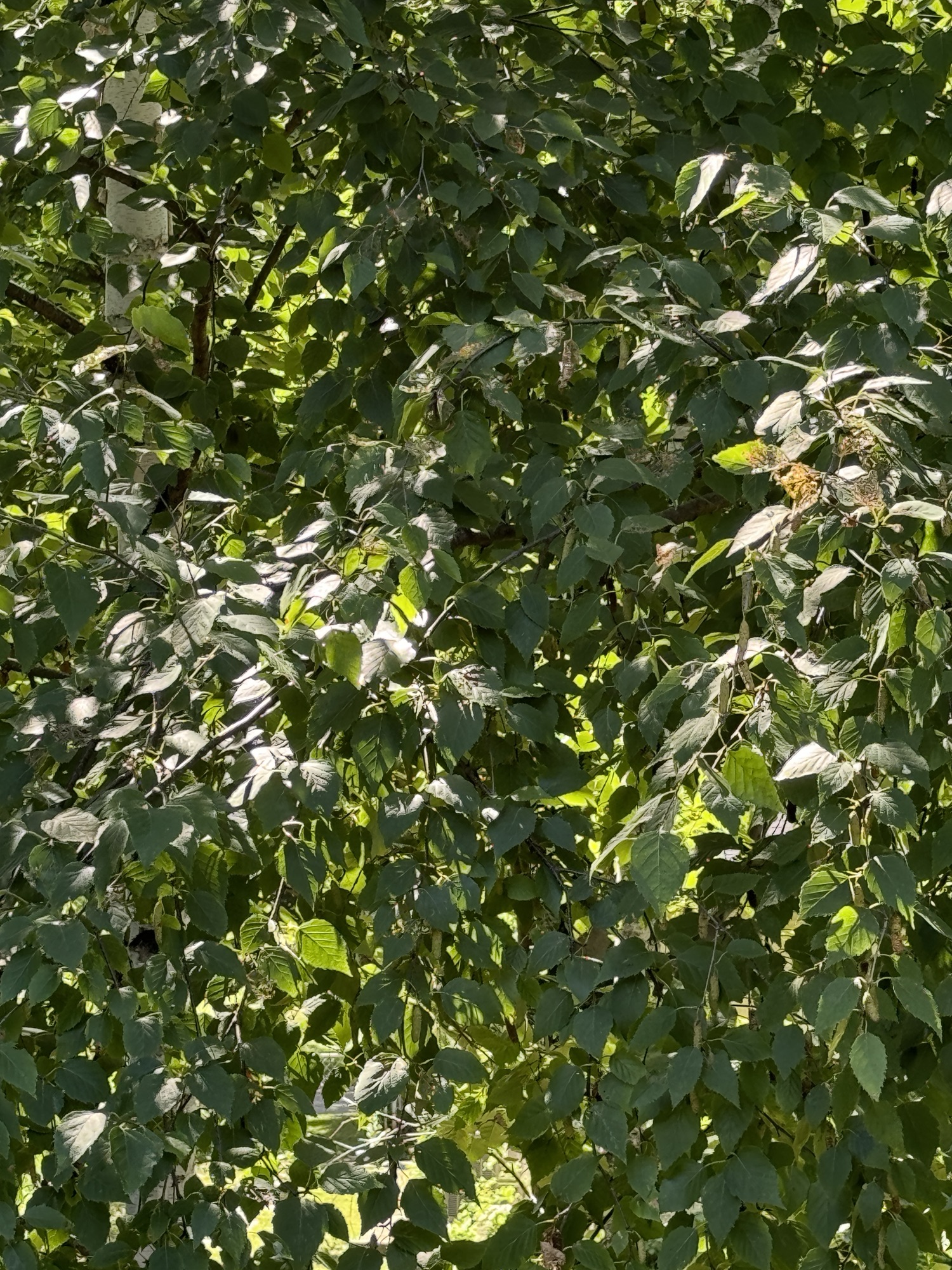
I’ve rediscovered that feeling these last few weeks. As I write these words, I am sitting on our backyard deck. A robin sings somewhere nearby. No, I’m wrong; upon listening more closely, it’s a cardinal singing, whistling, chirping. Sunlight comes through the birch leaves on limbs leaning over the deck, dappling on the deck planks. A small gray spider skitters along the bottom of the sliding door on the back of the house while a helicopter chk-chk-chks overhead. A motorcycle buzzes down what I’m guessing is Snelling Avenue by the direction of the sound.
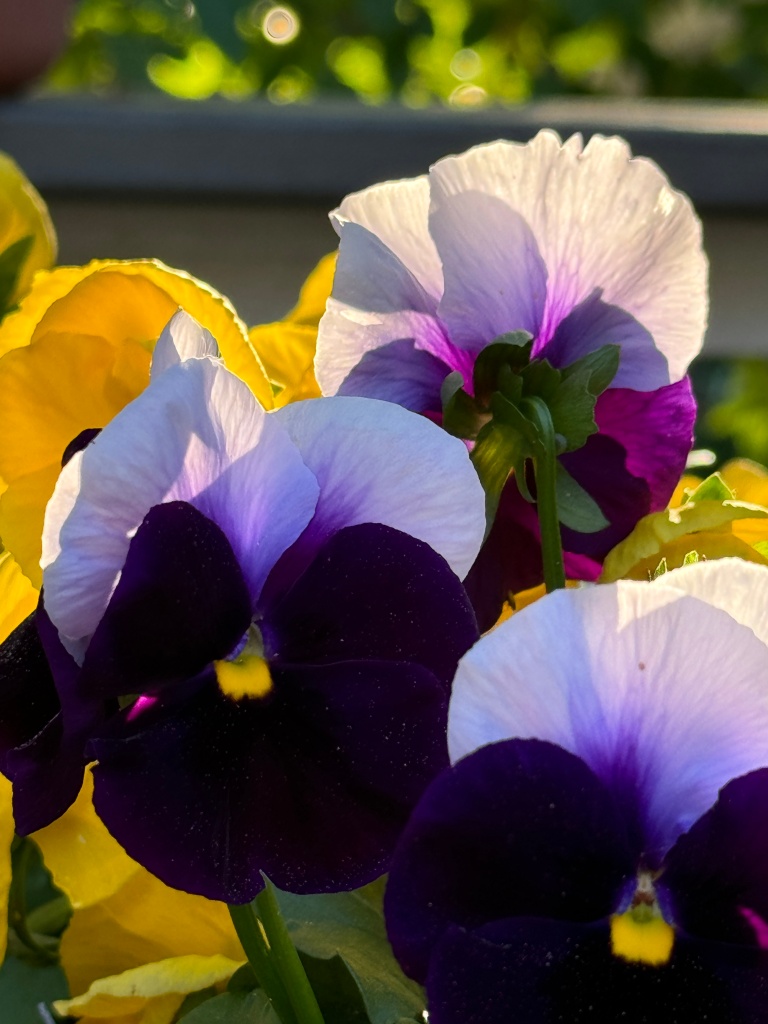
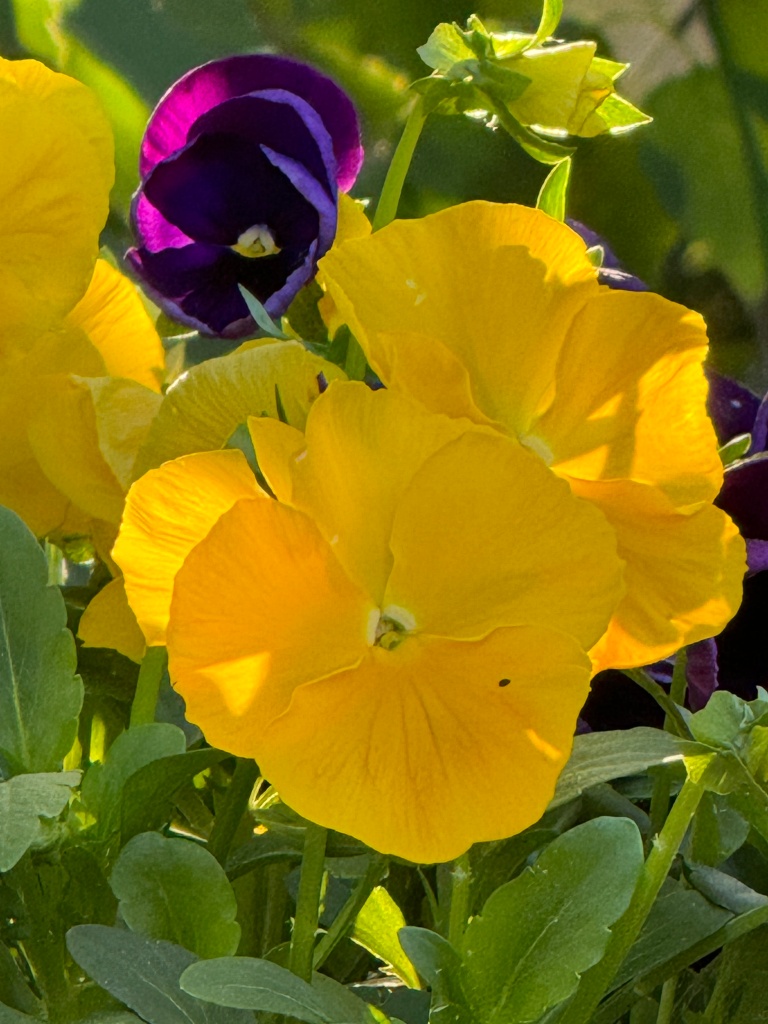
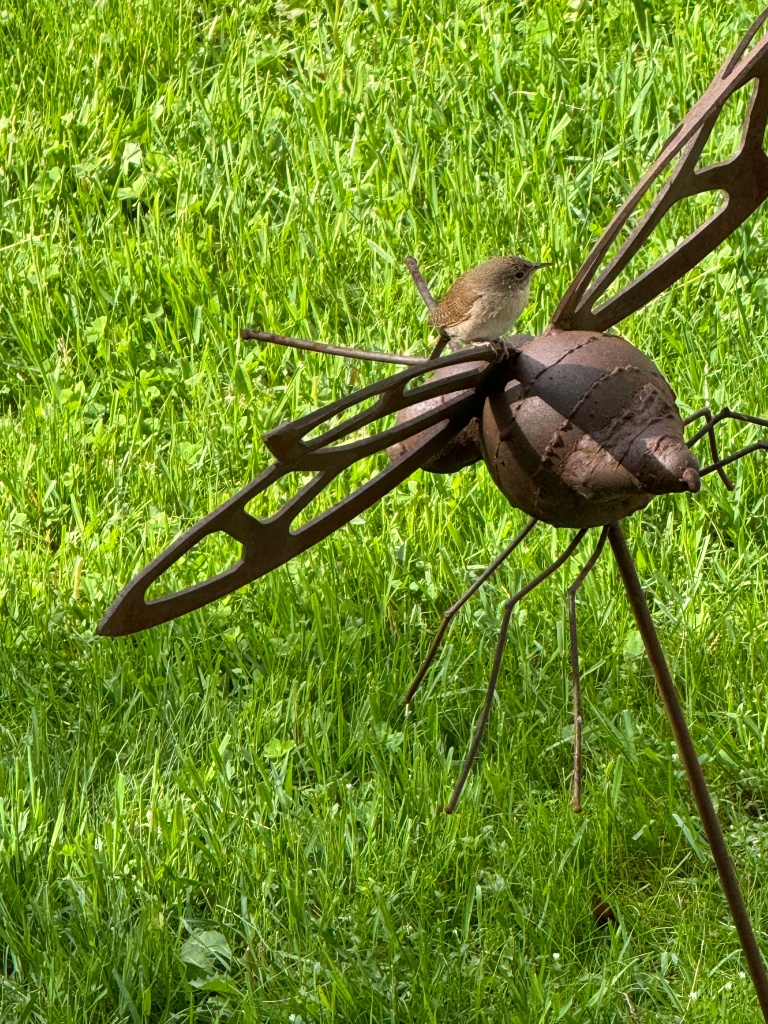
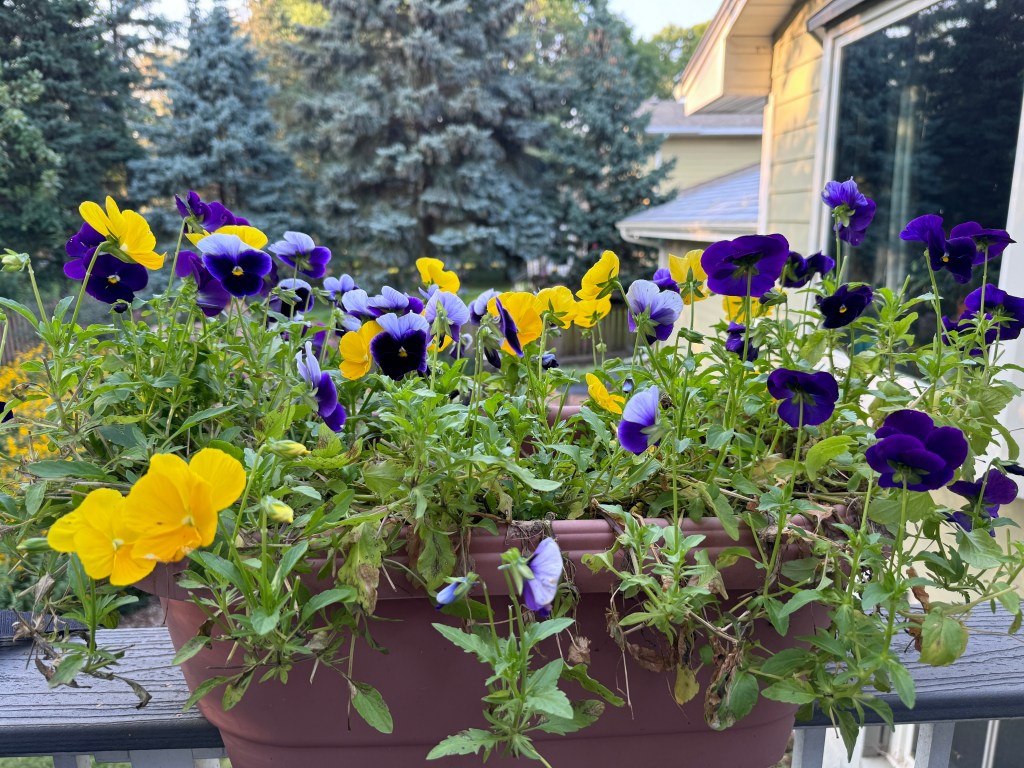
The garden has burst open with its usual June abundance. My partner Mick created packed-full deck containers of pansies in yellow and purple. Catmint waves in the breeze behind the garage, its stalks full of bumblebees. My favorite deep-toned wind chimes sing in that same garden, while our resident wren sits on top of them to sing his own tune. He’s been singing and singing for weeks, making me worry that he hasn’t found a mate. In other years, the arrival of wren babies by this time would have caused the wren to be quiet and watchful.
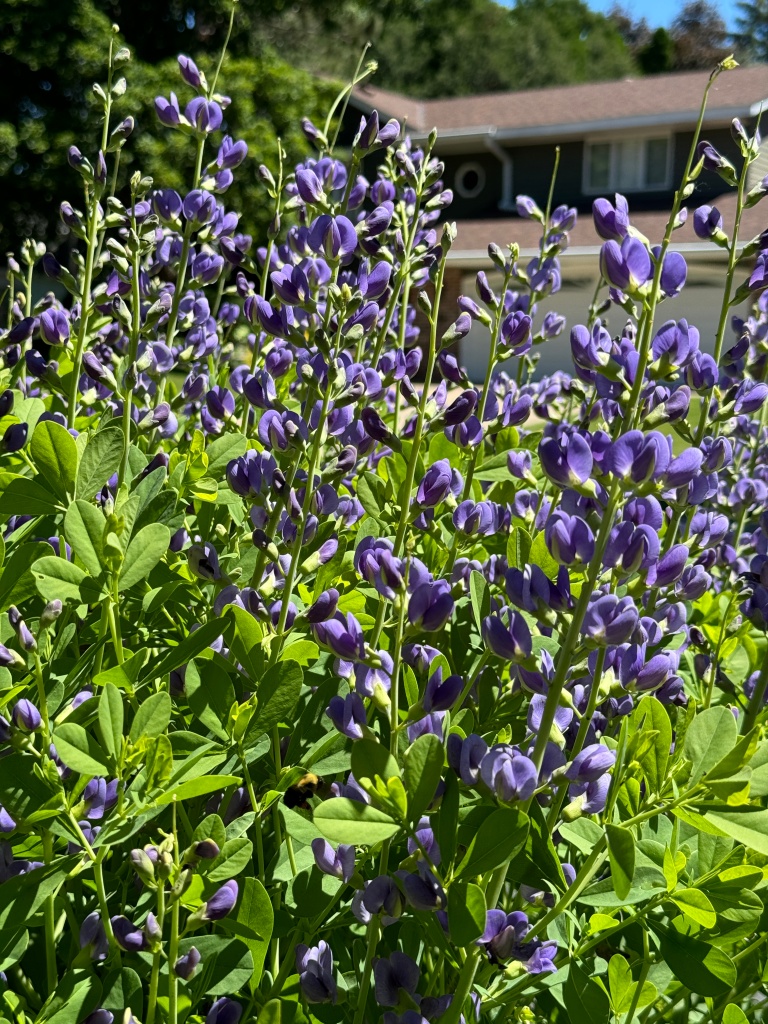
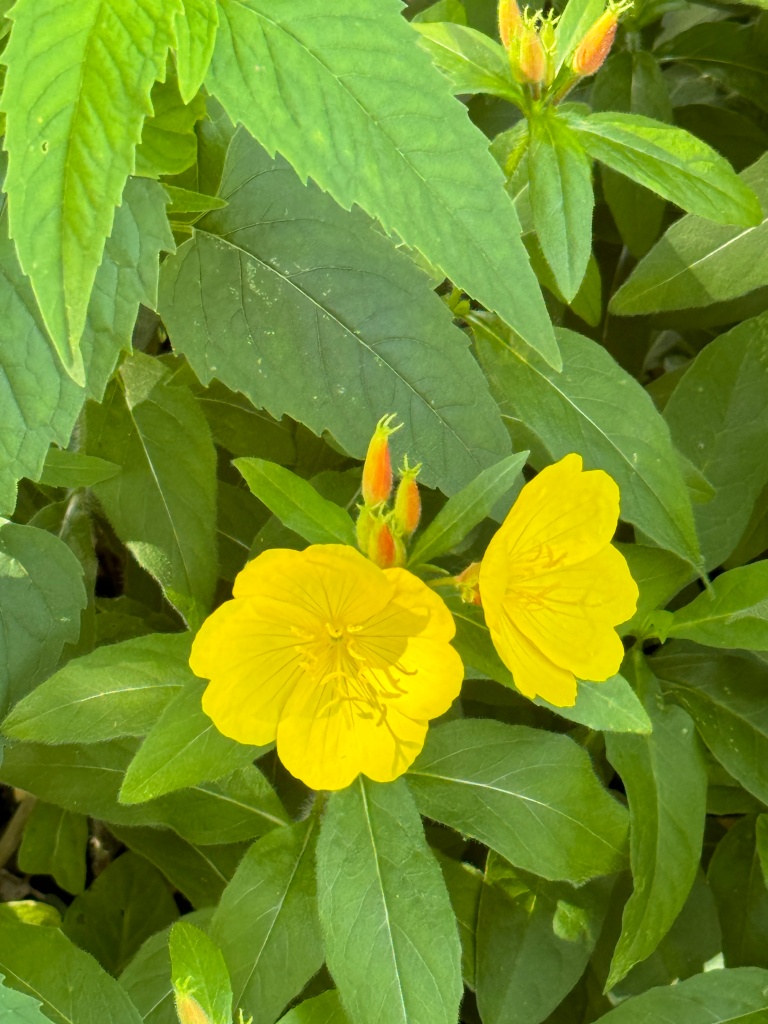
Scenes from our garden
That I have time to notice all these things while sitting still is a gift. There has been much busy-ness over the past six months, flitting here and there like the birds I’m listening to. There has been travel – packed bags, crowded airports, taxis on unfamiliar roads, beds not my own, food sampled for the first time. There has been childcare – days spent with my toddler granddaughter Maeve who is the very definition of “terrible twos” while being infinitely lovable. There have been poems to read and edit, blog posts to write, fellow creative crones to cheer on.
And now it is summer. Maeve’s parents are on summer break from their teaching jobs, so Mondays and Tuesdays are my own again. Mick and I have no further big trips planned, opting for journeys closer to home. I’ve only got one poet conversation for One Minnesota Crone scheduled for the next few months (August 1 – Wilda Morris) and I’m not taking on any more than that.
It’s time to relax. And hike.
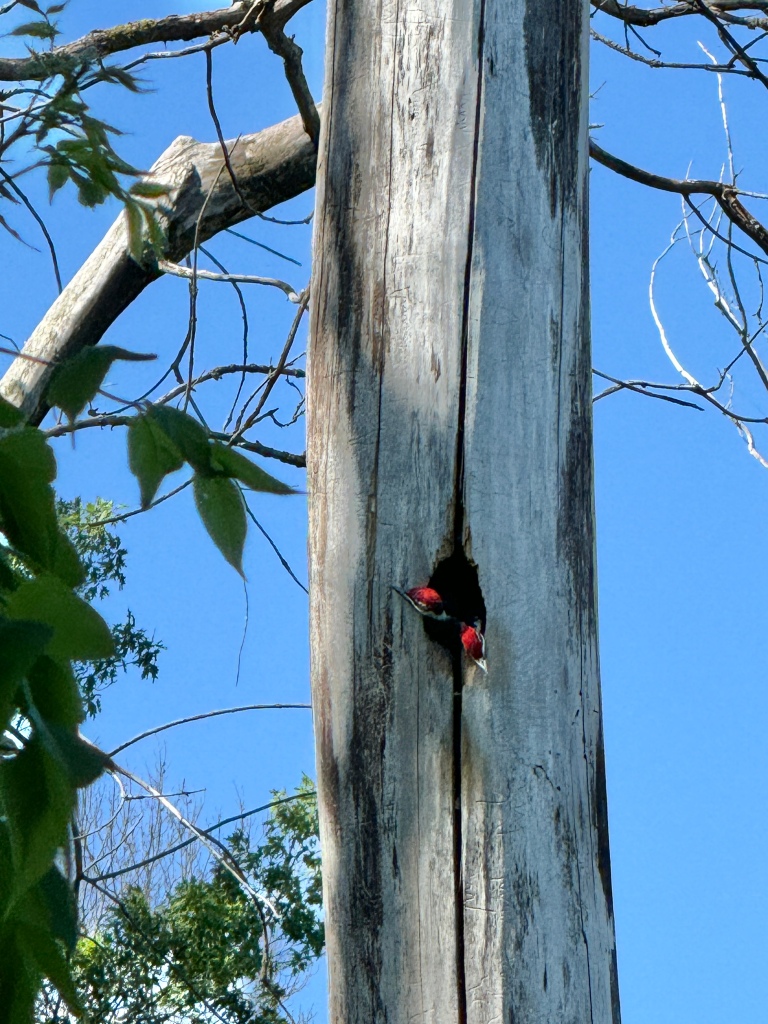
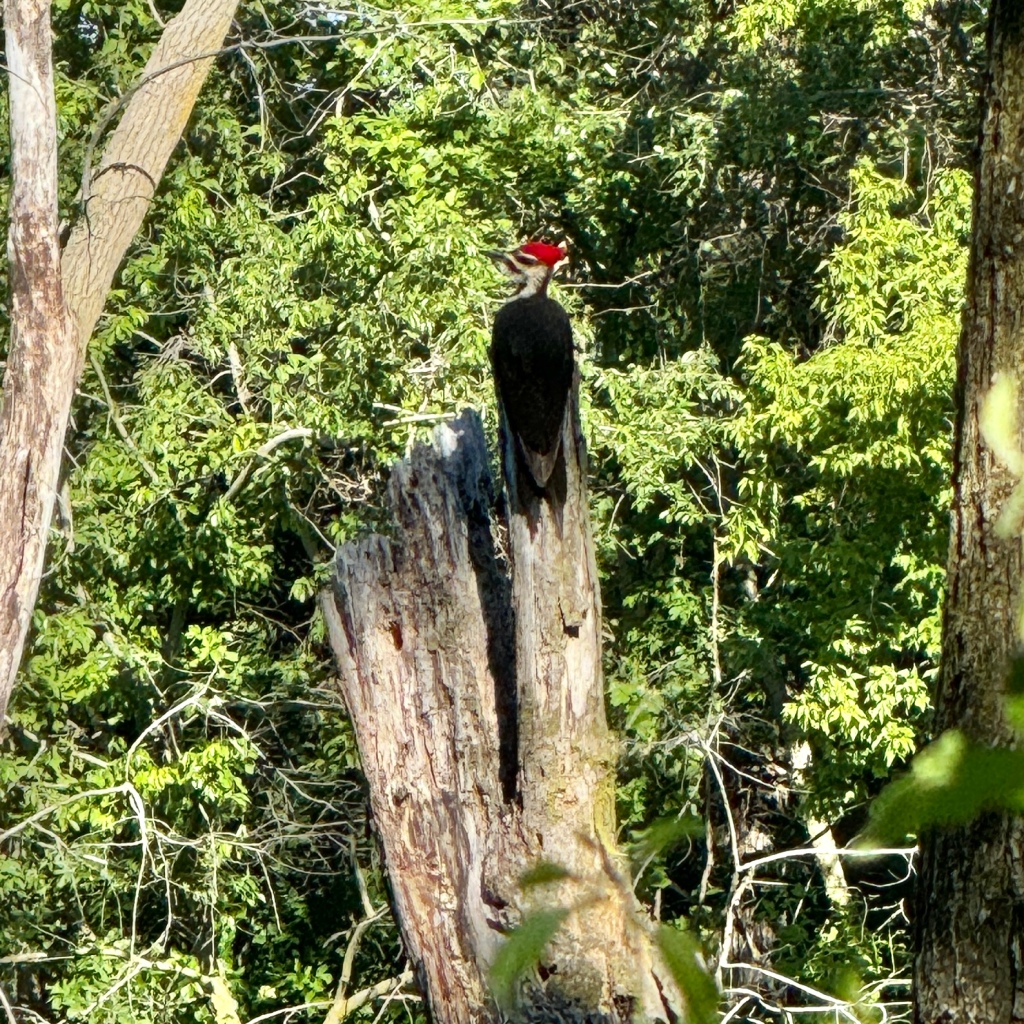
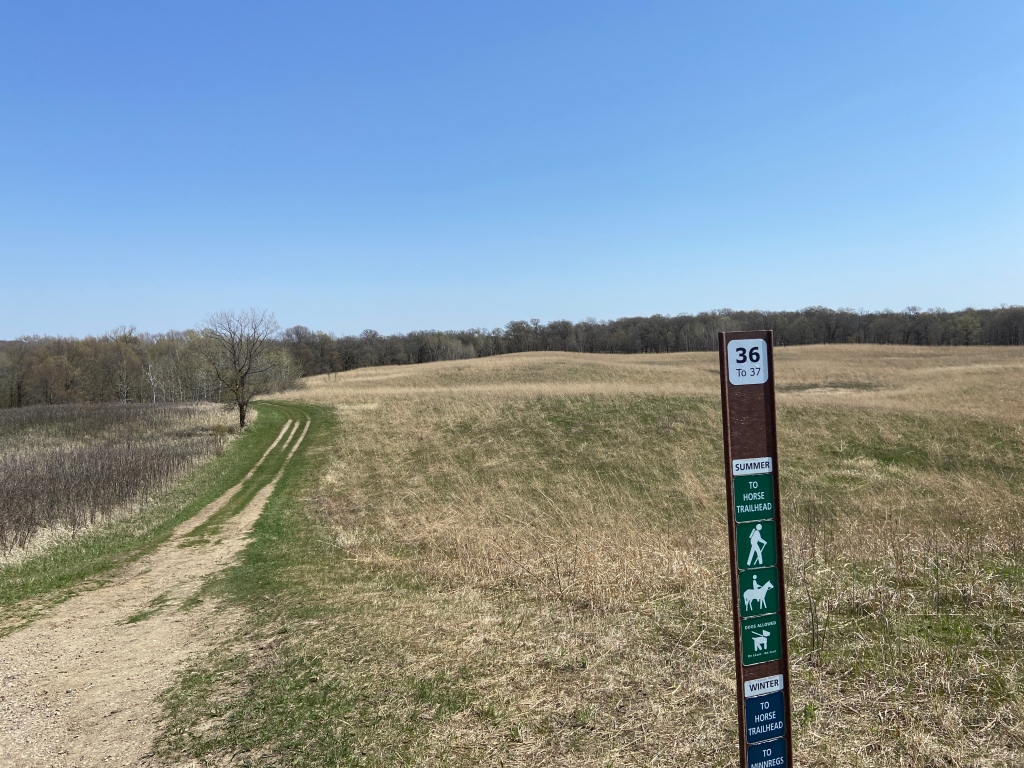
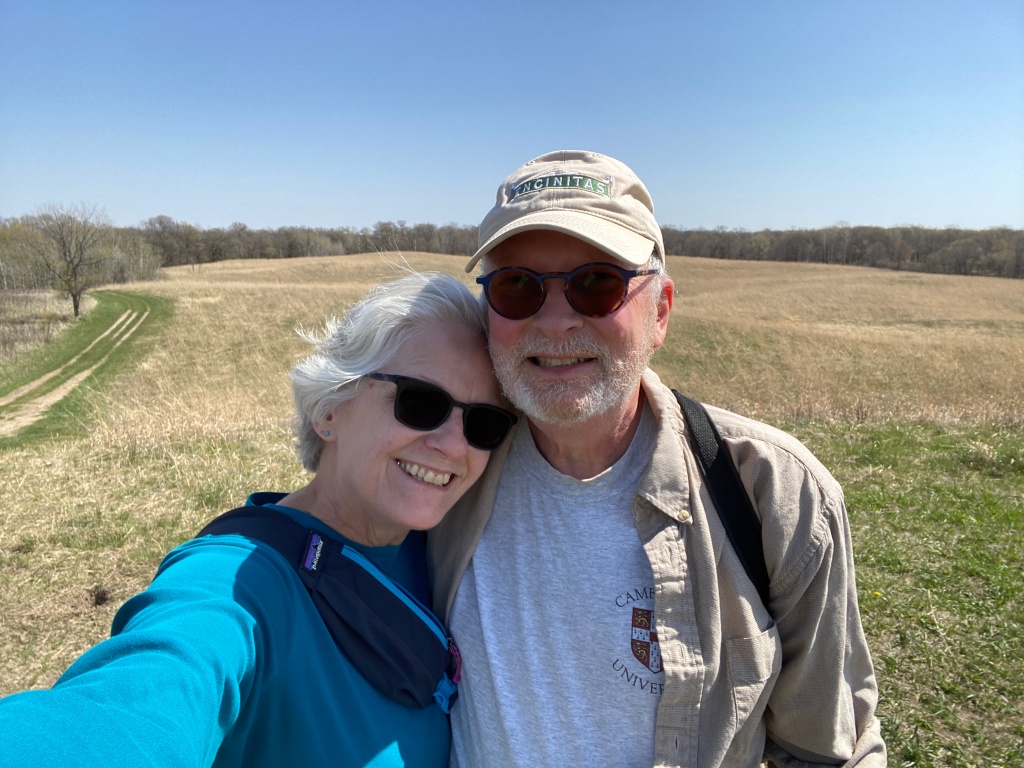
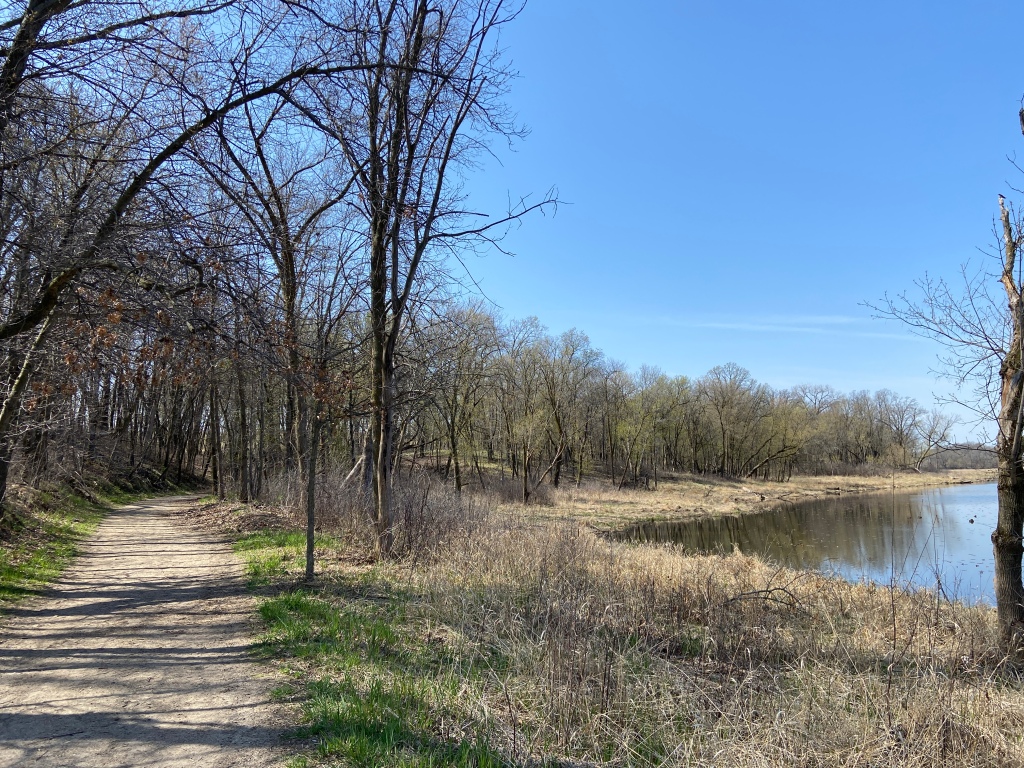
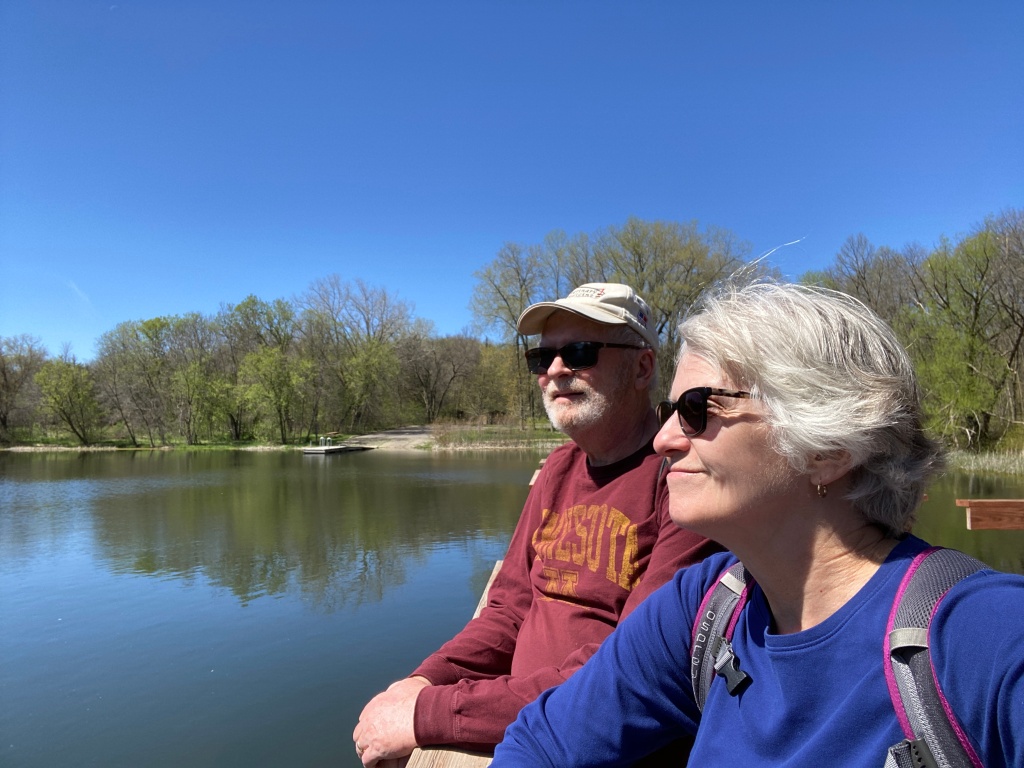
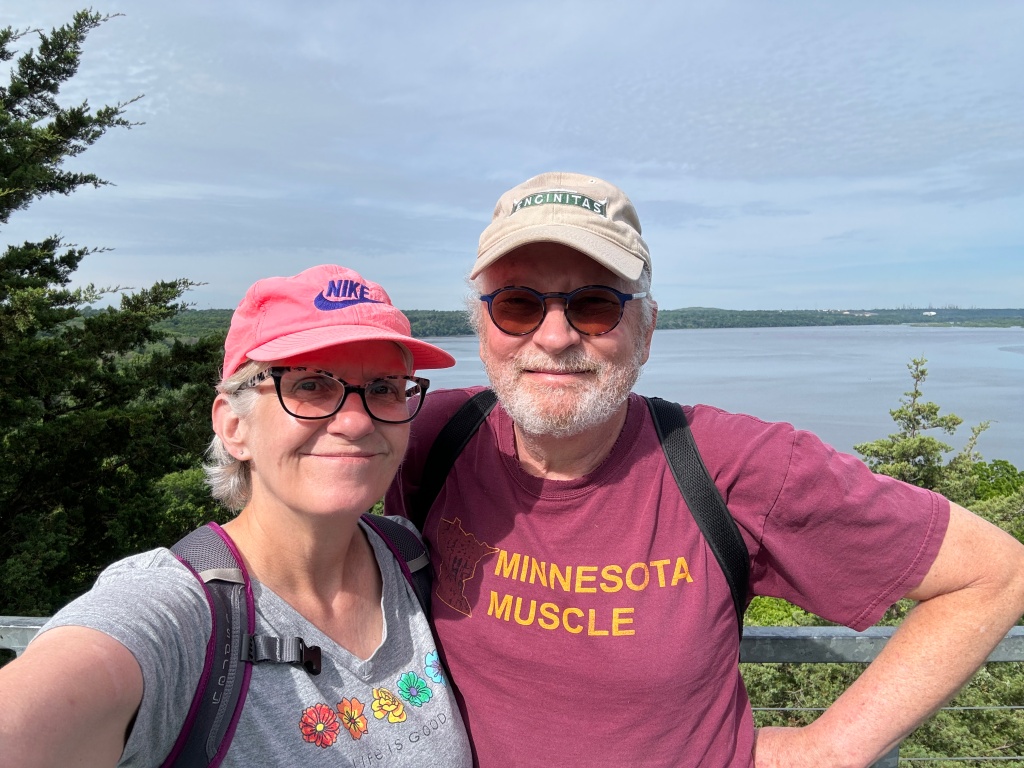
We’ve already done three nice hikes at nearby park reserves: Murphy-Hanrehan Park Reserve near Savage, Minnesota; Lake Rebecca Park Reserve near Rockford, Minnesota; and Spring Lake Park Reserve near Hastings, Minnesota. If you don’t live near the Twin Cities, you may not realize that hiking trails are everywhere around here. On days when we don’t have time to go very far, we often take a walk at Vadnais-Snail Lake Regional Park in Shoreview, Minnesota – just up the road from us. In fact, that’s where we went last Friday after realizing we had a few other things we needed to pay attention to. We were rewarded with this:
Pileated woodpecker babies look around for their next meal while the parent sits on a stump nearby at Snail Lake Regional Park, Shoreview, Minnesota.
Here are some snippets from the other trails:
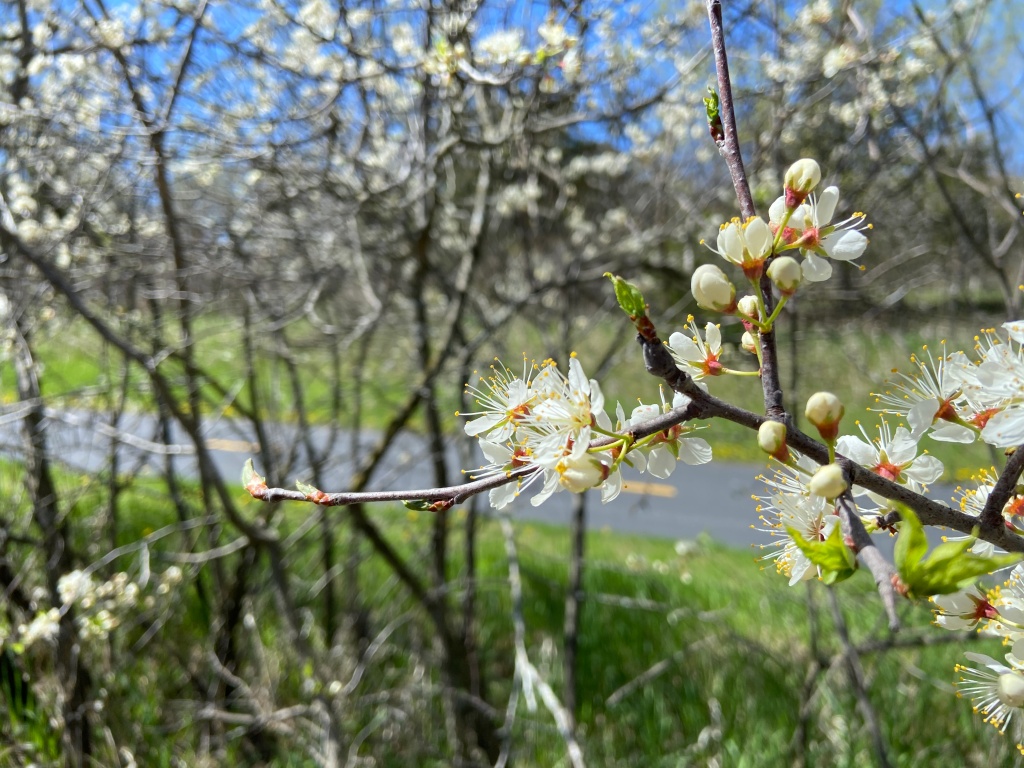
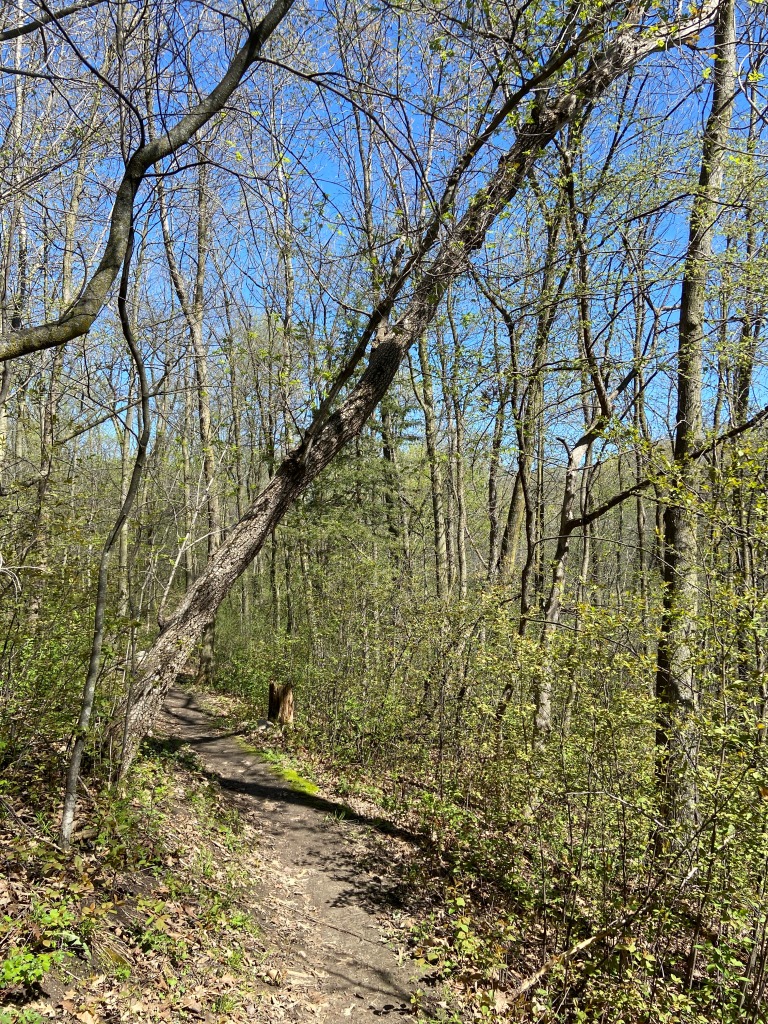
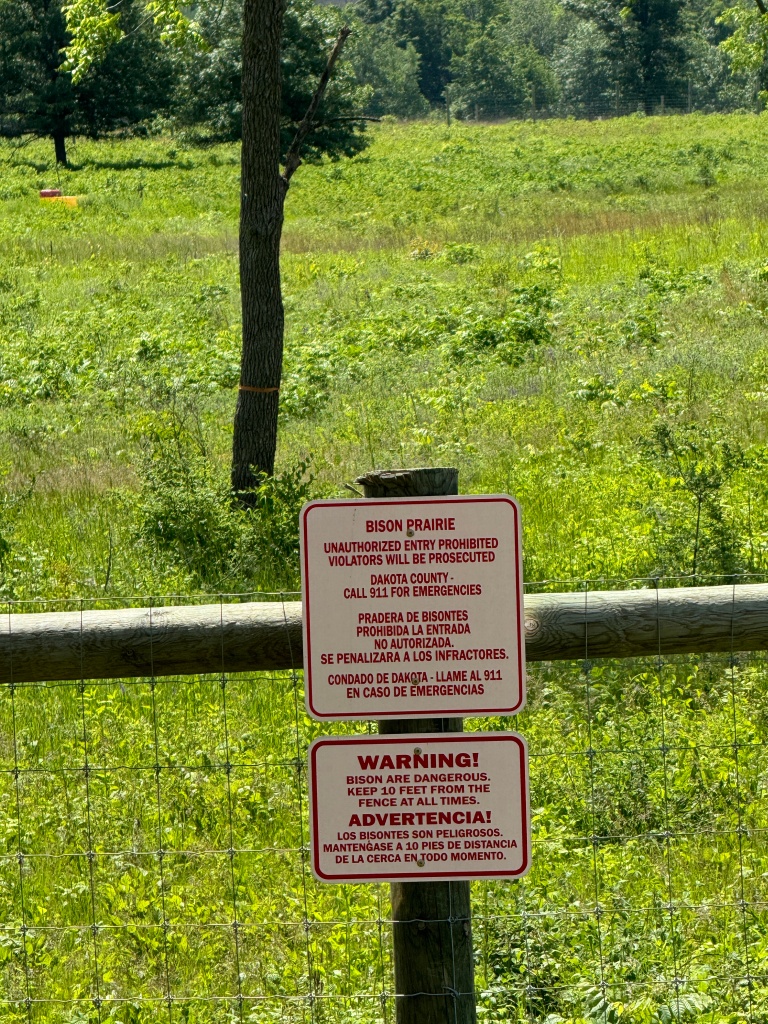
Murphy-Hanrehan Park Reserve offered a lot of birdsong and a lot of wind! We were here on a warm spring day before the trees were fully leafed out.Lake Rebecca Park Reserve smelled wonderful with wild plum trees (I think) in bloom. Not all of the trail was accessible; trail management includes a one-way trail that is designed to reduce erosion and closes when there has been a lot of rain. We’ve had a very rainy spring. Spring Lake Park Reserve is one of our favorite places, offering lots of wildflowers, river views, and bison – but only when the bison feel like being seen. They did not want to be seen when we were there a couple of weeks ago.
Part of what makes these summer days now upon us feel endless is time spent outside, without attention to what the clock says. Whether it’s time spent on my own deck in my own yard or time spent on a trail somewhere, I feel a luxurious slow-down, as if the only thing important in this moment is to observe and absorb the beauty I don’t see when I’m busy. That beauty is there with me or without me; it doesn’t care what else I have to do. It’s on me to slow down, be still, notice.
written on the day of the JDRF One Walk in Minnesota – May 18, 2024
Five thousand people gather in the Minnesota Vikings football training grounds, upbeat music blaring from speakers on either side of an outdoor stage. Juvenile Diabetes Research Foundation (JDRF) volunteers offer water, wristbands, assistance to the families who include someone with type 1 diabetes (T1D), like our daughter Abby. Diagnosed at the age of five, she will turn 30 this year. I can’t believe it.
We’ve done the JDRF One Walk to raise money for diabetes research almost every year since she was seven. The only walks we missed were when she was in high school and her fencing team’s state tournament fell on the same weekend two years in a row. In the early years after Abby’s diagnosis, I felt like a zombie, never sleeping through the night for fear I would miss a low blood sugar. Abby had a way of whimpering in her sleep when she didn’t feel right, so I learned to sleep lightly, waking at the slightest sound of her voice. Her father or I went on every school field trip until she was in sixth grade, always willing to make sure she could do whatever anyone else was doing because we would be there in an emergency. Her insulin pump, acquired when she was 10, made her far more self-sufficient than daily insulin shots taken on a rigid schedule, but we had to talk the school nurse into trusting that she knew how to use it. When she went to college, I still woke in the night, wondering if she was all right, if she was safe, if she was happy.
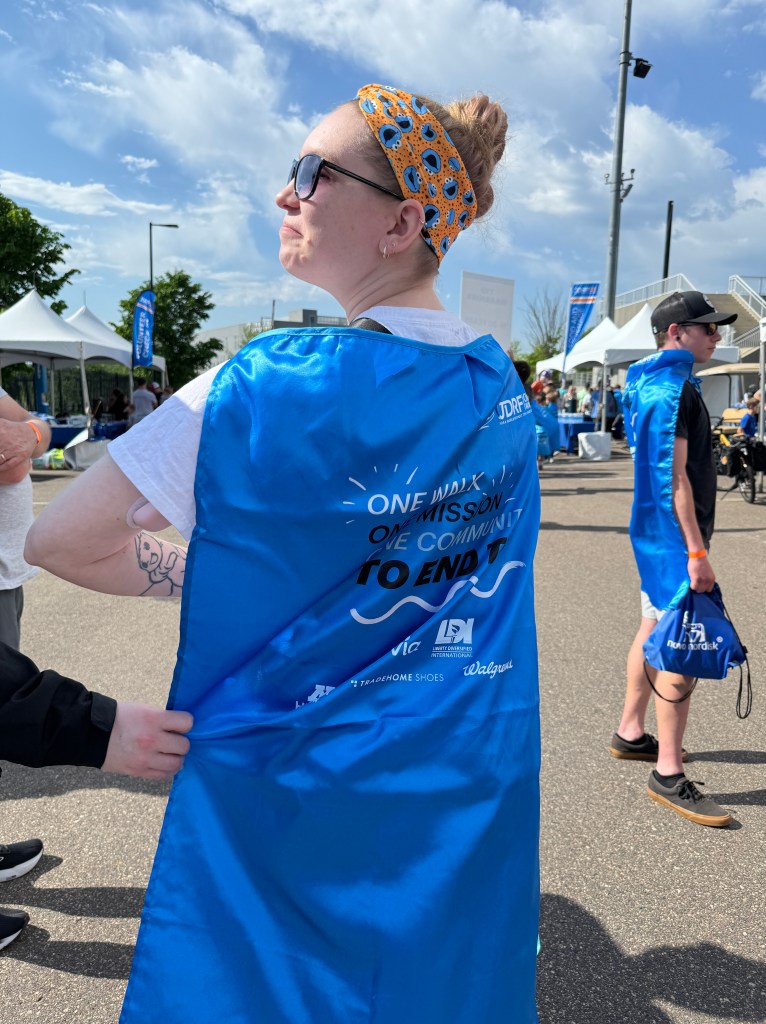
Today, at the 2024 JDRF One Walk, I can’t help but be proud of this warrior daughter who is smart about managing her body, does what she wants in spite of occasional blood sugar drops or spikes, and isn’t letting a chronic condition stop her from pursuing a second bachelor’s degree or applying for promotions at Target where she works in human resources. Seeing her don a blue cape for the “T1D Warriors” who have dealt with type 1 diabetes for more than 20 years puts a lump in my throat.
The walk begins. Drum corps line the sides of the arch under which we pass to start out. Their beat makes us bop as we move along, following the path all the way around the training grounds, through a marshy area with frogs and birds all making noise on this May morning. Little kids stop to reach their hands into the water, sad when the frogs slip away. Lilacs bloom along part of the route, their scent heady. Some people take a shortcut to accommodate elders or little ones in their group. We walk the full 2.3 miles: Abby, myself, my husband, Abby’s partner Jo. When we arrive back at the start line, we are in time to hear the total raised here in Minnesota for diabetes research: nearly a million dollars.
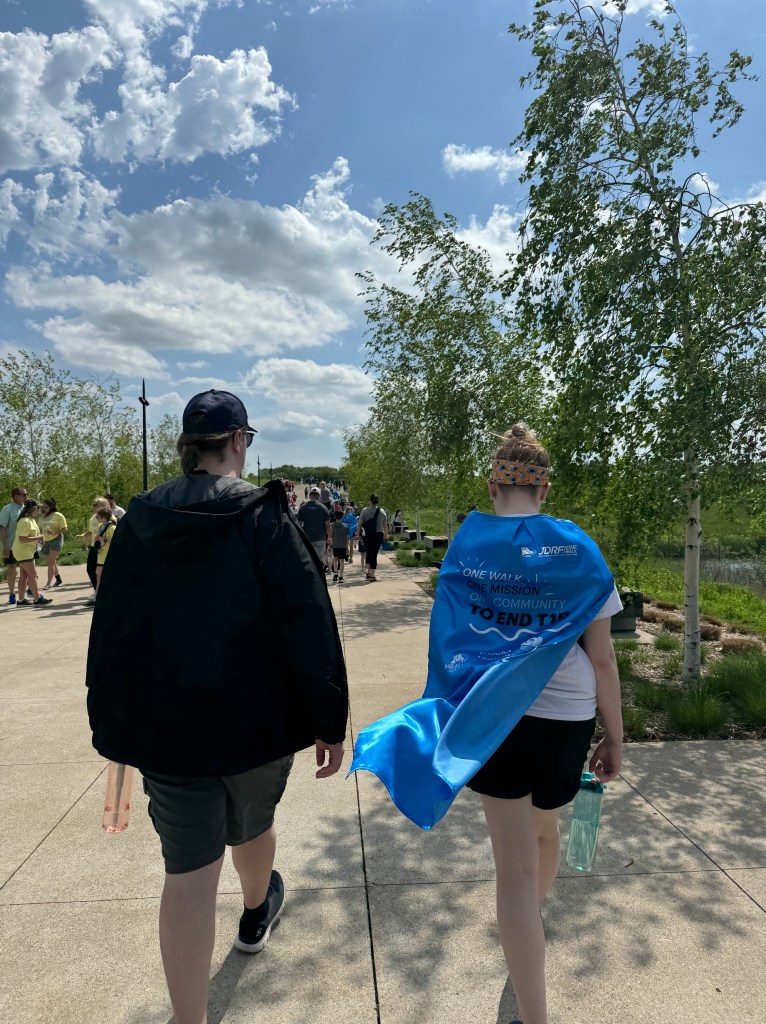
As we walk back to our car, I walk behind Abby and Jo, notice the way they look at each other. We helped Jo understand how to help if Abby had a blood sugar emergency and they’ve risen to the occasion as needed. Jo has been with us since Abby and they were both in high school. It makes my heart happy to know she’s not alone.
As we near our parked car, a red-winged blackbird lights on a pole along the driveway. His brilliant red patch glows in the sun, as if to remind us that bright spots are everywhere, if we just remember to look.
And I do.
T1D Warrior Abby – photo by kcmickelsonAbby & Jo head out – photo by kcmickelson
Know a family struggling with type 1 diabetes? Maybe you, yourself, are struggling? Here are some resources you may find helpful:https://www.jdrf.org/t1d-resources/
UPDATE: JDRF has changed their name as of June 4, 2024. They are now known as Breakthrough T1D. Here is the new link for the updated website: https://www.breakthrought1d.org/
I’ve been enjoying a season of travel these past few months.
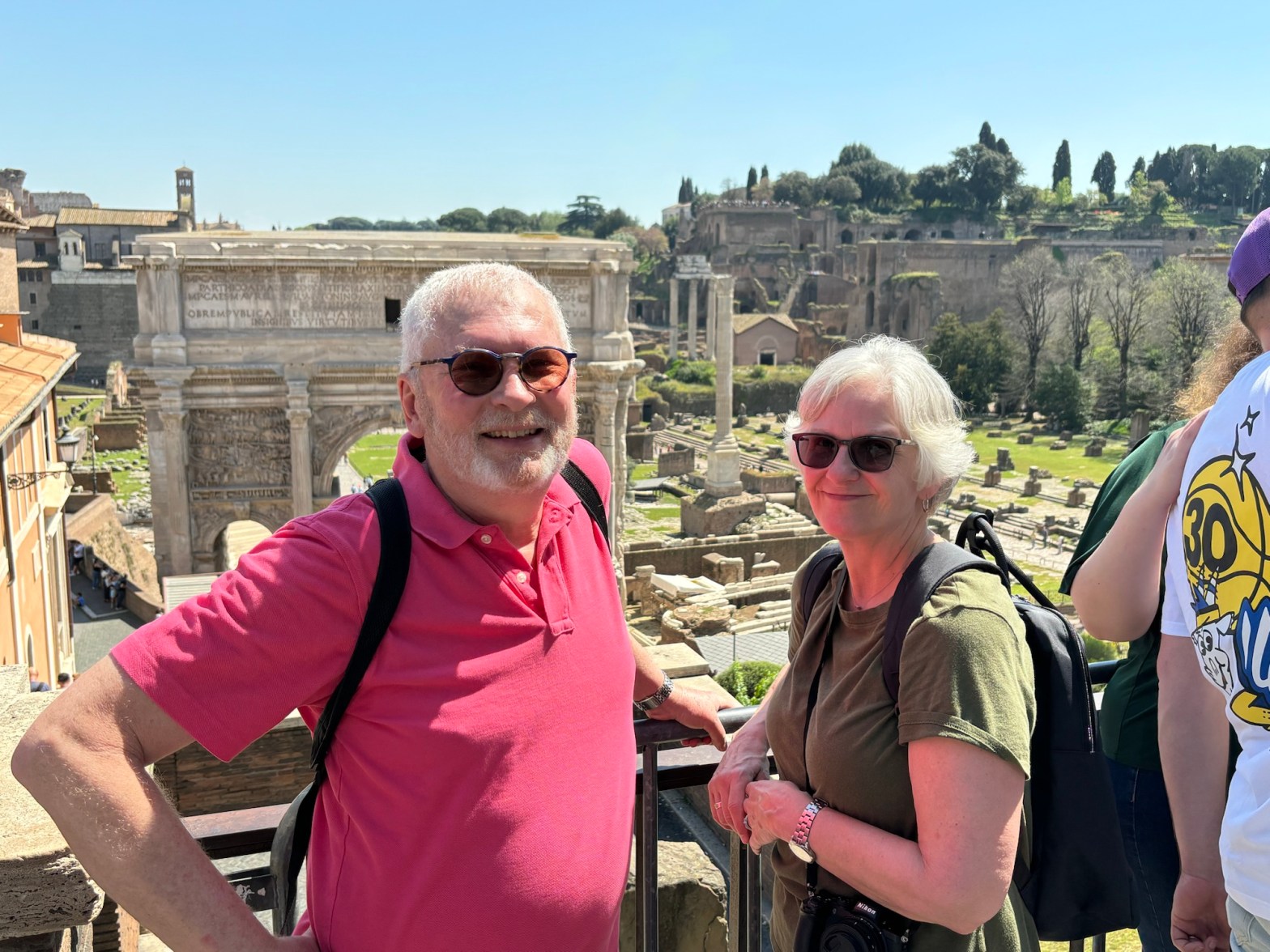
Earlier this spring, my partner Mick, our friends Mark and Mary, and I spent 12 days traveling around Italy. We’ve traveled with Mark and Mary before, renting a car in Dublin and driving into Northern Ireland, then back south to Connemara National Park, Galway, the Cliffs of Moher, and back to Dublin. It all worked out so well, we decided we could do other trips together and still remain friends. Last week, I took a girls’ trip to Asheville, North Carolina, for a few days with my good friend Luann, whom I’ve known for more than 20 years. We, too, have traveled together before, most memorably to New York City where Luann tromped all over Manhattan with me in spite of a torn meniscus in her knee.
This year’s trips have offered what the best travel always does: a shift in my own perspective and some renewed excitement for creative work.
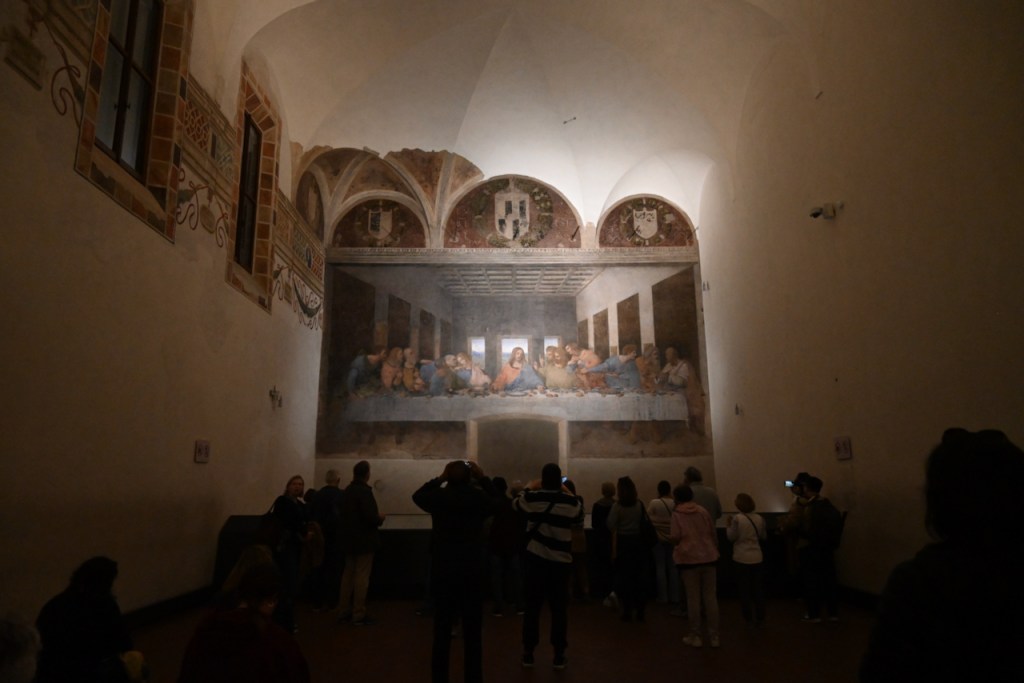
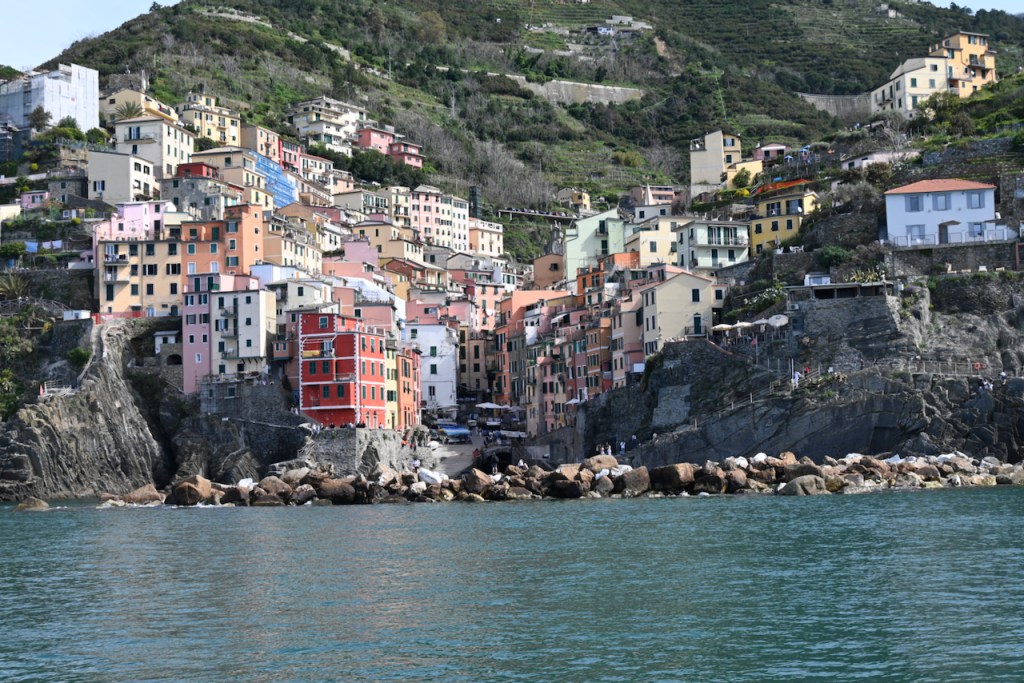
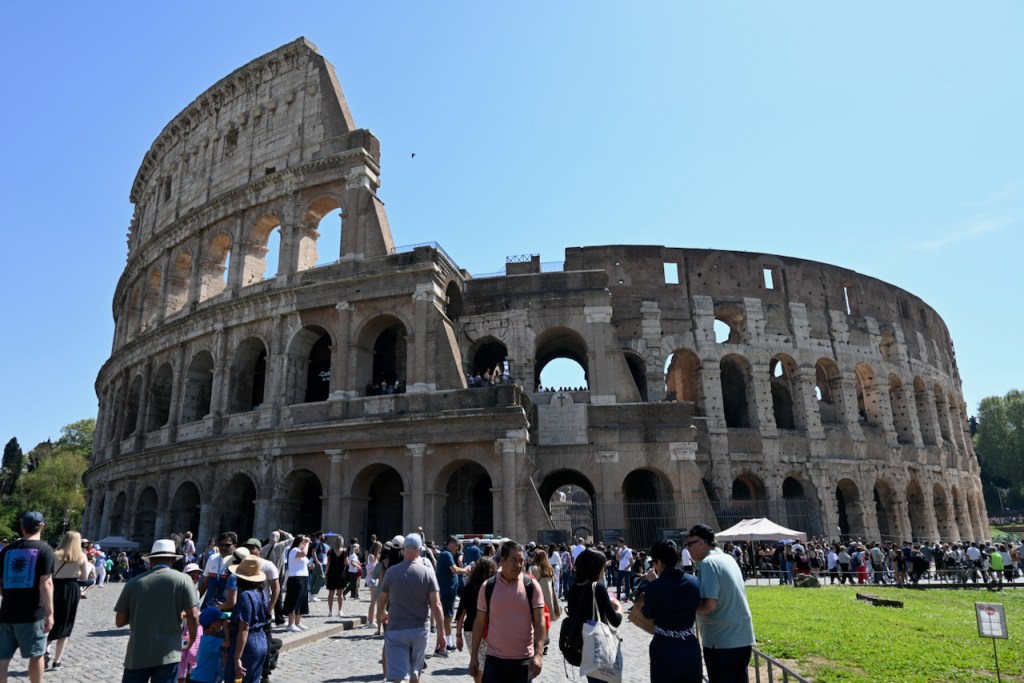
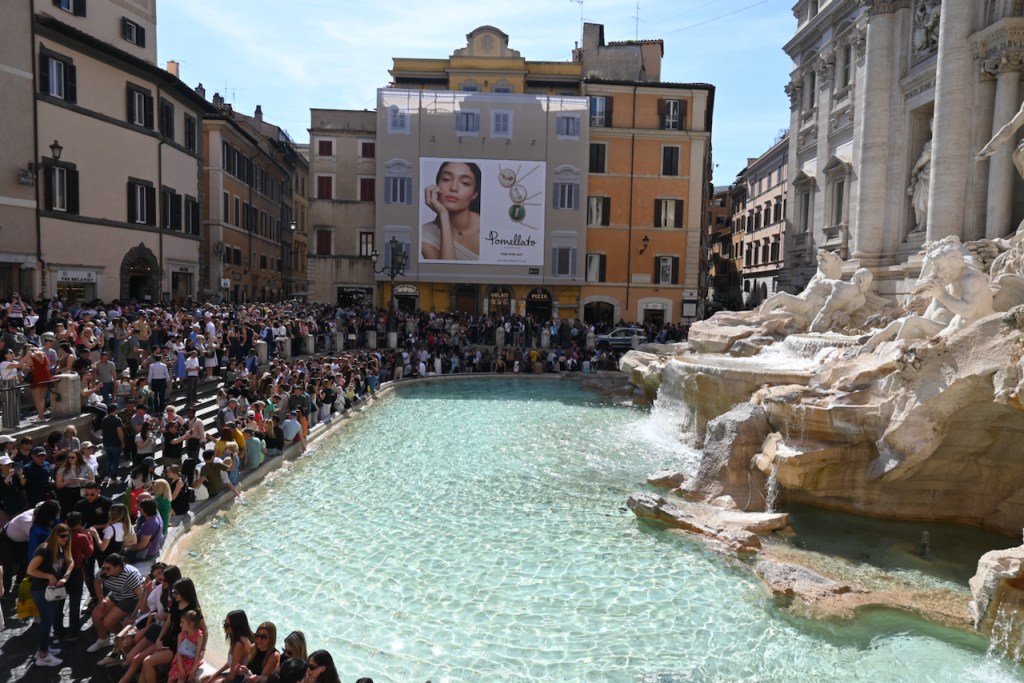
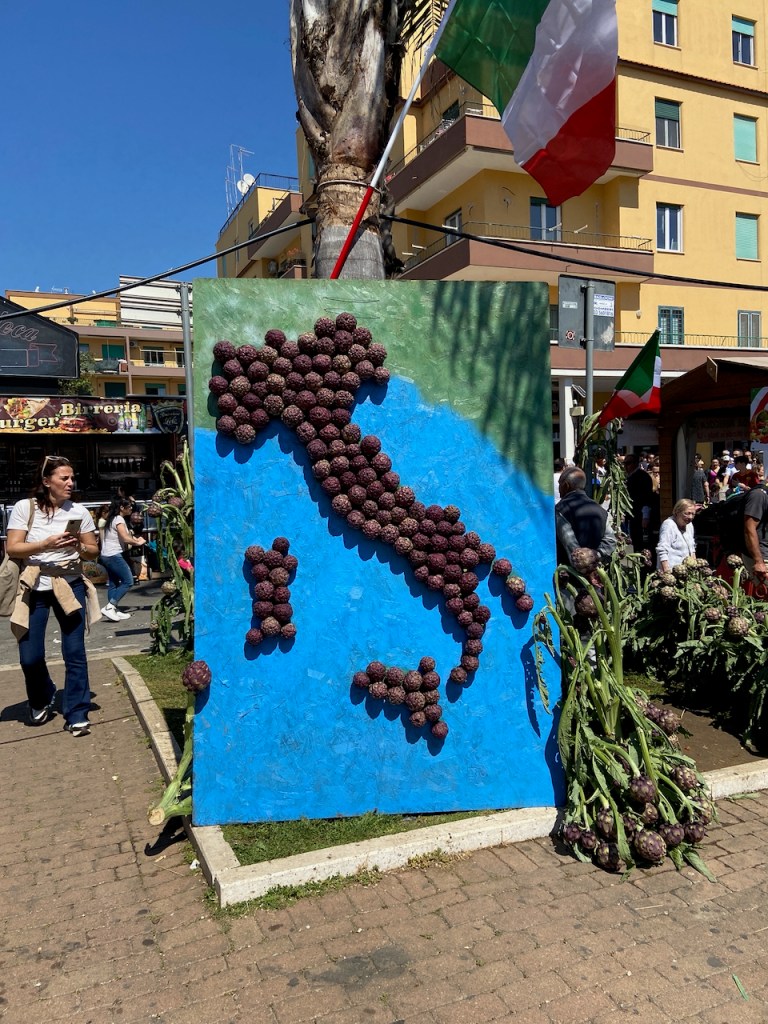
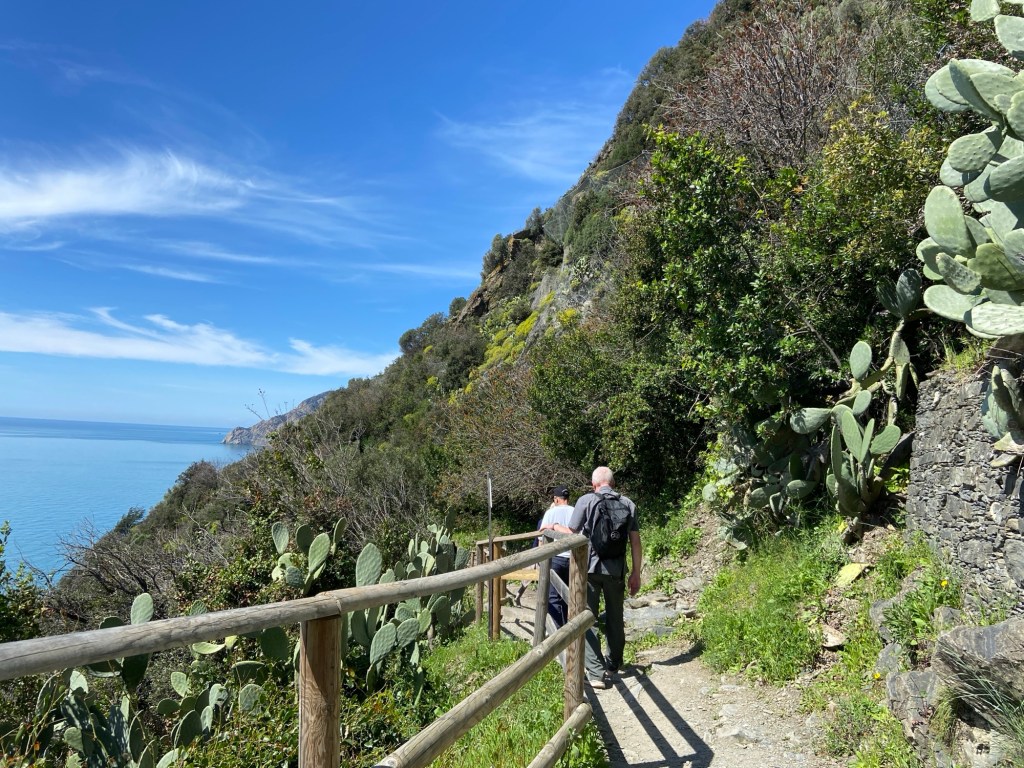
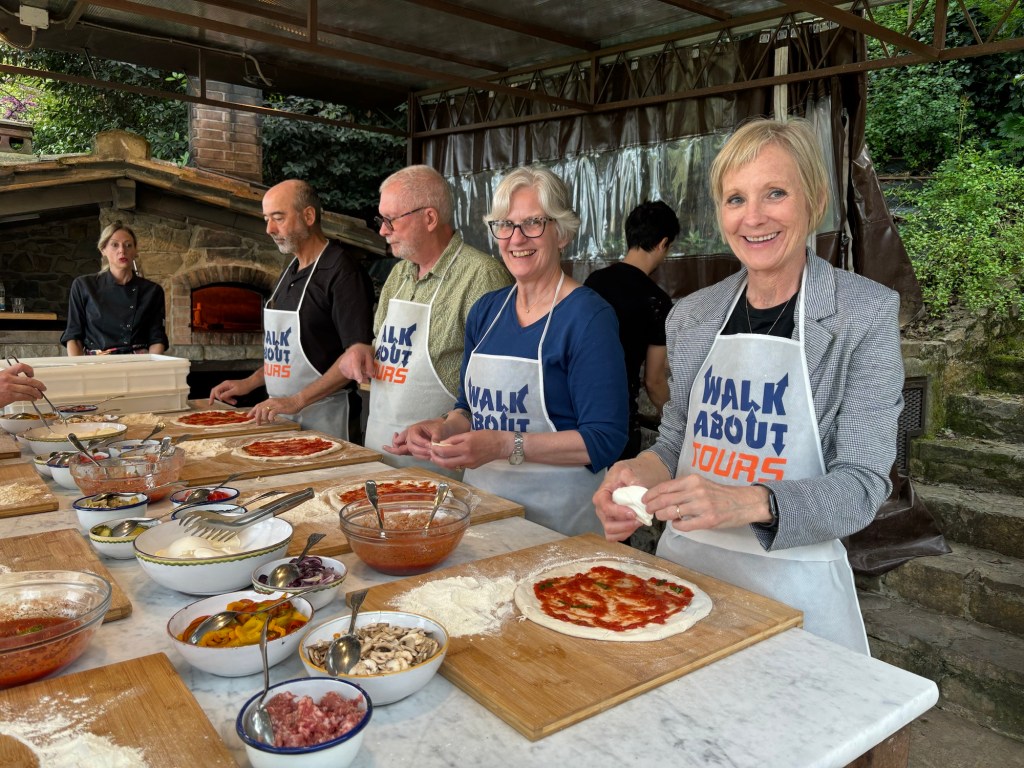
For me, travel isn’t about packing in monuments and museums and other tourist sites on a tight schedule that has me sleeping in a different place every night. Nor is it about doing nothing by a pool, although there have been times when I could see the value in that. I’m somewhere in the middle of those two extremes, with a tilt, at times, toward slow travel. My preferred style is to stay in one or two places for several days and explore on foot. Mick, Mark, Mary, and I chose a few things in Italy that required reservations made before we left the U.S.: a walking tour in Milan that ended with a viewing of The Last Supper, a Tuscan cooking class where we made pizza and gelato, a visit to the Ufizzi Galleries, and a walking tour of Vatican City that included the Sistine Chapel and St. Peter’s Basilica. We knew we wanted to hike in Cinque Terre, but we figured out where to buy passes for the trail when we got there. The trail was harder than we expected, but we went anyway and enjoyed stunning views of the sea and mountains, hillside vineyards, lemon trees, and narrow cobblestoned streets in the towns on both ends of our hike. We knew we wanted to go to restaurants that were away from all the monuments in Rome, so we asked the hotel staff where they went and had some of the best food of our lives (cacio e pepe in my case). We stumbled into an open air market in the middle of Florence and bought gorgeous leather wallets for our family members. Also in Florence, we meandered into an Irish pub and were amused to learn that the owners were two young guys from Florence who spent all of two days in Dublin before they opened their pub; they didn’t go anywhere else in Ireland. We compared that with the Irish pub we went to in Rome which had Irish owners working behind the bar. (And, yes, I’m inclined to visit Irish pubs wherever I find them.) We wandered into an artichoke festival in a small town outside of Rome for our very last day in Italy after deciding we’d had enough of crowds around ancient sites; one of our hotel staff lived in that town and told us we could sit by the sea there. And we did sit by the sea, but discovered there were places there that did not want us in their bars (no English, no tables in two places with plenty of tables available). We did not argue; we moved on.
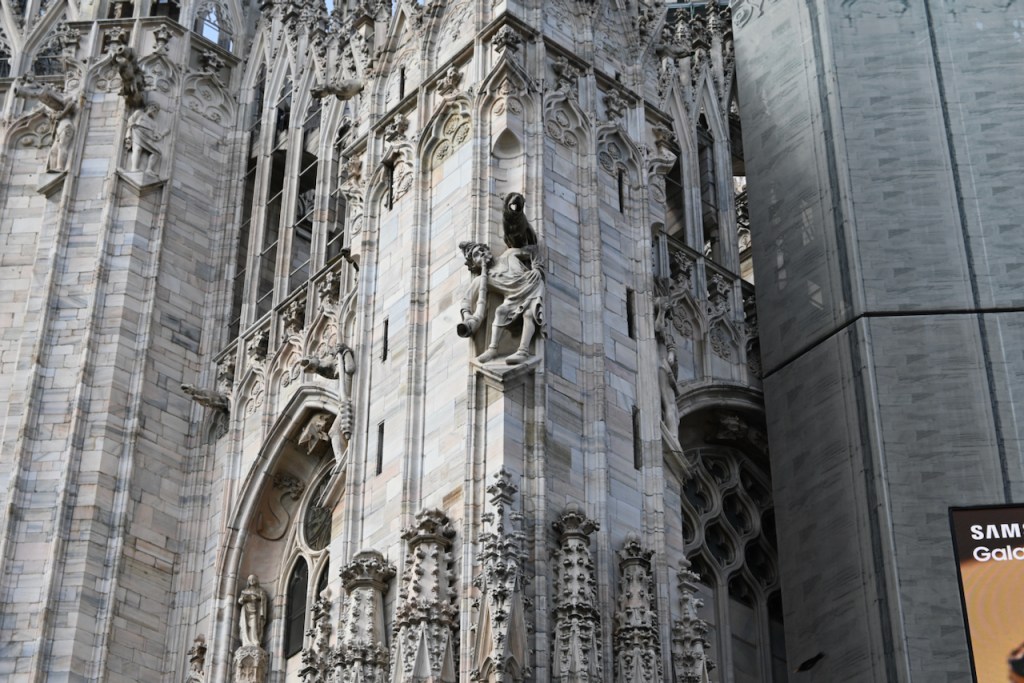
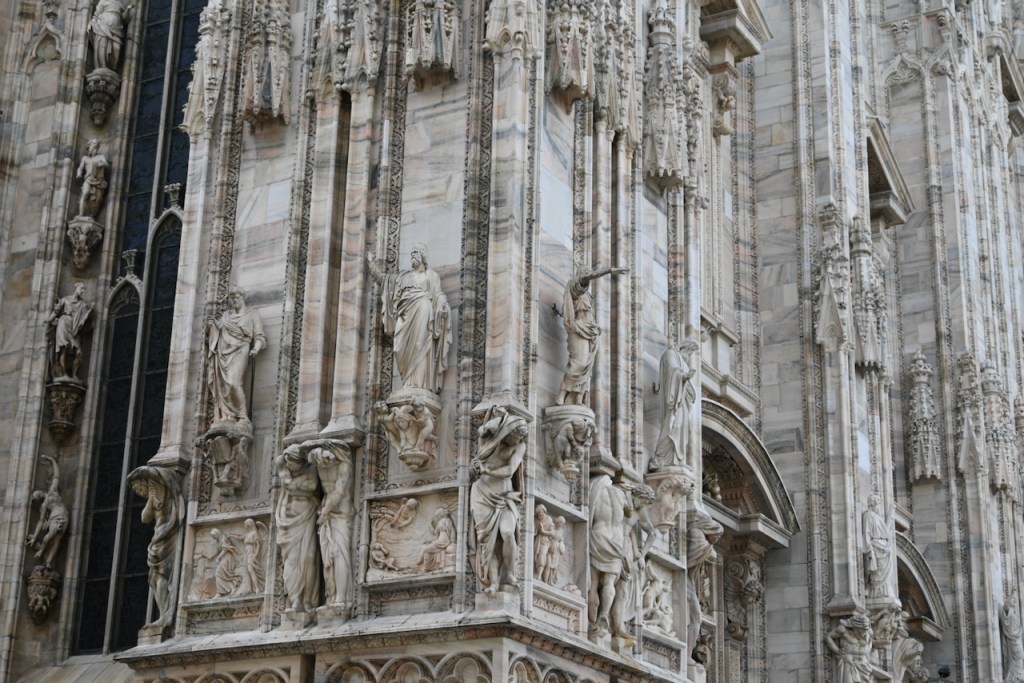
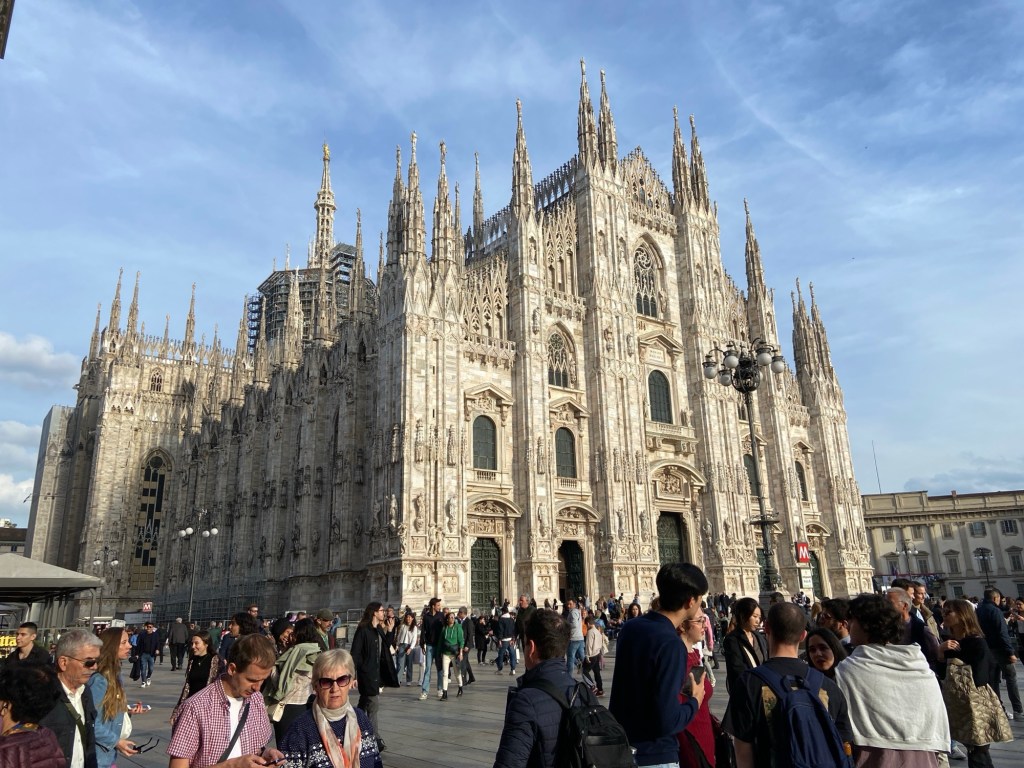
detail from Milan Cathedraldetail from Milan CathedralThe Last Suppermap for hiking in Cinque Terreworn stones that made up the hiking trailtrail buddyview of the sea from the hiking trailapproaching the town of Riomaggiore by ferryour AirBnB in Florenceview of Tuscany from the estate where we had our cooking classthe Colosseumcrowds around Trevi FountainItaly created with artichokesmy favorite artichoke art from the Ladispoli Artichoke Festival
I went to Italy knowing very little Italian, grateful and amazed at the number of people with whom I could communicate anyway. Menus usually offered items in English alongside Italian. Hotel and museum staff all spoke English; we found walking tours in English. And I made an effort, learning Italian words for please, thank you, and some foods. I was reminded over and over how many people in other countries easily flip between their native tongue and someone else’s. That makes me want to be better about knowing at least a scrap of the native language when I travel to another country. And it reminds me just how hard it must be for people coming here with very little English in their command.
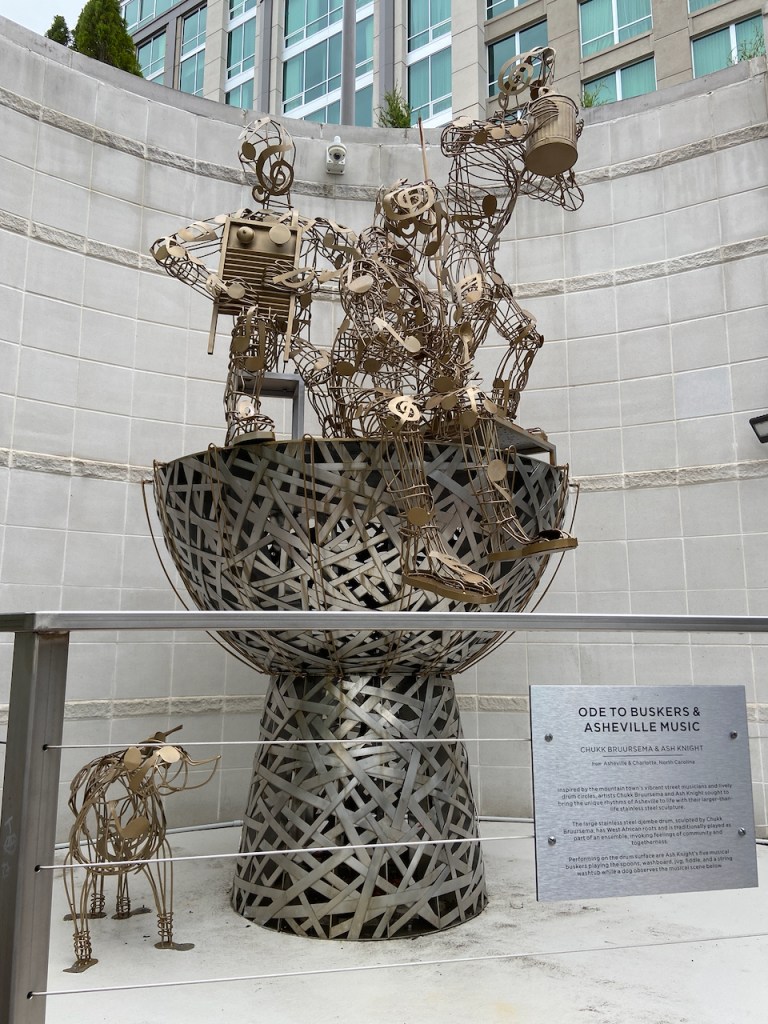
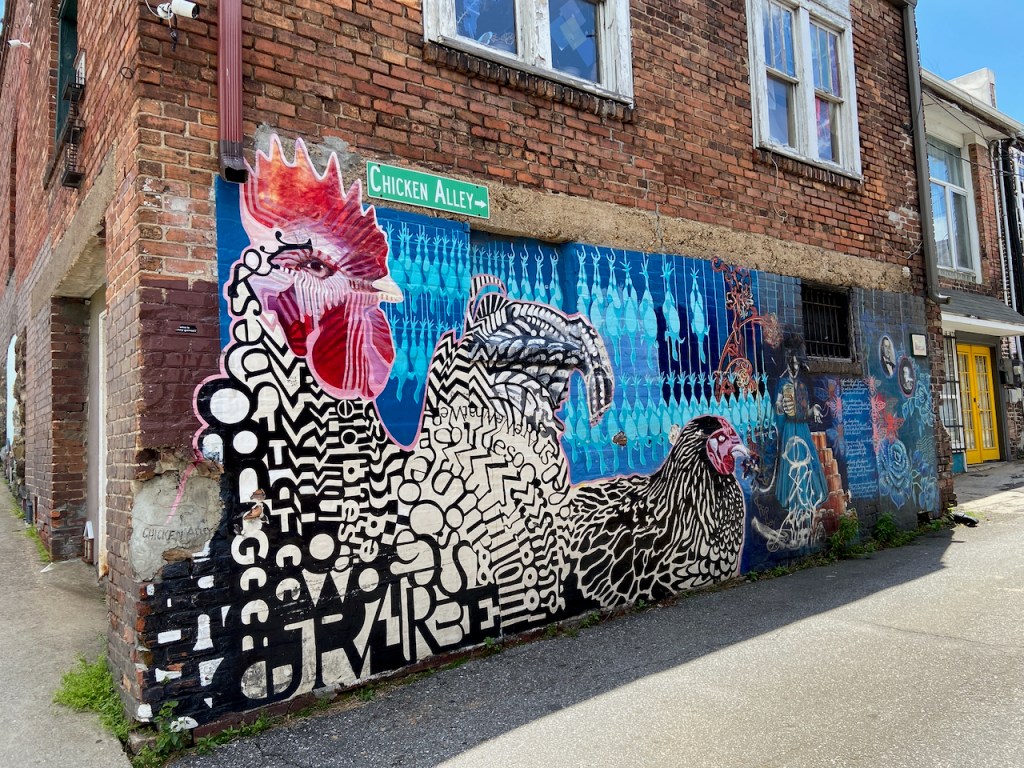
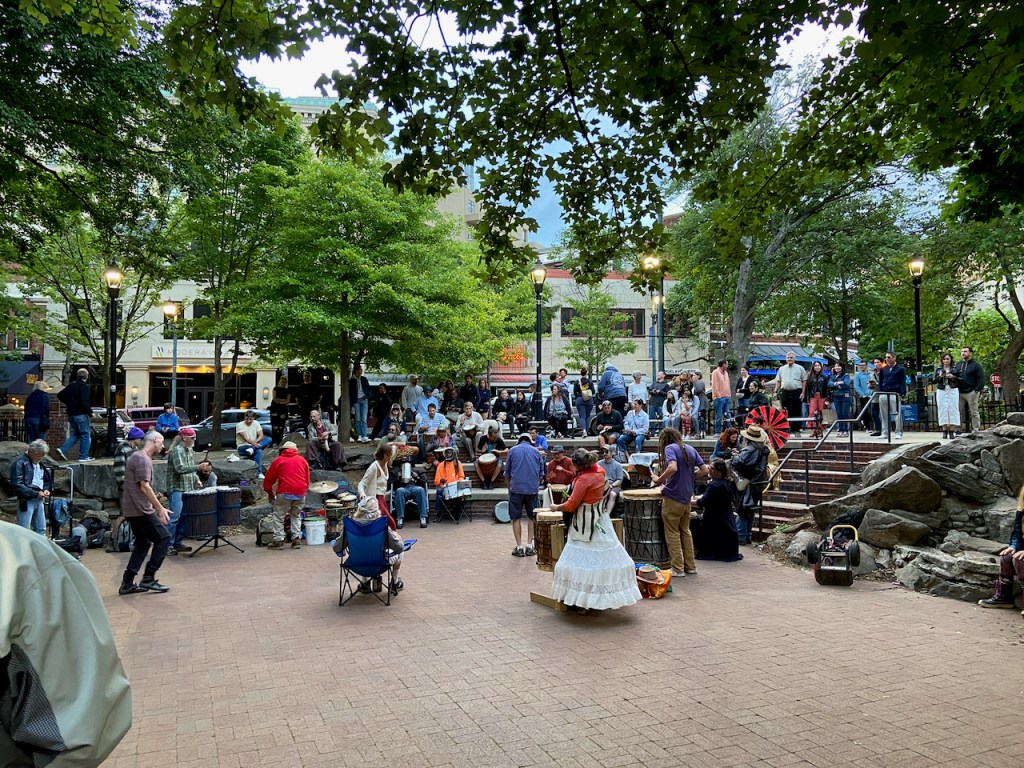
Travel to Asheville was so easy after being in Italy – only two hours on a plane instead of more than eight, and signs we could read without a translation app. Luann and I stayed at the Aloft Hotel downtown (I highly recommend it), walked everywhere. Walking everywhere while traveling in European cities is usually easy, but that isn’t always the case for U.S. cities; I live in a notoriously unwalkable area with mediocre public transportation. Asheville was a nice contrast. And, after being overwhelmed in Italy by the magnificent art produced by long-dead artists, I was delighted to visit artists working in their studios in warehouses along the river in Asheville. Chatting with artists always makes me think about expanding what I do – writing, painting, photography or a mish-mash of all three. Asheville also has a fantastic selection of tap rooms, only three of which we managed to go to. And one of my favorite things of all was stumbling upon the Asheville Drum Circle in Pritchard Park when we were on our way to dinner at Tupelo Honey on our last night in Asheville. It wasn’t until I looked it up later that I learned this drum circle has been drumming on Friday nights since 2001 and everyone is welcome. The sound was mesmerizing and primal, and I absolutely loved it.
Ode to Buskers in Asheville, NCChicken AlleyWhat greeted us just inside the door of Dssolvr Craft BreweryAsheville Drumming Circle
Now I’m back home daydreaming about future travel and art projects. I’m taking stock of the art materials already in my house, just waiting for me to do something with them. And I’m thinking about how important it is to get out of my own backyard, talk to someone I’ve not met before, say yes to eating something I can’t identify, and walk down streets without knowing what’s on the other end.
There’s comfort in familiarity, but there are sparks of delight waiting around unfamiliar corners. If it turns a little awkward (no English, no tables), just go in a different direction.
Getting on the plane in Rome
All photos by kcmickelson 2024 except “getting on the plane in Rome”, which is courtesy of Mary Rutherford.
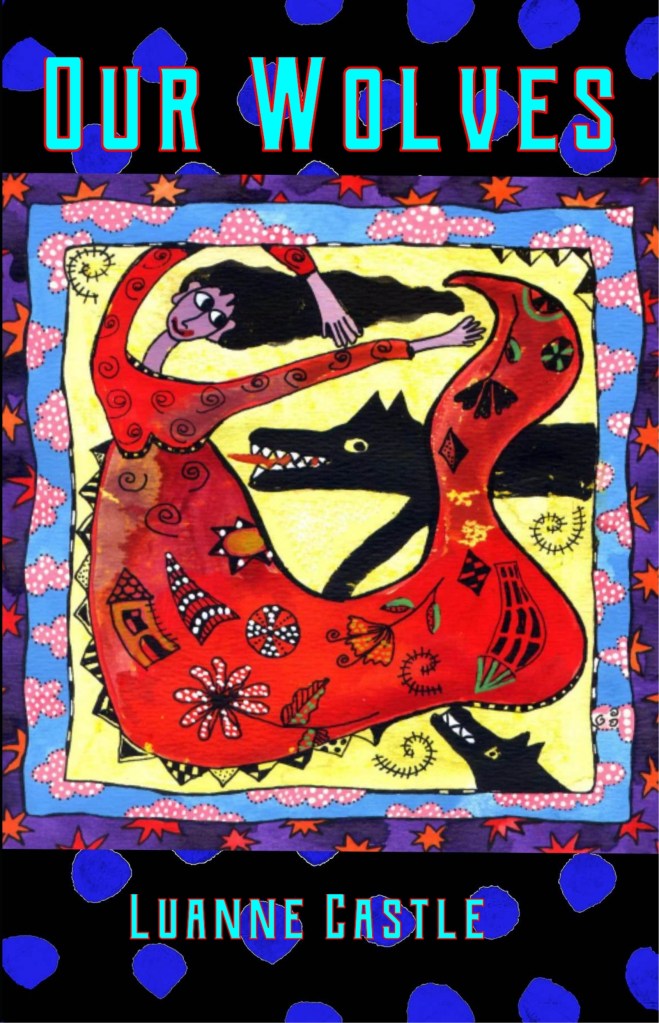
Today, I have the privilege of sharing a conversation with poet Luanne Castle, in which we discuss poetry, creative process, and her second chapbook Our Wolves (Alien Buddha, 2023).
OMC: Hello, Luanne, and thank you for sharing a copy of Our Wolves with me, as well as having this conversation about your work. The variations on the story of Red Riding Hood made for interesting reading and sent me researching the oldest versions of that story (Little Red Riding Hood by Charles Perrault, 1697; Little Red Cap by the Brothers Grimm, 1812). This chapbook feels like it came out at just the right time for women who are disappointed that we’re still fighting the same old sexism in 2024. It’s loaded with malleable metaphors that suit this time quite well.
Your Sonnet
People always tell me don’t talk to strangers
as if I am my big red mistake. Remember how I
made caramel brownies and helped eat them
when the jerk dumped you? And, you, I rode
the bronco when you wanted the mild mare
although in truth I was more scared than you.
All of you, am I the only one who felt pity
for a wolf on crutches in the middle of nowhere?
My mother taught me to be kind, to be helpful,
not to ignore the slow or less than able, the ones
who are different, the needy, so I asked what
he needed from me and he misunderstood.
My story is not so very different from yours
and yours and yours and yours and yours.
(p. 31, Our Wolves)
I know from listening to one of your interviews – I think it was on Tea, Toast, & Trivia – that Our Wolves began with some poems that didn’t make it into your 2022 book, Rooted and Winged. What was it about the Red Riding Hood tale that really hooked you, the piece that you eventually wanted to turn over and over in this chapbook?
LC: When I was very young, my mother bought me a Golden Book version of Red Riding Hood. This now vintage version is available for $150 online, but in those days, a Little Golden Book cost twenty-nine cents at the grocery store. I used to beg my mother to buy me one when we were shopping. Every night I asked to be read the story. The illustrations of an old-fashioned peasant girl charmed me, and the story of a little girl being given independence and responsibility in a dangerous world fascinated me. Even Red’s basket containing goodies fed my imagination. I used to have a recurrent dream based upon that basket. Also, the darker aspects of the story reminded me of the dangers even in my own home where I was frequently afraid of my father who had anger issues.
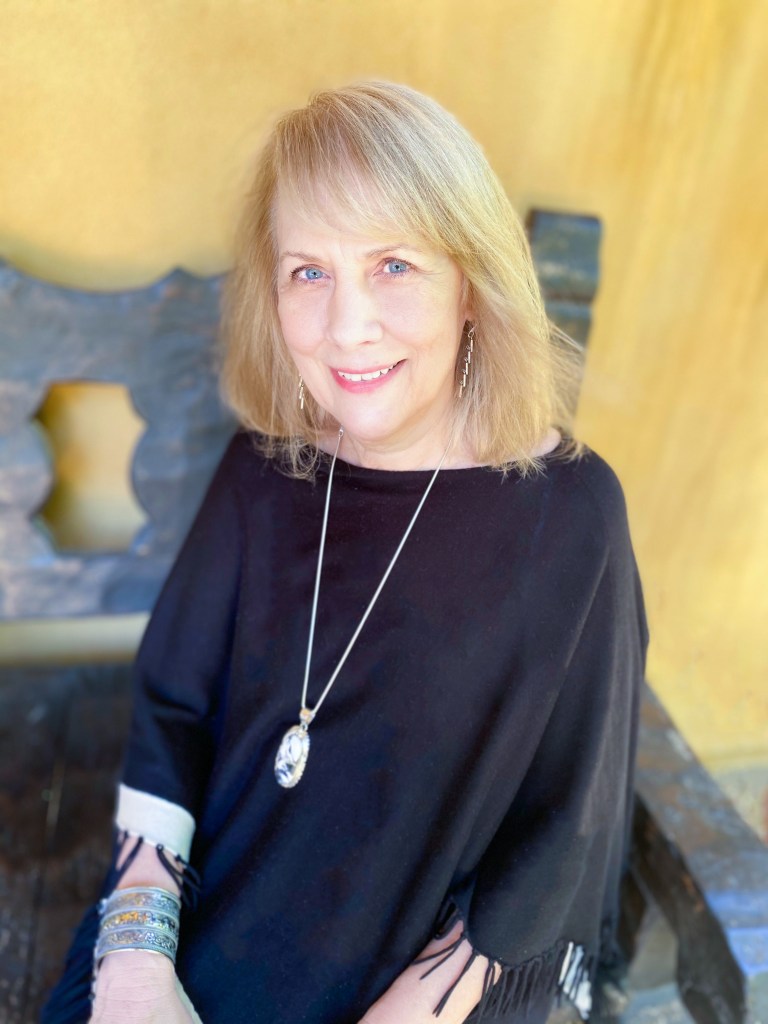
Luanne Castle (photo provided)
OMC: Growing up with a father who has anger issues shows in the poems you’ve created. I’m thinking of your poem, “How to Digest the Wolf”, where you have a line about taking the belt without crying. Also, the poem, “From the kitchen, you enter,” which has a line about how fast a father’s joy dissolves into anger and what happens next. These poems, in particular, speak to anyone who has had a parent with anger issues. What do you hope readers take away from Our Wolves? And have you heard any reactions that surprised you?
LC: I would love for readers to find or renew a love for folk and fairy tales because they are the building blocks of stories and stories are the way humans make sense of the world around them. I hope that the poems show a variety of ways of looking at one well-known story so that readers see how rich any one story can be. In fact, I could keep writing Red stories and poems. One surprising, but humorous, reaction from readers was a complaint that the book was too short. Our Wolves is a chapbook, not a full-length collection, and that decision was purposeful. I decided on a chapbook not because I couldn’t write more on the topic, but because I didn’t want to overwhelm the reader with Red poems. Rather, I’d like to leave them craving more.
OMC: I agree with not overwhelming readers. Your chapbook covers a lot of emotional ground. Do you have a favorite piece from Our Wolves? And why that particular poem? Or, maybe, another question would be whether you have a favorite point of view that popped up in Our Wolves?
LC: I had so much fun writing these poems and inhabiting different POVs that it’s hard to choose. I love to read “You All Been Waiting for a Wolf Confession” aloud because the wolf is such a character. I love writing “voices.” “How to Digest the Wolf” is a very serious memoir poem. “How to Make a Hand Shadow Wolf” is the last poem in the collection because it allows Red and readers to become wolves. By becoming wolves, we no longer have to fear “our wolves.”
How to Make a Hand Shadow Wolf
Start in your own room. Shut the door. If you can, lock it or else barricade with the hope chest and all your dolls. Prop a flashlight on the bedding, pointed at the gray fan-pattern plaster, and make a light-circle on the wall. Find your shadow. Try to keep track. Close four fingers with the thumb up. Curl in your index finger. There, your own shadow is a basic wolf. Add a thumb and wiggle the ears. Watch now. Your pinky finger is the mouth, open and close it. See, no teeth. Can you make an open eye by tweaking that one finger? Close it now. You’re in charge. Tip your hand, open the mouth, and howl at the moon, all aquiver.
(p. 36, Our Wolves)
OMC: I understand that fairy tales and Little Golden Books were an important part of your childhood reading experience. Do you still maintain a collection of childhood books to serve as references when you’re working on poetry that harkens back to those tales? And which are your favorites?
LC: Funny you should ask that question. I used to teach college-level children’s literature to education students. During that time, I added to my collection of books from my own childhood, which included books that belonged to my great-grandfather, grandmother, and mother, with many books, particularly Caldecott and Newbery winners and honor books. I have been keeping my collection, waiting for grandchildren. My first grandchild was just born in January, and I can’t wait to share the books with him.
OMC: Which poets do you love to read right now? Who resonates with you?
LC: Ugh, I have so many poets whose work I love. Diane Seuss is the queen. I’m reading her new book Modern Poetry right now. Joy Harjo. Victoria Chang. Carmen Giménez Smith. I could go on and on. And I have to mention that I still reread Sylvia Plath and Audre Lorde as they are two of my long-time favorites.
OMC: You also write flash fiction. There are similarities in flash pieces and poetry as far as word choice and rhythm. For you, what determines whether an idea moves into the flash fiction or poetic form?
LC: For me, a sense of story is important to flash, whereas a poem does not need story to support itself. But truly, it’s more what mood I am in. Do I feel like writing a poem or a flash story today?
OMC: What subject would you like to see poets take on more often?
LC: Menstruation. I recently published a period flash in a local zine and a few years ago published a period short story, “The Secret Kotex Club,” in Longridge Review which was nominated for a Pushcart. Note that these are both stories, not poems. I realize there are probably some beautiful menstruation poems out there, but I read a lot of poetry collections and poems in journals and don’t see many period poems. Another subject I’d like to read is this grandma business—about taking care of a grandchild on a regular basis.
OMC: Those are excellent choices for poetic subjects! Yes! There is a lot of power both in menstrual cycles and menopause – as in grandmothers. I take care of my youngest granddaughter a couple of days a week, and my own poems that come from that are usually focused on trying to look at things through a child’s eyes again rather than thinking about the grandmother wisdom I might contain. Do you have a new project in the works? Can you talk a little about what’s next?
LC: I haven’t begun to pull anything together, although I have published probably a dozen flash stories based on the paintings of Remedios Varo. Whether I end up trying to pull them into a collection or move in another direction, I don’t yet know!
OMC: I look forward to learning more about that in the future. And, I suspect, you’ll be writing your own grandmother poems and stories.
Thank you so much for taking the time to discuss your work with me. Do you have any parting shout-outs you’d like to share?
LC: The online poetry community has been such a blessing to me. There are so many wonderful poets writing today and unlike when I started out so much of it is available online without a library or paywall. When I was working on my MFA, I couldn’t afford to purchase literary journals and had to go to the library in person to read them. Many couldn’t even be checked out. I am so grateful to my readers who have stuck with me through all my books. They are in my heart.
OMC: This was a pleasure.
Below are links to more information about Luanne Castle and her work.
I’ve been traveling in Italy with my partner Mick and friends Mary and Mark since April 3. We started in Milan, then went on to Monterosso, Florence, Rome. We hiked, did walking tours, tried new foods and wines, took a cooking class, went to an artichoke festival, rode trains, took a ferry. It’s been a whirlwind.
I’ll write more later, but here’s a taste.
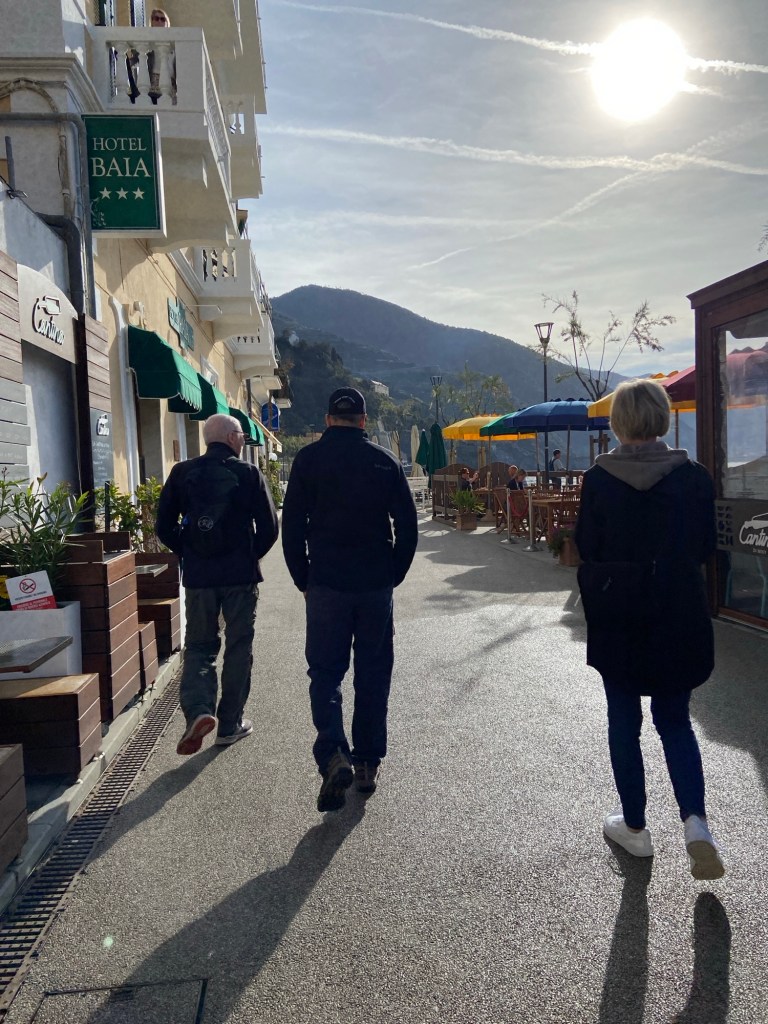
Our first view of the Milan CathedralFirst evening in Monterossohiking in Cinque TerreOur cooking class in FlorenceFriday morning tour in Vatican cityFriday night in Rome
I have many many photos on my Nikon to upload, so stay tuned.
If you’re interested in hearing various poets read their work from the comfort of your own chair, check out Gyroscope Review’s annual line-up of daily poets’ offerings. They’ll feature a different poet every day during the month of April.
On May 1, I’ll be featuring Luanne Castle in my next conversation with a poet. We’ll discuss her chapbook, Our Wolves, and poetry in general.
In other news, I’m traveling this month, so my next post will be from the road.
I’m writing this over a couple of unexpected free days while my granddaughter, Maeve, stays home with a nasty cold instead of her usual Monday and Tuesday with my partner Mick and me. I am grateful she wasn’t here when the garage door broke Monday, forcing us to call someone to repair it as soon as possible. We were going to run to Target before Mick’s softball game for a brace for his injured thumb (a hiking mishap), but a spring broke, rendering the garage door opener useless. The two-car-wide door is too heavy for us to open manually. So, I wrapped Mick’s thumb instead, he called a teammate for a ride to the softball game, and I stayed home to wait for the repair technician. While I waited, I did research for an upcoming One Minnesota Crone post.
It wasn’t long before a guy named AJ rode up our driveway in his white truck with assorted ladders and garage door parts in the back. He replaced the springs as well as the rusty cable that was only a thin strand away from snapping. Now the door works beautifully.
If only we could fix bigger things so easily. Things like minds slammed shut to new ideas, scientific evidence, and thoughtful discourse.
Last week, I didn’t watch all of the State of the Union address. It wasn’t a matter of disinterest as much as whether I could stand to watch the combative behaviors on full display by our elected representatives. I did watch the last 15 minutes or so, relieved to hear President Biden deliver a fiery and coherent address. Then my relief turned to dismay as Alabama Senator Katie Britt gave her weird, creepy Republican response from the damn kitchen. Why, oh why, would a professional woman agree to such a setting for a speech of this importance? And why would she use a baby voice, enunciating every word like she was in high school drama class, to talk to grown-ups? Never mind that the response also lacked factual substance. I felt, for a few minutes, like the slide of our country into a heap of smoldering wreckage is inevitable, with these divided sides that will not work together even when it’s in their best interests to do so. The opposing views of how this country could and should function share almost no common ground, both sides vilifying the other, civil rights sliding backwards for women, LGBTQ+, and others who are not old white men or their complicit wives. Education goes undervalued. Critical thinking does not happen.
What does happen? Knee-jerk reactions. Fear-based gossip. Immigrant stories told without all the supporting facts. Potential solutions shut down before they can be tested. Minds closed. Guns drawn.
And elected officials more concerned with re-election than doing the right thing.
I cannot and will not let that be where my mind stops.
There’s something about pouring paint, tilting a surface to make the colors run off the edge, swiping a silicon wedge across that same surface, then running a kitchen torch over everything to pop air bubbles that soothes me. The tactile-ness of it. The quiet of it. The elementary activity, using colors that match my mood or reflect what’s happening outside. This is where I go when I’m not writing, when I need another creative outlet, when my thoughts will not be still.
I can’t paint when Maeve is here. She is two-and-a-half; wet paint is a magnet for her little fingers. I save the kid watercolors for her, nontoxic paints that I can wash off her hands. My hands are encased in nitrile gloves, damp shop towels at the ready, an old apron over my clothes.
This week, the colors I use are mostly blues: phthalo blue, cerulean blue, light blue. I decide to toss in some silver. I like hints of shimmer. Titanium white for the base color.
My mind wanders as I mix the paints with Floetrol. When did Democrats become associated with blue? When I Google it later, I learn that the New York Times used blue for Democrats and yellow for Republicans in a special color map way back in 1908 to show the details of Teddy Roosevelt’s election, but red states and blue states weren’t a thing until 2000. I think red, the color of anger, is the better choice for Republicans.
But I’m not here to focus on anger.
Opening a closed mind is a lot harder than opening a broken garage door. At least with a garage door, the broken spring is unmistakable. The rusty cable is right there in front of you. You remove the broken bits, replace them, re-engage the opener, and voila. You can open the door, take the car out, get to Target or softball or the next volunteer gig. You can go to work, to school, to the doctor’s office – all with your own vehicle that you’ve been lucky enough to park in a garage.
Lucky. That’s the part we forget about a lot. If I were someone fleeing a war zone, a drug cartel, or climate change that rendered my land unusable, a garage door is not something I’d be worried about. It would be down to basics: food, shelter, safety. Closer to home, if I were trying to get away from an abusive relationship, I’d be worried about the same things. I’d be pretty pissed off, panicky, and sad if there was nowhere to go, if no one would give me or my family a chance to live.
What someone is worried about or running from is not always visible. We can’t always see when someone’s luck has run out, especially when we’re not even aware of our own extremely good fortune.
I think a lot about how mean everything feels right now. How many people are upset over immigration policies and health care and school curriculums and support for Israel vs. support for Palestinians. How Russia’s unending assault on Ukraine has become a hum in the background.
Four years ago this week, things shut down because of COVID. For a brief time, we seemed to be united in trying to do something right, something good. Most people tried to be careful, respectful, sympathetic to those who lost family members and friends to COVID. Then some started chafing beneath COVID restrictions, George Floyd was murdered, Trump tried to overturn an election, anti-vaxxers raised hell. Compassion dwindled in supply.
We’ve never recovered.
I’ve thought and thought and thought. How do we move forward from such a fractured place? I said earlier that I wouldn’t let my mind stop at the reactionary view offered in Katie Britt’s post-State-of-the-Union address. And I mean that, but, damn, it’s hard to get past it. Every day, I can’t resist the pull of the news, absorb story after story that involves violence, misinformation, selfishness, more reactionary talk. Sometimes, it’s overwhelming and I take a break for a day. But then I’m right back at it, convinced that it’s better to know what’s happening than not.
There need to be more stories of compassion. Less lashing out in anger. More listening. More of that thing we learned in elementary school about putting yourself in someone else’s shoes. I said earlier that there is almost no common ground between the two political sides. Not none. Humans all want to be happy and safe.
Life Stuff: Poems by Rose Mary Boehm, Kelsay Books, 2023. Paperback, 156 pages. $23
Life Stuff is a collection of poems that examines events from poet Rose Mary Boehm’s entire life – her childhood in WWII Germany, parenting her children in London, surviving an operation for a brain tumor while living in Madrid, making a life with her second husband in Peru. Everything is up for consideration as if Boehm is getting her life in order. After all, her author’s note tells readers, “I have reached the last installment of my life…….memories and musings…”stuff that comes to mind” when you start thinking too much.”
The very first poem in the book supports that idea of things coming to a finish before the work takes off to encompass a lifetime.
EMBERS
I live in the embers of fires that once were fierce. White, gold, red, amber conflagration.
Youth. Needs must. No prisoners. No forethought. No consequences considered, torching what came near enough, and the iceman a chimera whispered about by shivering old women
no longer strong enough to hold the flames. I have felt his breath in the shadows. Last night he held my hand, sightless, unforgiving.
For those of you who don’t know Rose Mary Boehm’s work, she has published eight poetry collections, two novels, and been nominated for Pushcart and Best of the Net prizes. It’s worth noting that all this work is in English, which is not Boehm’s first language. But it is the language she adopted quite some time ago as a young woman raising her children in London, and the one she continues to ply as she examines life’s wonders and intensities.
I first became aware of Rose Mary Boehm this past December when I read work as part of a Kelsay Books publication event for several of their authors. She contacted me in January after reading my conversation with Laurie Kuntz here on One Minnesota Crone; another poet conversation was clearly in order. Here it is.
OMC: Hello, Rose, and thank you for taking the time to have a conversation about your work. Life Stuff is quite an expansive collection of poetry. I was particularly engrossed in the poems about your childhood in Germany. Seeing this historical period through the child’s lens is interesting because children tend to offer up the wonders right in front of them, not understanding what they don’t have, even as their brother offers them a teddy bear while waiting in the bomb shelter. It’s the child’s day-to-day life that is foremost, the warm eggs stolen from the neighbor’s hen house, the candles for the Advent wreath, the matter-of-fact-ness about whether a father’s train will get bombed and make him late coming home.
And, of course, there is so much more that follows the wartime poems. There are the poems that show how you reinvented yourself over and over, adopting new languages and cultures, making English the language you eventually used for your poetry.
Would you mind talking about the initial idea for this collection? Did you intend this as a final poetry collection, or as more of a poetic memoir that gave you a way to look back over your life thus far and make sense of it all? What is it you hope readers take from this work?
Rose Mary Boehm
RMB: I think it was a bit of both. Perhaps my final collection and looking back. I think looking back came first. At my age the thoughts often go back into your past, evaluating, wondering, ‘mining’ as in, what’s the stuff I am made off? Who made me who I am today? How did I get from there to here? And so on. I admire memoir writers who seem to have a relatively clear film of their past. Even though my memories go further back than many others, they come as impressions. Not in a time-lined stream of recollection, not in order of occurrence.
Once I passed 80, I became more and more aware of my eventual finality, that I am at the end, not at the beginning. And my poetry changed to the more narrative kind, trying to capture moments that appeared like shreds of fog floating by, condensing, thinning, condensing…
When I had quite a few of these poems, it made sense to put them all together into a manuscript that just may be my last one.
OMC: That makes sense, especially the part about the memories not coming up in order of occurrence. There is an organic shape that takes hold. Is there a poem from Life Stuff that you feel really anchors this collection? Or, perhaps, a poem from each of the two sections?
RMB: Uff, that’s a difficult one. But on turning this in my mind, I feel that the lead poem, “Embers”, takes me (and hopefully the reader) into that realm where you begin to re-assess what’s been, whereas the rest are the consequence of this re-assessment.
“Embers” also leads to Part II, where perhaps “How to Prepare for my Final Flight” takes us to what, one day, will be the conclusion of my journey. It also hints at the fact that I am not alone. I am fortunate enough to still have a loving and beloved partner who will probably outlive me—he is younger than I am—and at that I am not a believer in the traditional sense.
OMC: I felt that way about both of those poems, too, but I know it’s difficult to choose one or two from a collection this large. They all have their weight. In one of your poems, you talk about not burdening your children with all these stories unless they ask – “Nobody at This Address” on pages 35-36. Have they read this book? Have they asked?
RMB: I really don’t know, and I didn’t ask. Yet. They live in London, I live in Peru. There has been much hurt on both sides over the years. Now they are adults, have built their own lives, and we are good. I am still not sure how much they want to know, but I am sure they will ask the moment I am no longer here. They have read other collections.
OMC: As a writer who has been creating poems for a very long time, what have you found works best for you when you are putting a collection together for publication? Waiting until you’ve had several published in journals and then seeing if they can come together in a book, or having an idea that guides you for an overall theme, or something else?
RMB: Even though I wrote all my life – I have quite a collection in German (I was very much inspired by Rainer Maria Rilke, Hermann Hesse, Christian Morgenstern, Kurt Tucholsky, Erich Kästner, Eugen Roth, Hans Magnus Enzensberger, etc.) and even though I became a copywriter later in life, even though I tried my hand at novel writing, I began to write poetry in English very hesitantly at first, then with more courage. Publishing my poems was still not even a twinkle in my eye when I began again, after I retired at 66.
Publishing mostly poems that had already been published in online poetry journals and print anthologies was the first step. It didn’t occur to me until after I published more and more that perhaps someone would be interested in publishing my poems as a collection.
OMC: Do your German poetry collections offer the same territory – memories of growing up in Germany during the war, raising your children, etc.? Or do you delve into different places in your native tongue?
RMB: When I wrote in German, I was still at a time of my life where I thought that my contributions—in whichever form—would make a dent in the way the world works. So, yes, many of my poems were influenced especially by the political poets, and those who made fun of the establishment. I also notice quite often that certain ideas for poems come from this well of influences in ideas and language. I have been known to write some short, quite surreal poems, inventing a little guy called Mungo. There are 25 of them, and they have been published in The New Absurdist. Responsible for these is fabulous German poet Christian Morgenstern, whom I still admire and love to this day. His poems were often gently funny, poking the sleeping bears (the politicians) and/or incredibly playful. And if Morgenstern could write “Fish’s Night Song”, then anything was possible.
Fish's Night Song
OMC: Okay, that’s fun! Thanks for sharing “Fish’s Night Song”. What other creative pursuits do you practice and how do they fit with your writing practice?
RMB: I started out with the piano. Stage fright prevented me from playing publicly. I then concentrated on mastering more and more difficult and satisfying composers. I always had a piano or access to one, somehow, whenever I settled somewhere for longer periods. Here in Lima, we live in a flat, and it became increasingly difficult to play when the need touched me. That’s when the neighbors slept – either their siesta or their night sleep. The piano is now the heart of a music room in a school for the less privileged children on the outskirts of Lima and has a life again. I used to sing but lost my voice to age. I painted and exhibited in group shows when I was very young, and I drew and had a solo exhibition in London. I no longer have the means or the need. Writing is now my only creative outlet.
OMC: As a mature poet, has your idea of what poets contribute to the world shifted over time and how? What do you feel is your most important contribution as a poet?
RMB: Yes, it has shifted. When I was young—as we do when we are young—I thought I could change the world with my writing one day, when my writing would be read. I also needed to express the melancholy and angst of youth. When I began to write poetry again after 70, I didn’t really think of contributing to anything. I just enjoyed the gift I had been given to string words together and make something special, beautiful, paint pictures—that’s it: I painted pictures.
Now I hope to open some reader’s heart and mind, hope they enjoy the pictures with me, feed on my vulnerability. It usually takes one to open up for the other to dare to look. I would love to touch a string here or there where my music resonates with someone who perhaps never before dared to look too closely.
OMC: After a lifetime of reinventing yourself, what brings you the most satisfaction now?
RMB: My husband, my children, my grandchildren, my poetry. And not always in that order.
OMC: What’s next for you?
RMB: To travel to Europe at least one more time and see my loved ones: kids, grandkids, friends. Another book perhaps? I have an idea.
OMC: Well, I hope you bring that idea to fruition. Thank you, again, for offering a glimpse of the person behind the work. I’d like to close here with some sample poems from Life Stuff.
This first poem is from page 22 and first appeared in Writing in a Woman’s Voice. I was struck with the child not knowing what she was missing.
APPLE CRUMBLE WITH LOVE
I didn’t know about grown-up desperation then. Had got used to carrots, potatoes, and water. Didn’t mind porridge made with wheat ground in Mum’s lap with our old coffee grinder. Had no idea what coffee was. I knew whey, not milk. Butter was a foreign word. There was something nice in a slice of dark bread with a layer of mashed potatoes. Sometimes I brought home an egg, stolen, still warm, from under one of Frau Keller’s hens.
For my birthday Mum made an apple crumble with flower, water, and a few apples which had overwintered in a drawer, wrapped in newspaper. At the time I didn’t understand why Mum was crying when she tried to prize the beautiful apple crumble from the baking tray with a hammer and a chisel.
This next poem struck me for its demonstration of how one might get used to reinvention. It is from page 63 and was first published in Lothlorien Poetry Review.
A QUESTION OF BELONGING
Where are you from? they ask, and I can’t tell. The more urgent their enquiry, the less I understand the question.
My mind contemplates geographies and deeper places excavated by fear, love, desires, and the grand fugue.
I pulled in my roots a lifetime ago. They now hang suspended in mid-air, needing nothing more than an affable welcome.
For more information about Rose Mary Boehm, visit her website HERE.
To purchase a copy of Life Stuff by Rose Mary Boehm, visit Kelsay Books HERE.
Happy belated Valentine’s Day to everyone, whether you have a partner or not. Everyone deserves a little love.
The week before last included a little down time for Mick and me while we visited my brother and sister-in-law in Florida. We saw amazing wildlife at J.N. “Ding” Darling National Wildlife Refuge on Sanibel Island and in Six Mile Cypress Slough Preserve, watched for manatees at Manatee Park, found horrifying left-over hurricane destruction in Fort Myers Beach, meandered through ArtFest Fort Myers, and toured the Edison Ford Winter Estates. We crammed a lot into four days, and I’m grateful to my brother and sister-in-law for carting us around, suggesting where to go, and letting us stay with them. It’s lovely to be cared for as a guest in someone else’s house, a very different experience than staying in a hotel. After spending several weeks recovering from post-holiday pneumonia, this was just the ticket.
Here are a few highlights:
Can you find the screech owl? We almost missed him, but a photographer who found him clued us in. This was at Six Mile Cypress Slough Preserve. I couldn’t take my eyes off the banyan trees at the Edison Ford Winter Estates.This Sanibel Island heron was as mesmerized by the waves as I was.Sleepy gulls and one sandpiper scurrying between them all.An osprey soared overhead at Ding Darling.Can you find the alligator? These animals really know how to blend in – at Six Mile Cypress.
And now I’m back in too-warm-for-real-winter Minnesota, planning ahead for the next conversation with a poet here at One Minnesota Crone. On March 1, I’ll feature Rose Mary Boehm. And I have a conversation with Luanne Castle planned for May 1. I’m also planning to travel to Italy with Mick and some friends, so there will be much to share with you in the months ahead.