I love the month of December. Most of it is about anticipation – for holidays of all sorts, time with friends or family, traditional foods we indulge in only during this time of year.
But it is the quieter side of December that gets my attention. The hush of snow falling. The early dark. How stars are so crisply defined in a cold night sky. Warm bedclothes on shivery mornings. The visibility of my own breath when I walk outside.
There are quiet moments in the kitchen: sipping coffee in the early half-light; planning the next meal to share with others; remembering the presence of family in this space, all of us talking and laughing at once.
This is my December, the one that keeps me warm and centered while temperatures drop, and pressure to take part in the multitude of holiday activities and shopping mounts.
The hush of December whispers beneath all our busy-ness. It shushes in a hidden river beside us. It hums along in soft holiday music, flickers in candlelight, rises in steam from hot chocolate next to a fireplace.
It warms a hug shared with someone we love.
Welcome to December.
December is a Fine Time for Poetry
Since reading is the perfect winter activity, please consider the gift of poetry. Forget any bad stuff you might have thought about reading poems (maybe from being forced to in high school?) and come check out some very readable collections from the women poets I’ve interviewed this past year.
This week, many of us in the U.S. will gather with family and friends, cook ourselves silly, eat until we are close to bursting. There may be football, both on a television and in the backyard, an old football resurrected from the garage and tossed around while turkey cooks. There may be too much wine poured, relaxing tongues and spilling into conversations no one really wanted to have, secret thoughts offered up to regret later.
Or, maybe, there will be an honest effort at finding something for which to be thankful, looking for something good that is sorely needed in this moment. That’s where I’m at this week, thinking about how my kids, their partners, and my granddaughters will gather with Mick and me around our table this year, lucky that we all live in the same area so we don’t have to navigate airports and highways and worry about the weather. Lucky that we have a house to gather in. Lucky that there will be food on the table and a fireplace we can hang out in front of afterward.
Of course, I am delighted to be planning the food and figuring out what help I need to ask for. There are other really good cooks in this family.
This week, I’m going to make fudge with my oldest granddaughter Camille the day before Thanksgiving. We’ll melt chocolate, stir in marshmallow creme, pour the mixture into a pan as we recreate the same recipe I’ve used since my son Shawn was five years old. I found another recipe for marble fudge that I’m also going to make with Camille, something new to add to this year’s offerings.
As I write this, a 16-pound turkey is resting in our refrigerator. A bag of potatoes waits on the counter. I’m scrounging around for a salad recipe that is different from what I’ve offered in the past. Wine and soda are stocked in the cupboard. And it feels a little festive around here, a little more joyful than it’s felt since the election. Joy is something that can co-exist with awful things; a necessary co-existence that I acknowledge and embrace.
This is part of our resilience – to find the joy, to find the gratitude in our daily lives. To store it up, remember it later.
Happy Thanksgiving. Look for your joy.
OUR FAMILY FUDGE RECIPE

3 cups sugar
3/4 cup butter
5 oz can evaporated milk
12 oz semi-sweet chocolate chips
7 oz jar marshmallow creme
1 tsp vanilla

Combine sugar, butter, milk in 3-quart saucepan.
Bring to full rolling boil, stirring constantly.
Cook about 4 minutes over medium heat - keep stirring.
Remove from heat.
Stir in chocolate until melted.
Add marshmallow creme and vanilla. Stir until well-blended.
Pour into foil-lined pan - 13"X9" for many small fudge pieces or 8" square for fewer but thicker pieces. Let set.
Store fudge in refrigerator.
Yesterday, I woke up out of sorts. A little angry. A little fearful. Not the way I like to start my day.
I knew exactly what I had to do.
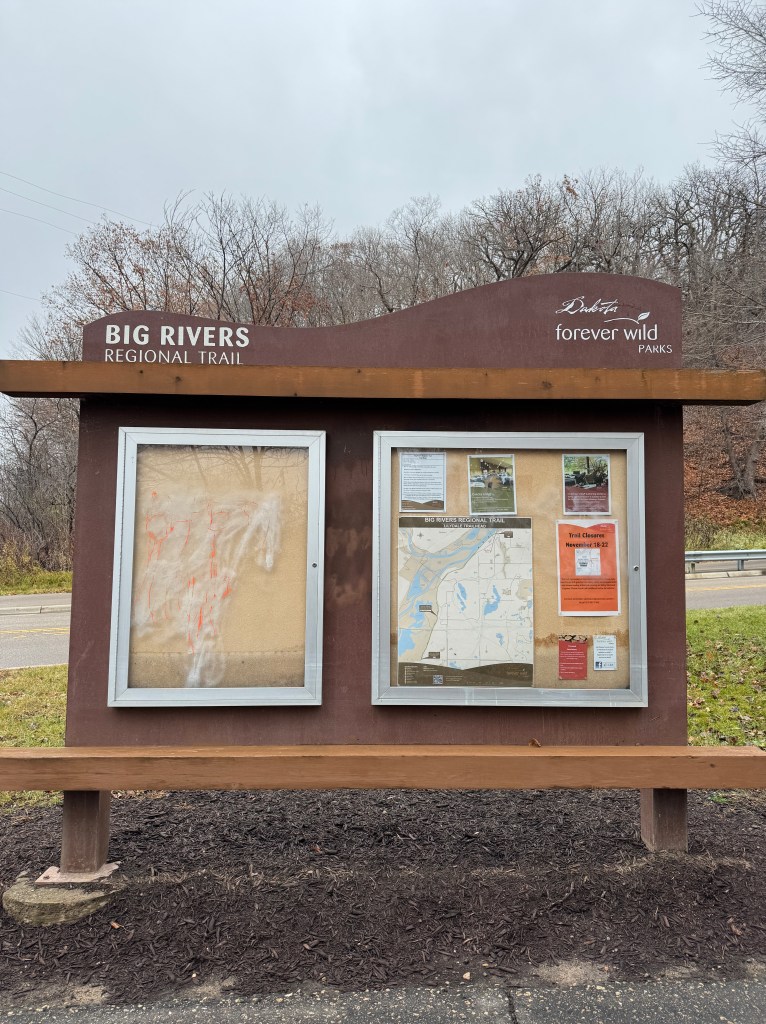
By 7:00 a.m., Mick and I were heading out the door. We didn’t have to go far – just a few miles on the other side of St. Paul to Lilydale, where there is a trailhead by the Mississippi River. The trail itself winds beneath I-35E, follows riverside railroad tracks, offers overlooks every so often.
Our starting point for a walk along the river.
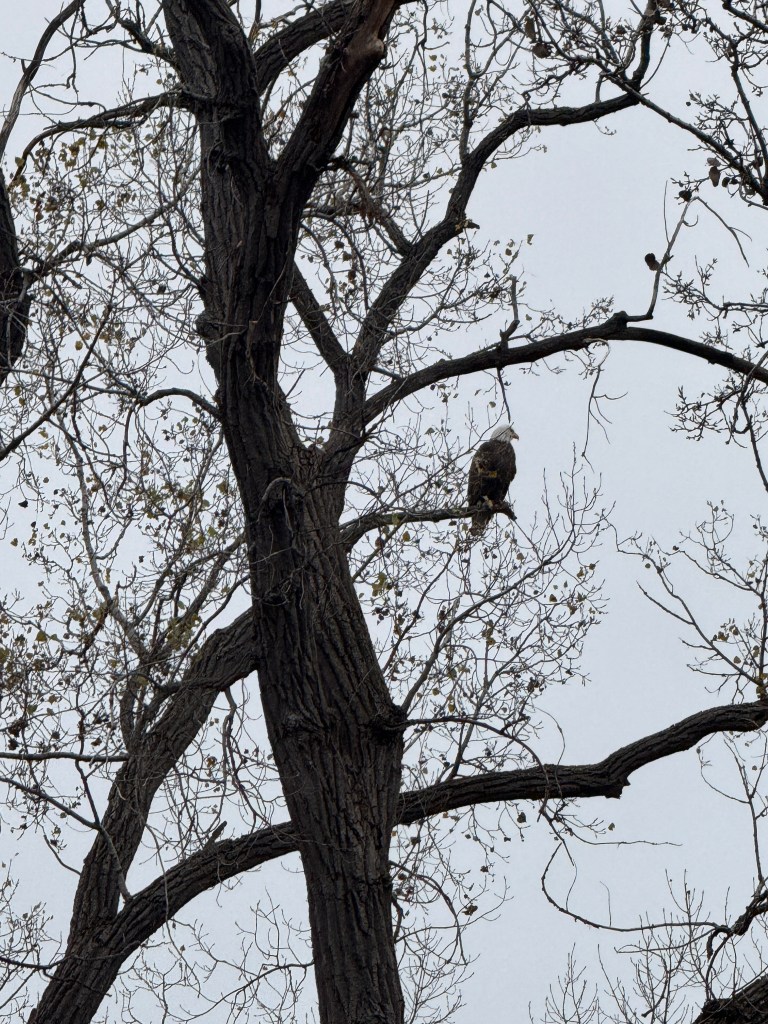
The morning was dark, damp, noir-ish. Trees, their limbs mostly bare now that it’s mid-November, raked the low-hanging clouds. We hadn’t gone far when we saw a bald eagle surveying the river banks.
Eagles hang out along the Mississippi River. Even in dim light, their hooked beaks and white heads make them easy to identify.
The eagle was my first moment of awe. When I was a kid, it was rare to see an eagle. Now, I notice them more often, perhaps because of where I tend to hike, but also because of efforts to stop poisoning them with lead and DDT over my lifetime. This eagle had a presence that was graceful, strong. An example to be considered.
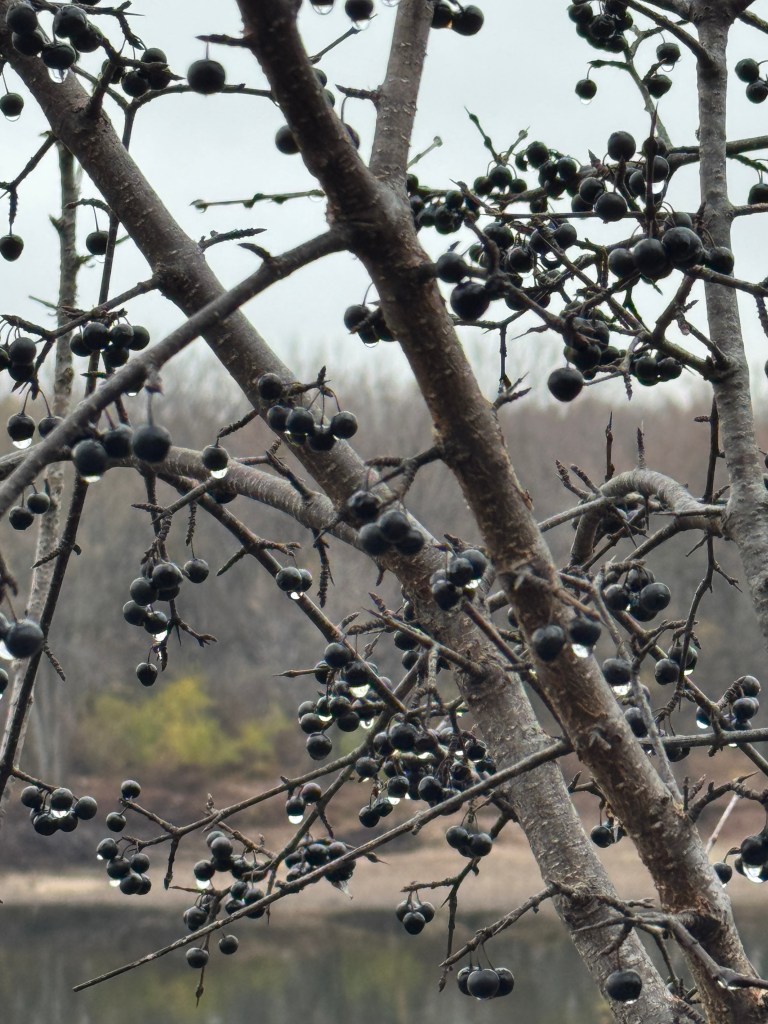
My second moment of awe unfolded as I noticed water droplets hanging from some kind of berry-bearing shrub. In the dark morning, the droplets made a chandelier of the shrub, reflecting what little light there was and reminding me that not everything is as dark as it first seems. Our eyes adjust and we find the glimmers.
I had a little trouble getting my iPhone to focus on these droplets, but I tried.
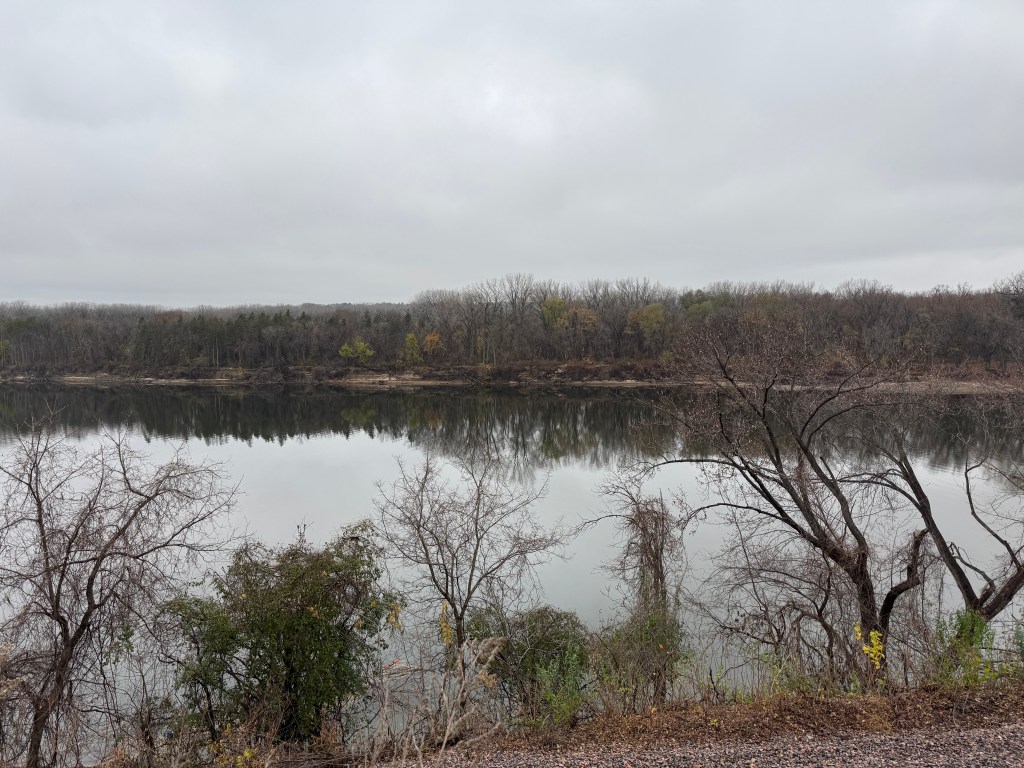
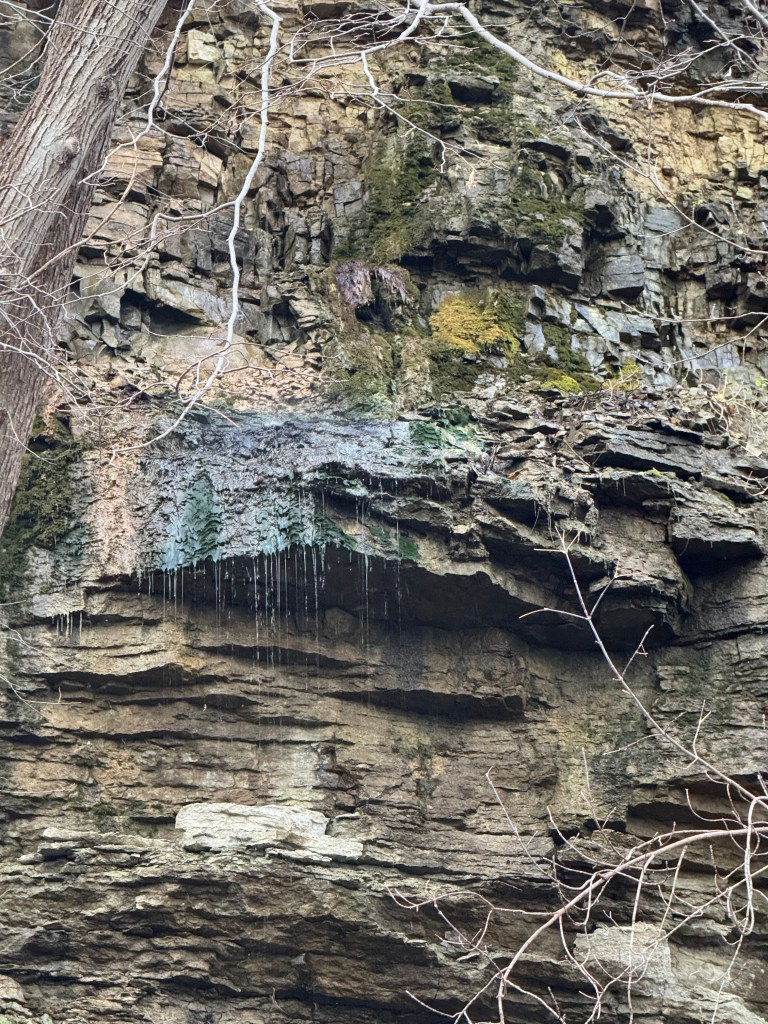
Other moments of awe followed. The sound of water trickling over limestone cliffs. The smell of fallen leaves decomposing into the soil. The smooth glass of the river’s surface. Woodpeckers’ black-and-white bodies flashing through tree branches. Squirrels chattering while sitting on high tree limbs, their furry tails arced into question-marks on their backs.
Mick and I walked for three miles, saw only one other human being. As we settled back into our car, we both felt better. The sun never came out, the morning remained damp and dark, but a walk along the river still offered magic.
Later in the day, a friend on Facebook asked what pieces of advice we could share with each other in this moment, something we believed with our whole heart. I offered mine: “Going for a walk outside always clears your head, even if the weather is crummy.” She answered me with, “Truth.”
Here we are, more than a week out from the election, and I know I’m not alone in bouncing around among feelings of grief, anger, and disbelief. This morning, I had breakfast with a close friend who confessed to waking up angry every day now, and we both brushed away a tear or two as we tried to make sense of this moment. We talked about staying present, finding ways to use our feelings for positive actions, staying away from the dark holes that are so easy to plunge into when it feels like our society could crumble any second.
This is not hyperbole.
This is the moment when being clear about what you stand for is what gets you through, what guides you as you look for the path ahead.
One Minnesota Crone stands for compassionate actions that care for people and planet, especially women who have been shoved aside in this American patriarchy that just can’t seem to evolve. The older I get, the more fundamental this idea feels. There’s more, but I think a succinct statement for this moment is a good place to land today.
That said, awareness of the beauty around us is the tool I’m going to continue to use to remain clear in my thinking and maintain a creative practice. Here is today’s offering.
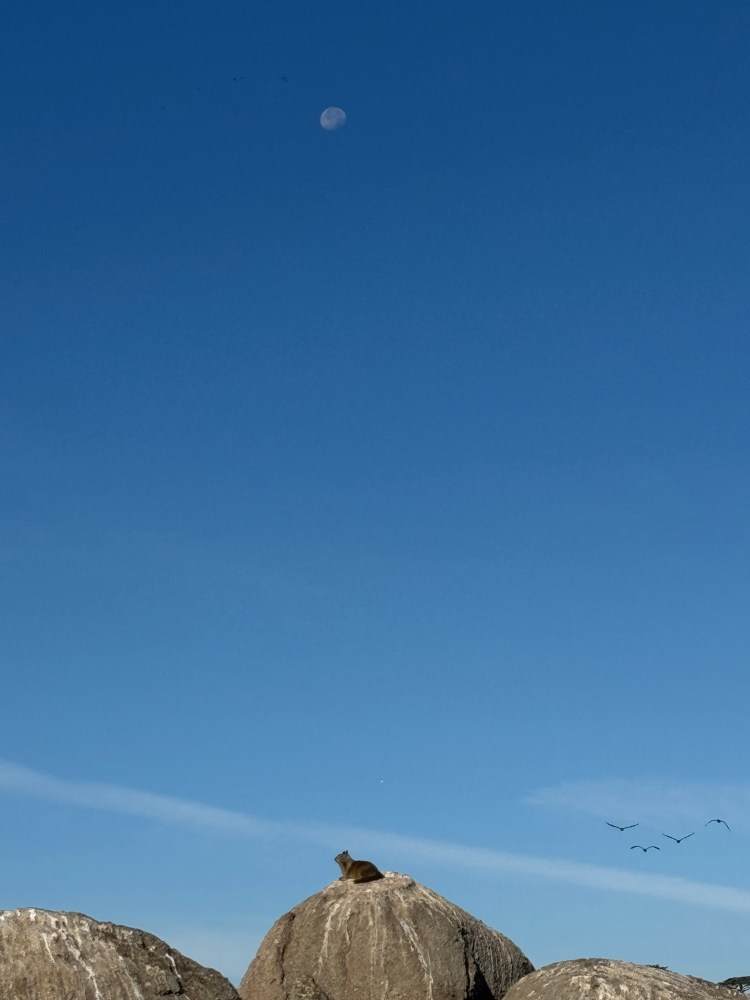
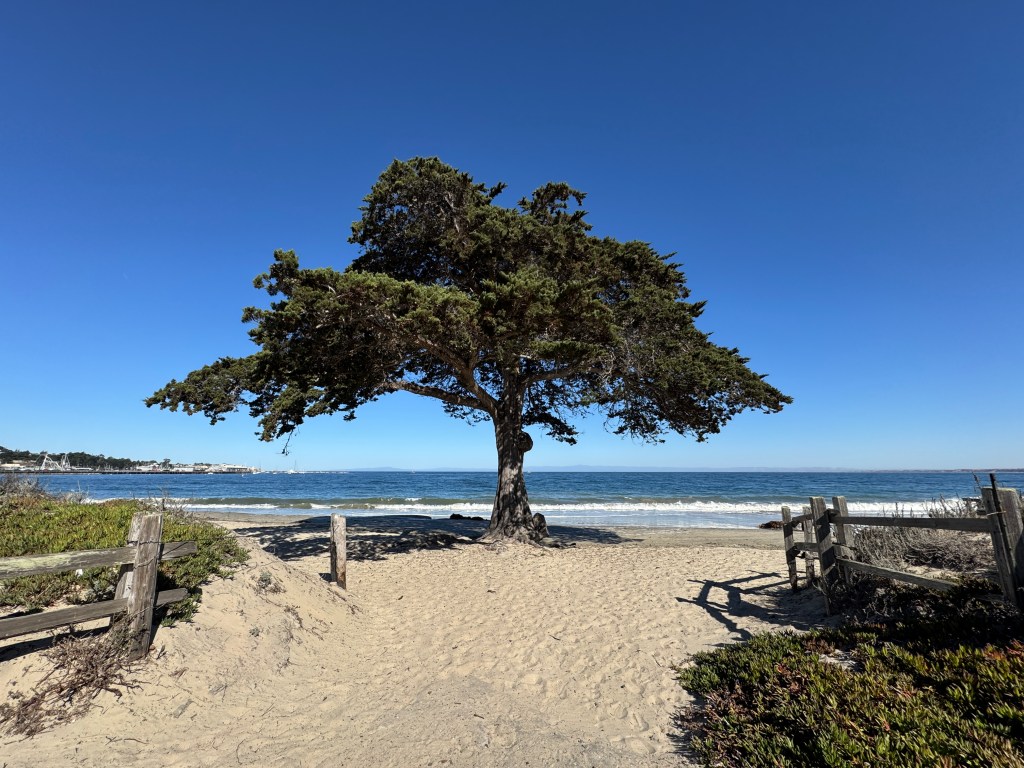
Waning morning moon, ground squirrel, pelicans – Pacific Grove, California. This particular spot – Lover’s Point – was one that Mick and I returned to several times during our week in California in October. I’m grateful we were able to store up so many moments of beauty and calm. What I like about this shot is how vast that sky is, how far away the moon and yet its light still reaches us. I’m grateful for an iPhone that can hold an image like this right in the palm of my hand.
Notice the ground squirrel in the front with his eyes closed – a little moment of furry meditation. This made me laugh.
Hanging around outside with a few squirrels turned out to be something that brought me joy. That might be something you can find in your own backyard right now.
What a week it’s been. Many of us are exhausted, sad, still processing the election outcome. And life doesn’t stop, does it? For myself, that meant calling a plumber for a kitchen drain that backs up every few years, admitting our dishwasher needs to be replaced, juggling the budget to pay for new tires on my car. It meant listening to friends and my kids as they struggled to balance how they were feeling with the reality of whatever needed to be done that day, whether it was job-related or family-related or something else.
That makes this weekend time particularly welcome. Even the rhythm of doing housework feels soothing in this moment: the warmth of the dishwater as I wash the breakfast dishes, the smell of lavender as I clean the bathroom, the swoosh of water in the washing machine as our dirty clothes magically become clean again, the hum of the vacuum as Mick moves around the house. There is the anticipation of listening to our friends’ acoustic trio when they play tonight at a nearby bistro. There is the softness of the sweatpants I’m wearing as I write, comfortable in the second-hand desk chair I have in my office. There is the little glow from the lava lamp a friend sent me for my birthday. And there are the pictures of my family on the magnetic bulletin board beside my desk.
All week, I’ve been seeking comfort and beauty wherever I am. The other piece of this equation is to offer comfort and beauty to someone else.
May today’s offering please you in some small way.
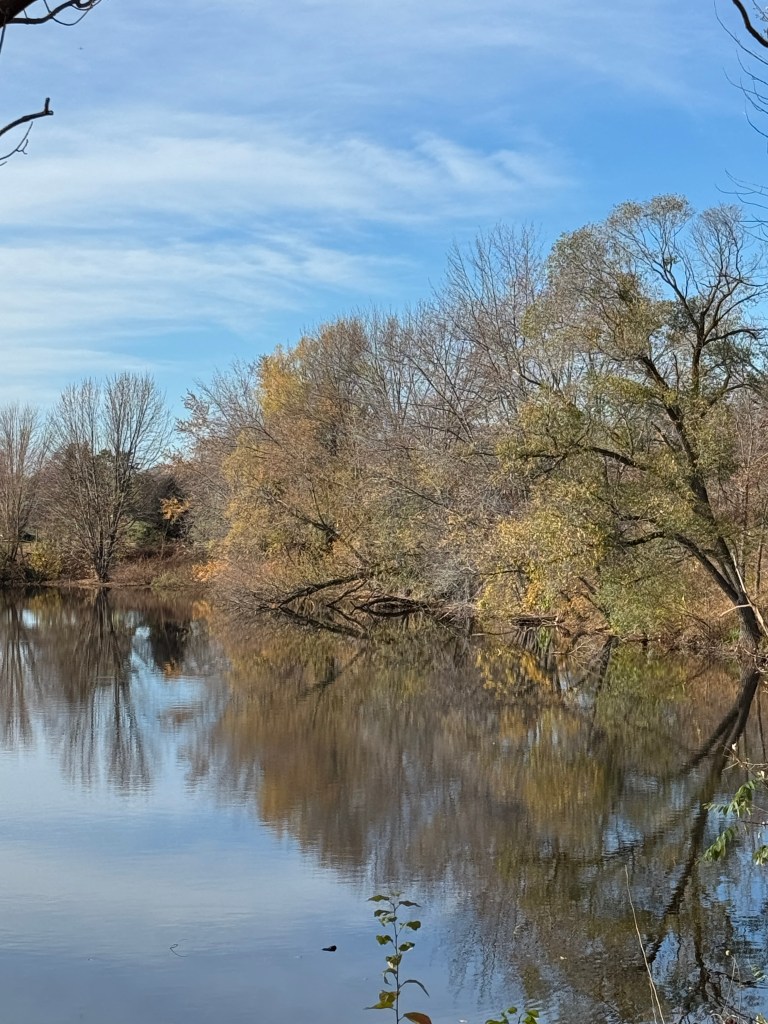
An impressionist reflection of the trees around Como Lake, St. Paul, Minnesota. There is something about November-ish trees and sky that feels calm, as if calling us to settle in, find our favorite blanket, sip our favorite beverage, be safe at home.
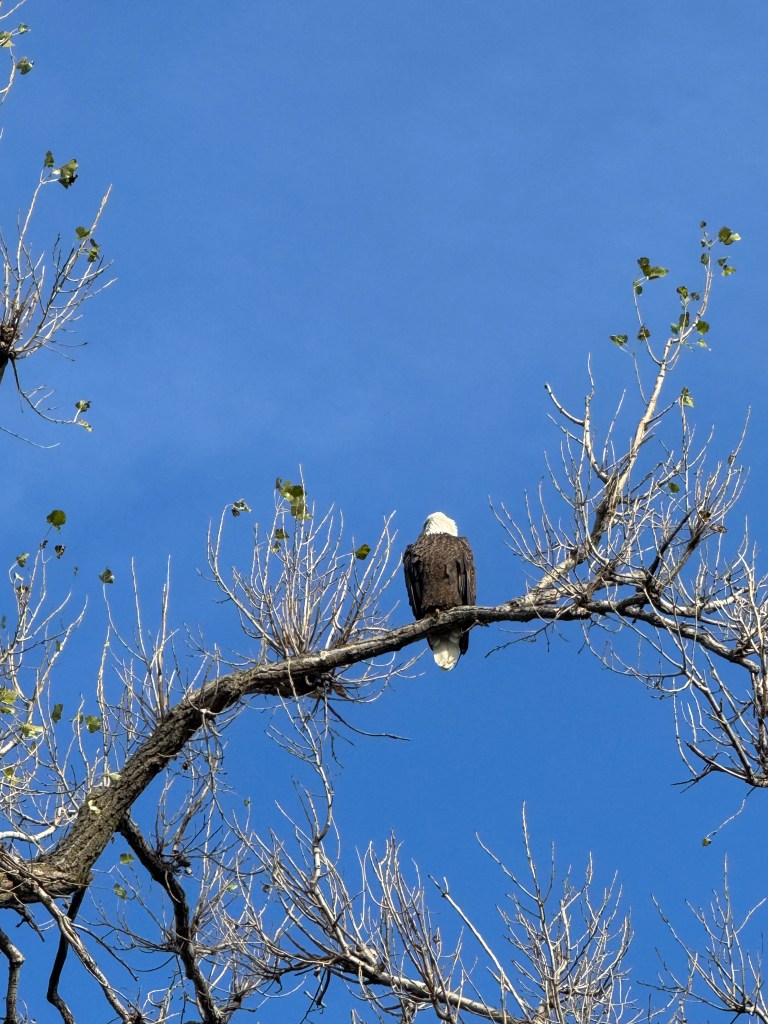
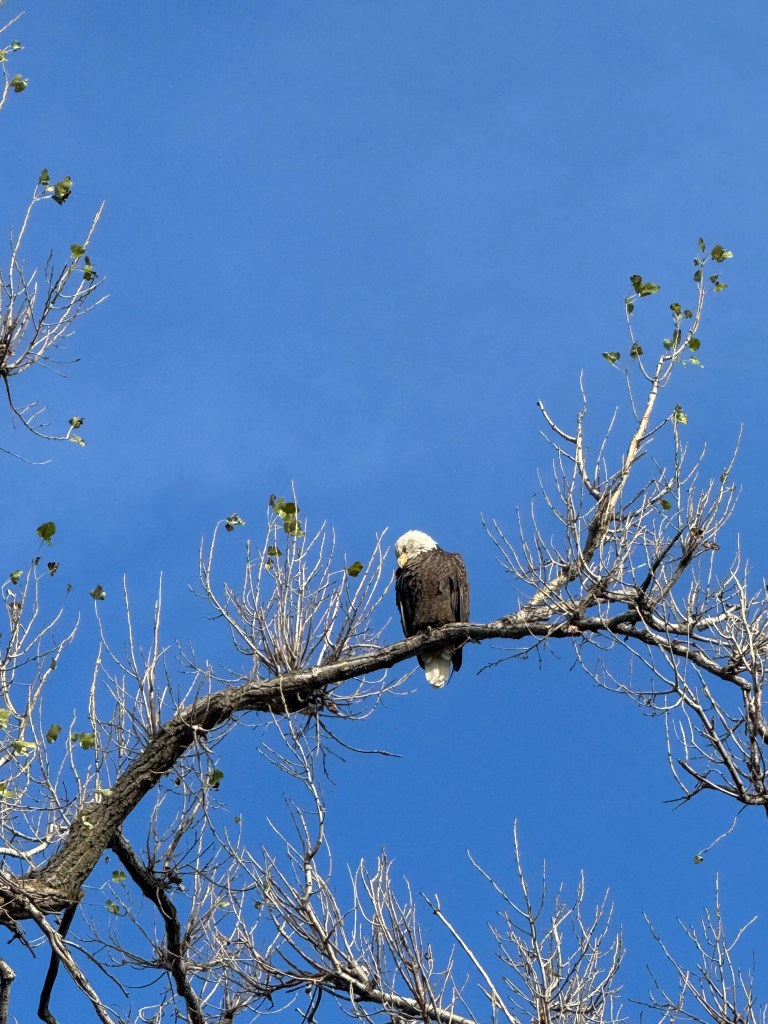
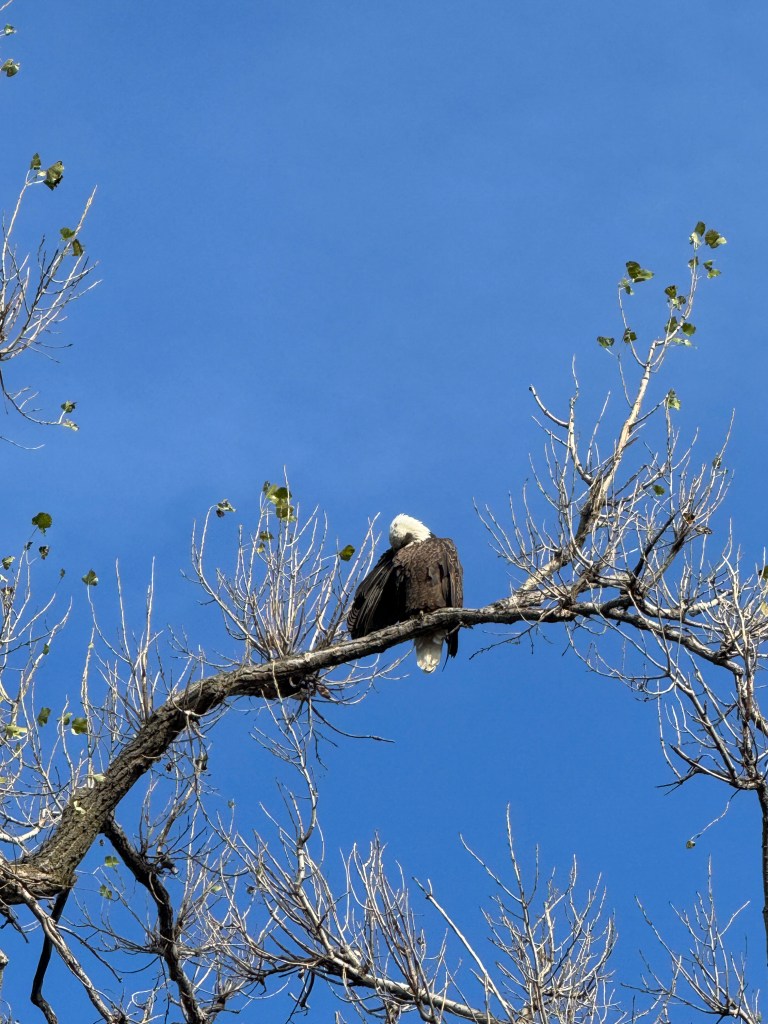
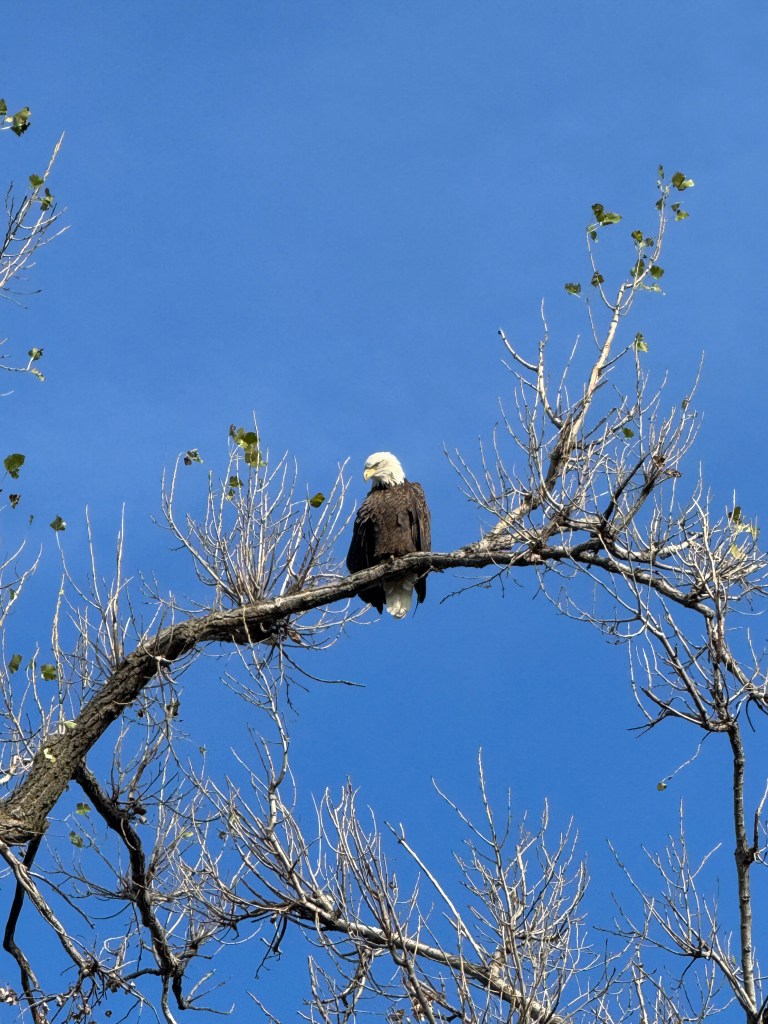
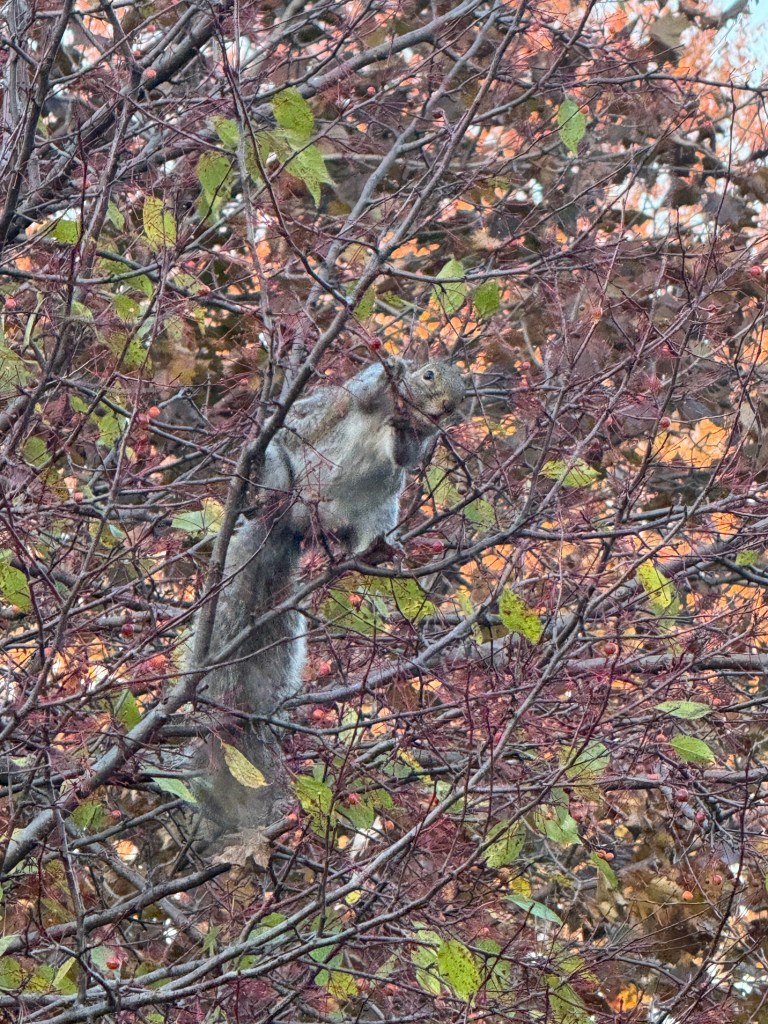
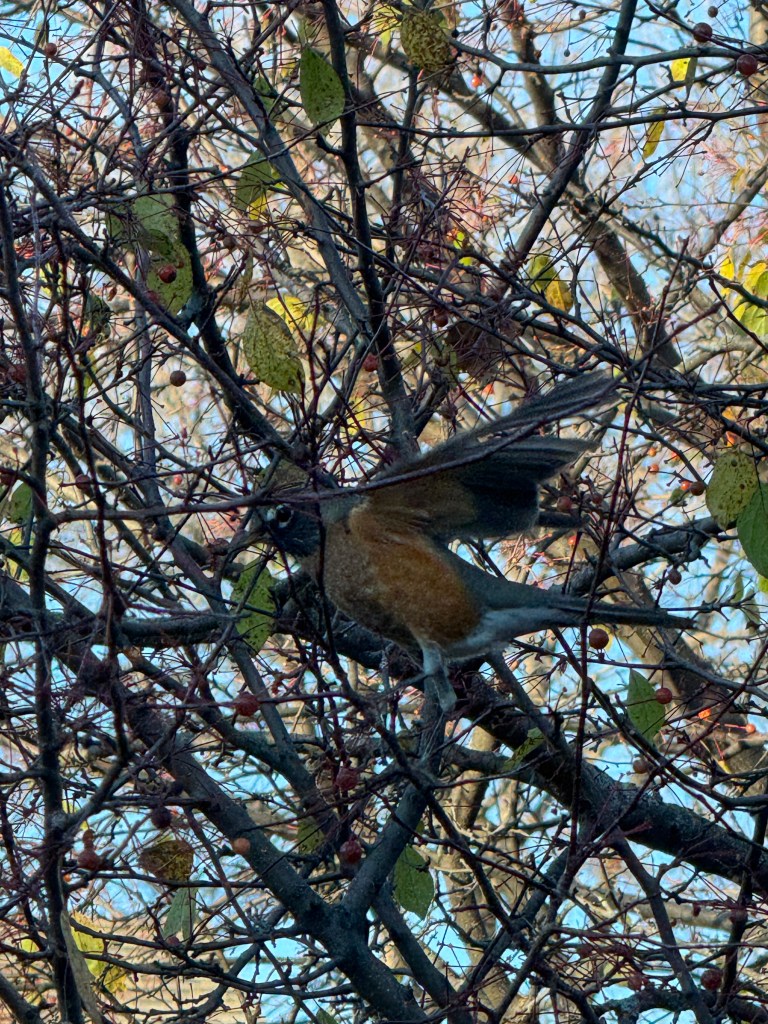
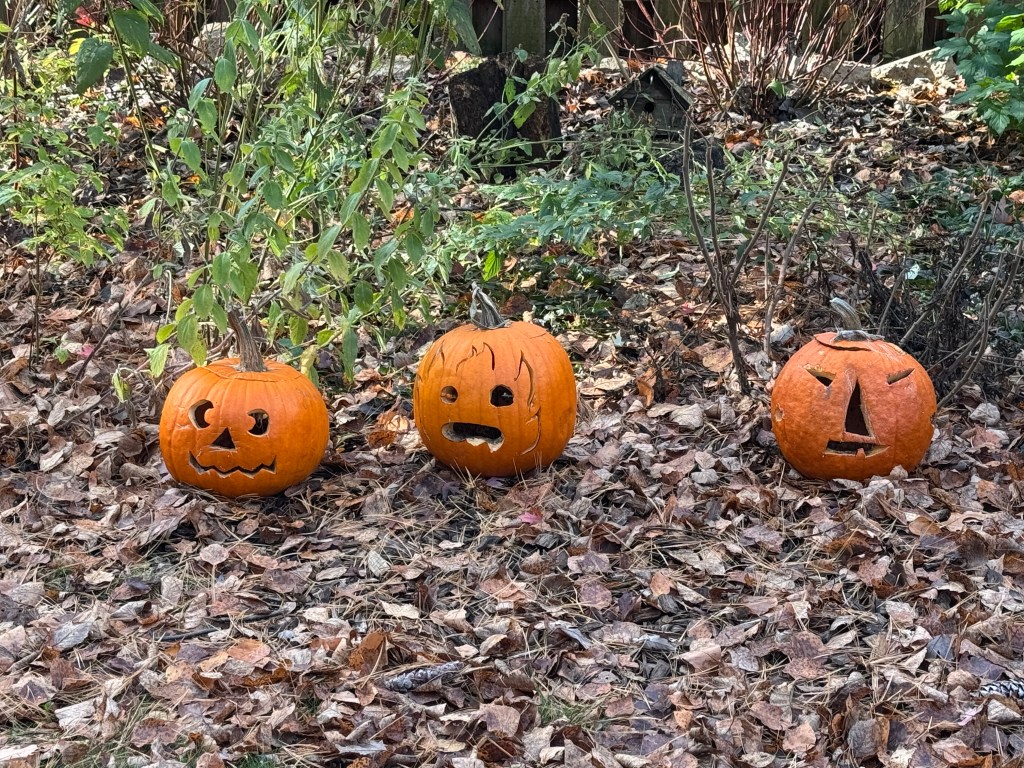
This bald eagle appeared in a tree near Como Lake yesterday. Someone coming toward Mick and me on the walking path said, “Did you see the eagle?” We looked up and there he was, looking around, grooming his wings, considering his next move. Eagles keep their wits about themselves no matter what. Their focus is sharp. Meanwhile, in our own yard, we are offering a buffet. Squirrels and robins have noshed on our crabapples these past few days. The Halloween pumpkins are now in the garden, decomposing and, perhaps, getting nibbled on. Food for others has been the focus of our yard for a long time.
In the wake of our election results, I’ve decided to take whatever small actions I can to put kindness, comfort, encouragement, and beauty back into the world.
That means retooling One Minnesota Crone a little bit by posting more frequently for a while, sharing whatever Zen moments I stumble over and gather up. This is, after all, a place of encouragement in itself, a place of finding something that nourishes, boosts, calms.
Today, I feel like I did at the beginning of the pandemic, uncertain and worried. But I also feel that I learned from that experience – learned how to find resilience, understand the power of gratitude, weed out bad information, connect with those who know that difficulties are a nudge to find a better path forward.
Let’s get going.
Today’s moment of much-needed Zen:
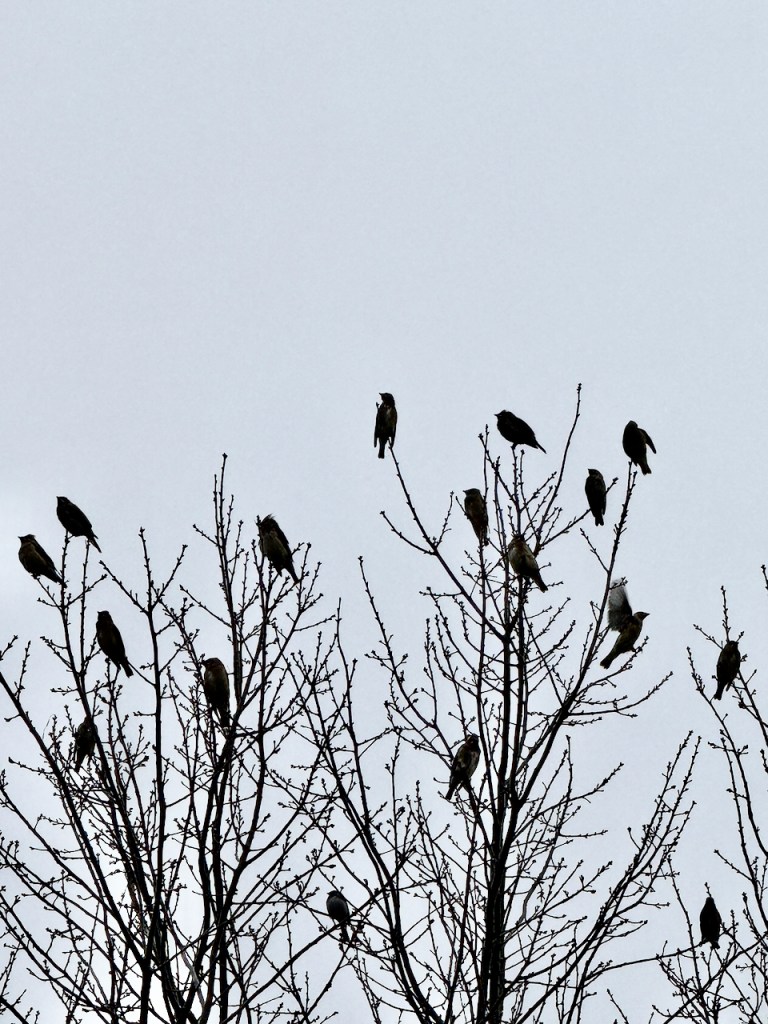
The way birds flock, any birds, against a gray November sky, reminds us we are better together than divided. These are cedar waxwings (hard to see in the dim light, I know) who came through our yard to feast on the nearby crabapple tree’s abundance. Once nourished, together they will migrate for the winter.
This is how I’m staying sane during this insane election season.
A couple of weeks ago, Mick and I spent a week in California visiting Pacific Grove, Big Sur, and Monterey. We hiked among redwoods and alongside the Pacific Ocean, rested, sipped wine, read, ignored the news and reclaimed a slower pace that feels healthier than what we’ve been doing. It’s so seductive, feeling like we have to stay on top of the news, get stuff done, say yes to invitations that fill our calendars until there’s no space left. I’m very good at giving away my time until I realize I have left none for myself. So, a reset was just the thing. Not only that, but we had Mick’s birthday to celebrate.
Flying directly into the five-gate Monterey airport from Minneapolis proved to be a good choice for starting our vacation/reset. Picking up our rental car was easy, and the route to our hotel took about 15 minutes. We had a room booked at the Centrella Hotel in Pacific Grove, and we arrived just in time for their nightly wine tasting. After enjoying some nice pinot noir, we took a two-block walk up the hill to dinner at a local Italian restaurant, La Mia Cucina, where we sat at a little table in back and enjoyed some wonderful classic spaghetti and meatballs for Mick and fresh fish for me. The evening closed with a post-dinner walk back down the hill, fog rolling in, and we were enchanted.
Centrella Hotel, Pacific Grove, CA
Early morning walk to Lover’s Point
A couple of sea otters, just chilling
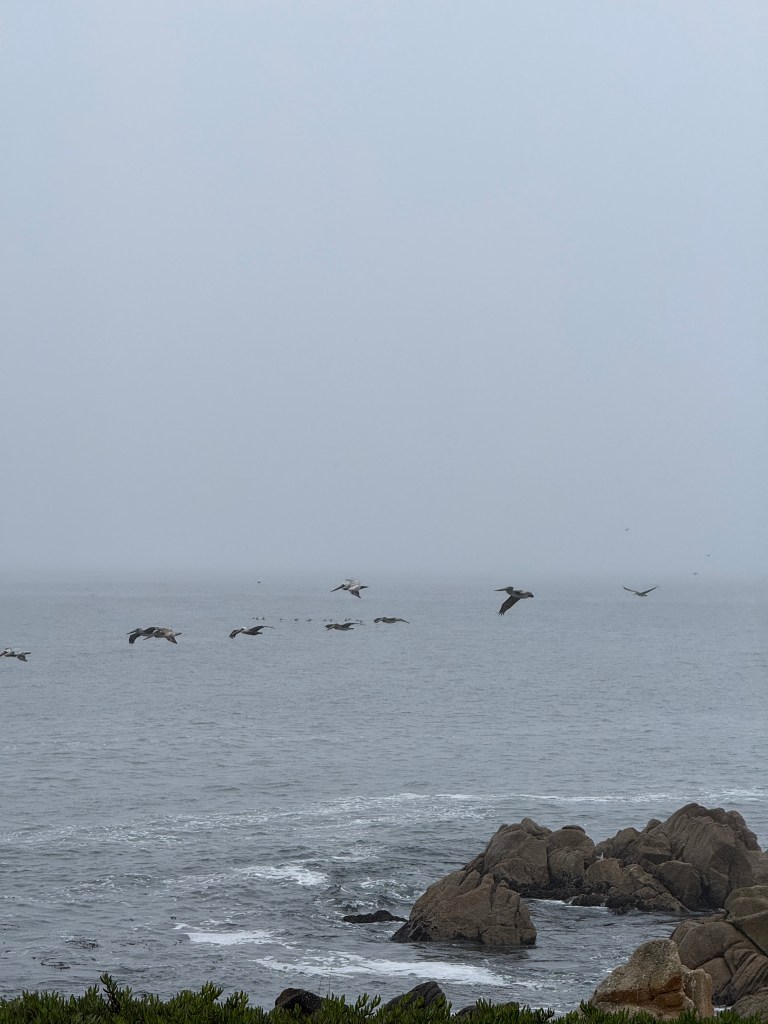
Pelicans everywhere
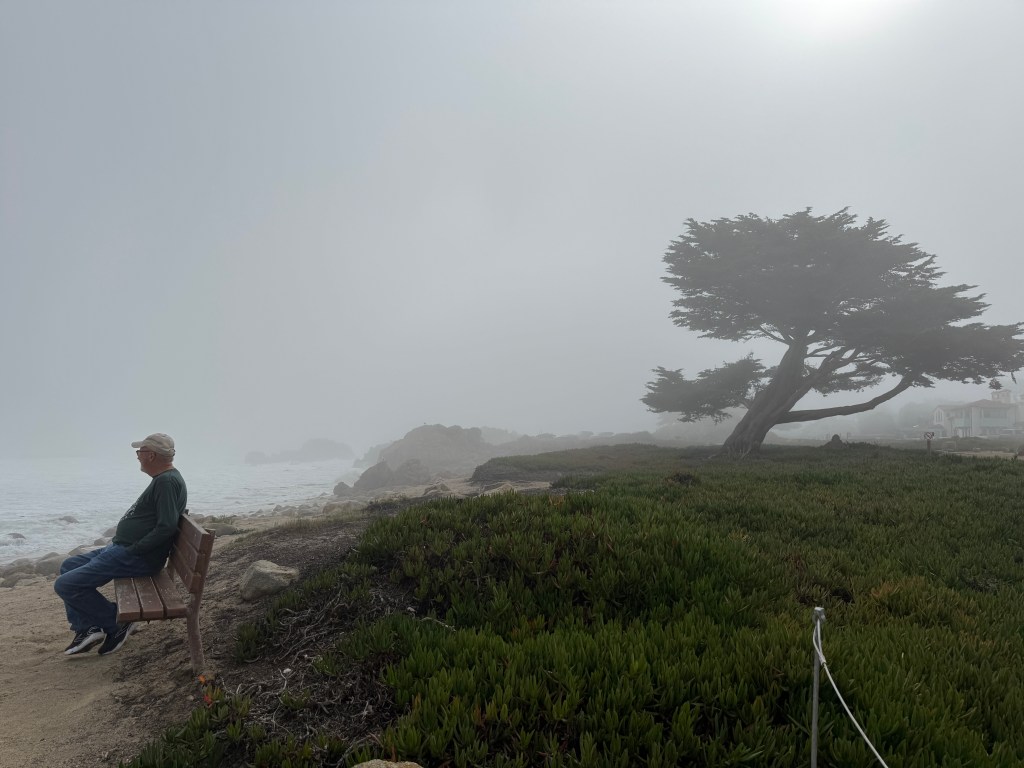
Foggy overlook
That fog was still there early the next morning. We woke before breakfast was available in the hotel dining room, our bodies still on Minnesota time. We decided to walk down to Lover’s Point to get some exercise. Big, crashing waves greeted us, and some well-seasoned surfers floated in the roiling water, waiting for a good wave. We watched them for at least half an hour. A relaxed sea otter hung out in the waves just behind the surfers, little paws working on his breakfast. I was surprised at how many people were out so early in the foggy morning, running, walking dogs, watching the ocean. We felt at home. The fog was no less thick when we returned to the Centrella, got coffee, ate yogurt parfaits, and talked about our plans for the day. We decided to walk to the Monterey Bay Aquarium, since it was only a mile away and our rental car was fine parked on the street until later. We arrived just in time to see two humpback whale flukes in the bay. Everyone at the aquarium was excited about the whales, crowded around the observation area, phone cameras rolling. We took it as an auspicious moment, a sign that we were going to see some wonderful things in the week to come.
We weren’t wrong.
A sea otter at feeding time – Monterey Bay Aquarium
Purple-striped jelly – Monterey Bay Aquarium
Moon jelly – Monterey Bay Aquarium
Giant Pacific octopus – Monterey Bay Aquarium
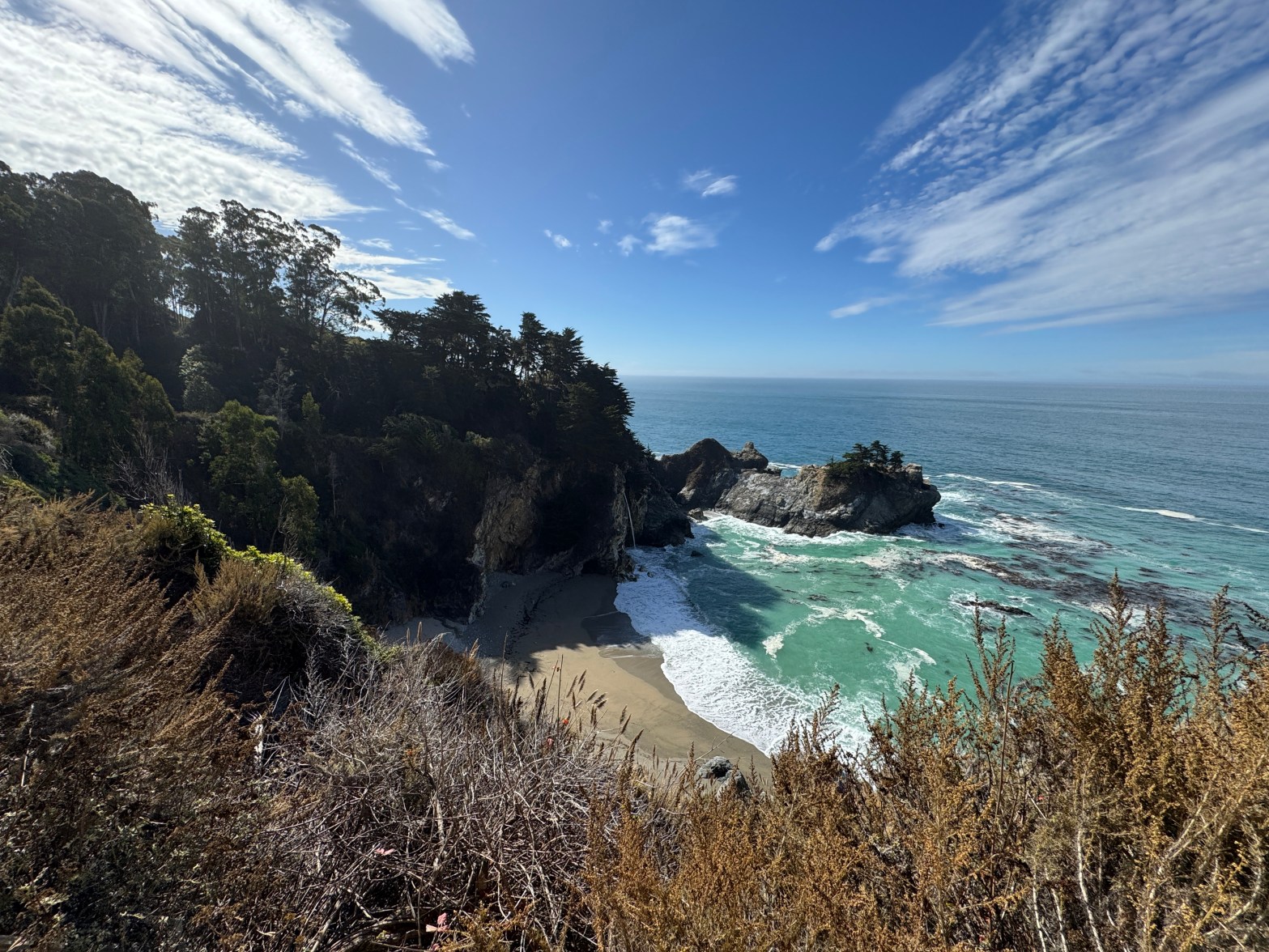
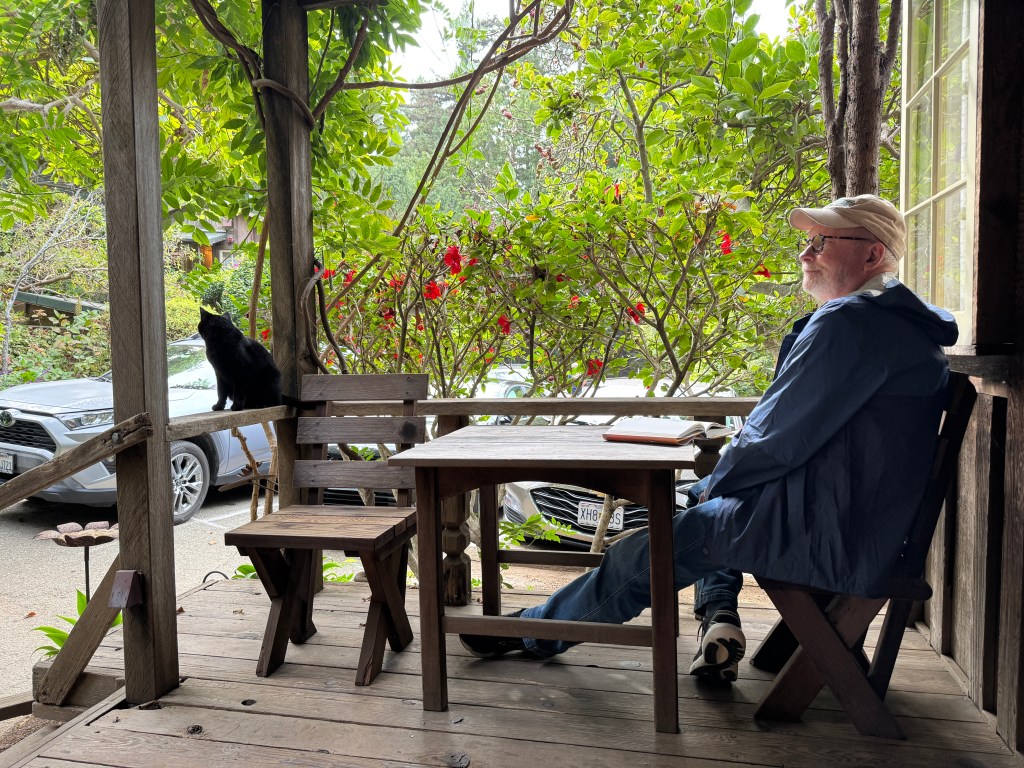
After two nights in Pacific Grove, we headed south on Highway 1 to Big Sur, where we had a cabin reserved at Deetjen’s Big Sur Inn. The place is rustic: wood-stove heated cabins, no cell service, no wi-fi, no televisions, dim room lighting. One emergency phone lived on the side of one of the main buildings. Cats meandered in the gardens and made themselves at home on the hoods of cars with still-warm engines. Redwoods surrounded everything. The sound of the ocean shushed and boomed just across the road. Hummingbirds zipped around the flowers still blooming in mid-October, sometimes narrowly missing my head.
Entrance to Deetjen’s
Our room
This little black cat hung around us a lot
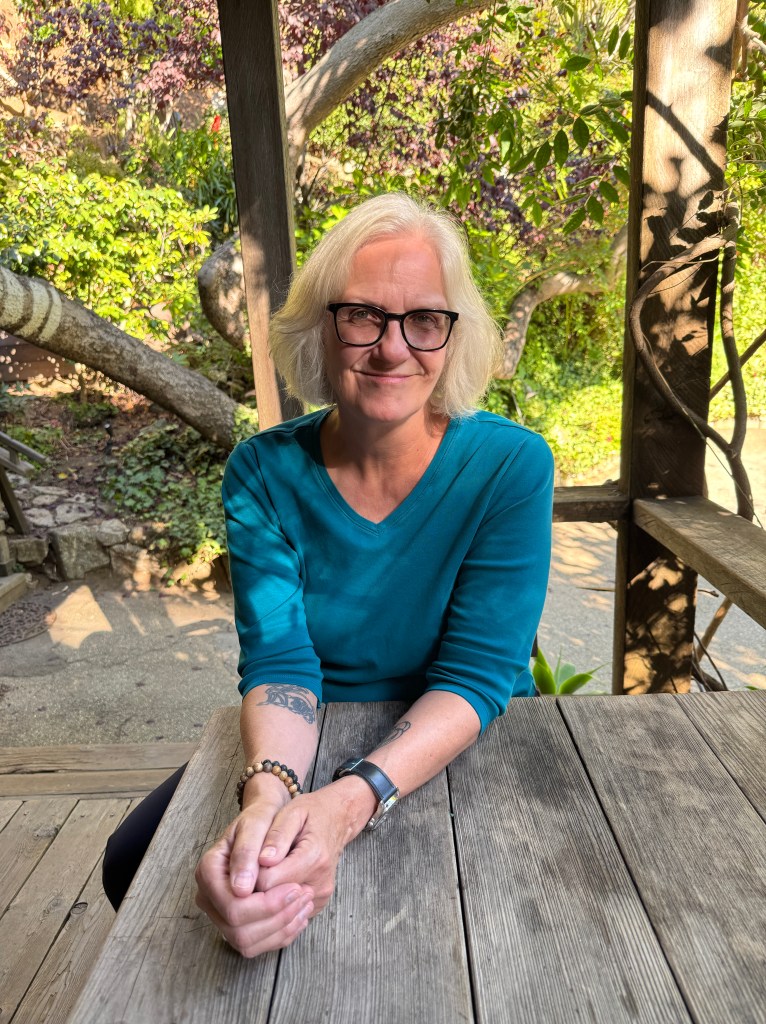
I was in a happy place
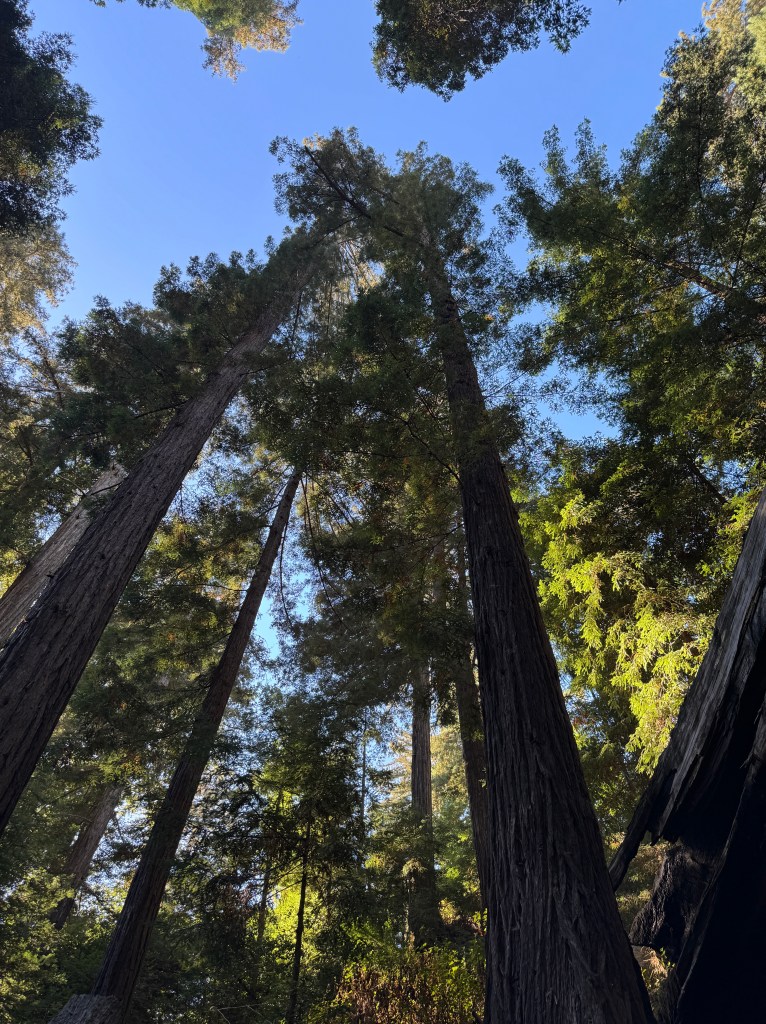
Redwoods forever
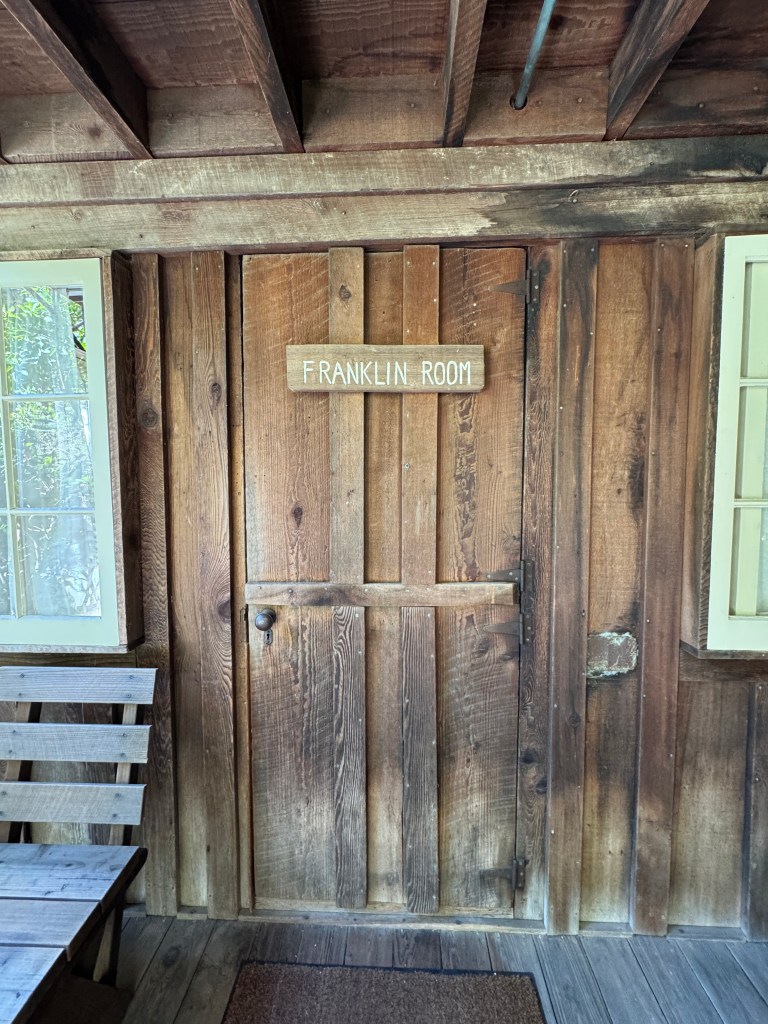
Deetjen’s is where we really relaxed, found the quiet inside ourselves. It was our base for a few hikes in nearby Pfeiffer Big Sur State Park and Julia Pfeiffer Burns State Park, where we were reminded that we are used to hiking on much flatter ground. The restaurant at Deetjen’s is well-known for its locally-sourced breakfasts and dinners, simple and hearty preparation, and a coziness that other places nearby lack. In our cabin, I started reading Steinbeck’s Cannery Row, which felt like just the right kind of book for those surroundings. Given that the Franklin Room we stayed in was built in the 1940s, when Cannery Row came out, and that we had just strolled along the actual Cannery Row only a day before, I felt transported in a way that never would have happened if I read the book at home.
But the real gift of Deetjen’s was time among the redwoods. Mick loves redwoods more than anyone else I know, and he drank them in. On our last morning there, we just sat for a while near a little waterfall on the property, inhaling the scent of the redwoods and relishing how disconnected we were from the rest of the world in those moments.
We could have stayed there the entire time.
Waterfall at Deetjen’s
But we didn’t. We had our last room for the week reserved in Monterey, a nice room with a fireplace that was walking distance from the old Monterey downtown area and fisherman’s wharf. In Monterey, we were back to noise and lots of people and traffic, but that was okay. Walking to so many places was easy, we found one of the best taco trucks ever (Wedo’s), enjoyed a simple breakfast at the Old Monterey Cafe, sampled local beer at the Dust Bowl Brewing Company, and used Monterey as a base to go do some wine tasting at three different places.
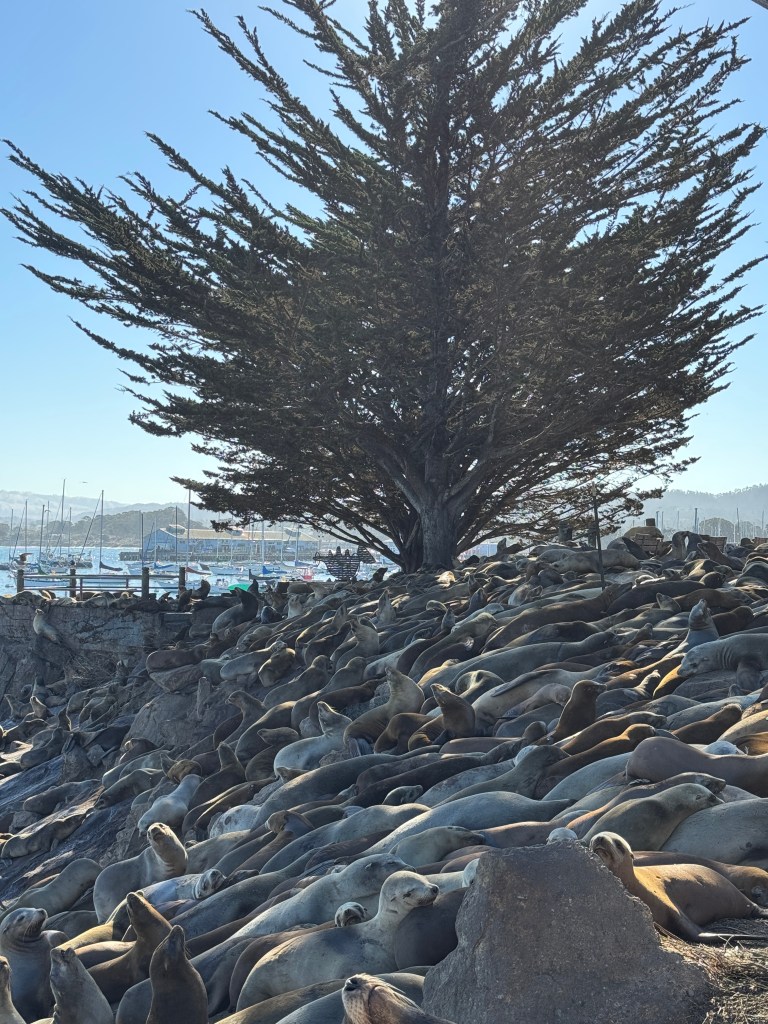
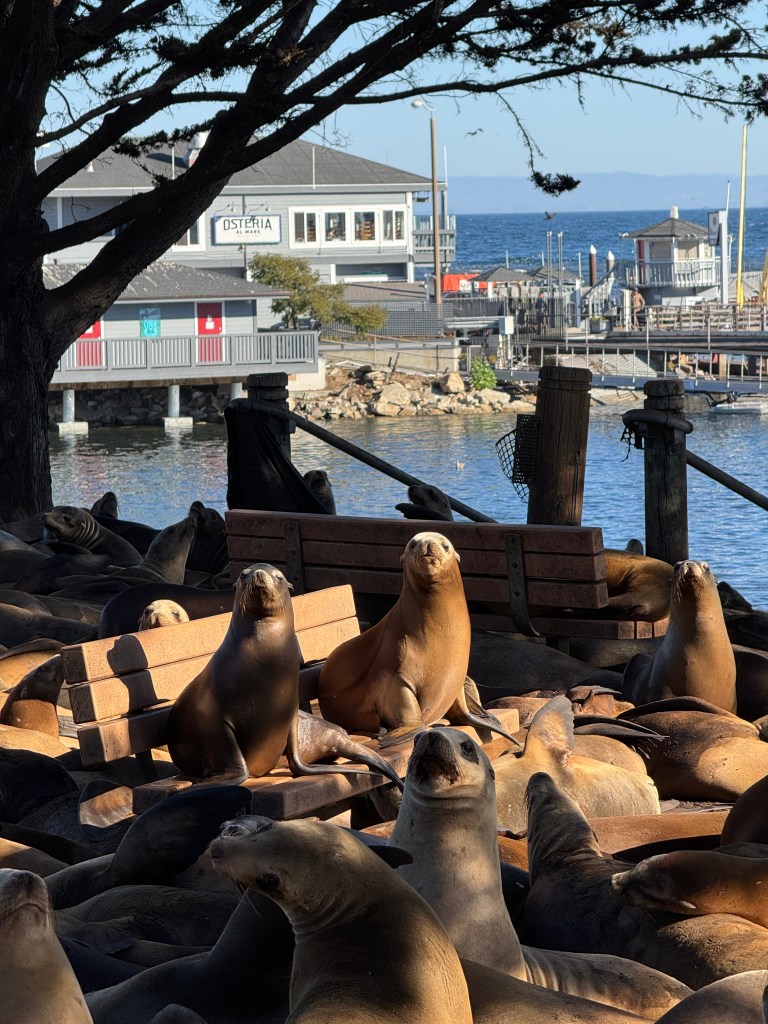
The site in Monterey we visited every day that we were there was, of course, where the sea lions have taken over an area near San Carlos Beach. There is a national marine sanctuary in Monterey Bay. I finally learned the difference between sea lions and harbor seals (sea lions have ear flaps and harbor seals don’t, sea lions bark loudly and harbor seals don’t). I also learned that massive groups of sea lions smell awful, but they are hilarious to watch.
Sea lions as far as the eye can see
No one is going to argue with the sea lions about using the park benches
Coming home from such a magical week in California was jarring. I am so grateful that we had the chance to take a break during this election season, that we could come back home rested and somewhat ready for what is coming. I’ve been thinking about the quiet of that week a lot since we’ve been back, tucking away little pieces of solace that I know I’ll be calling up in the weeks to come.
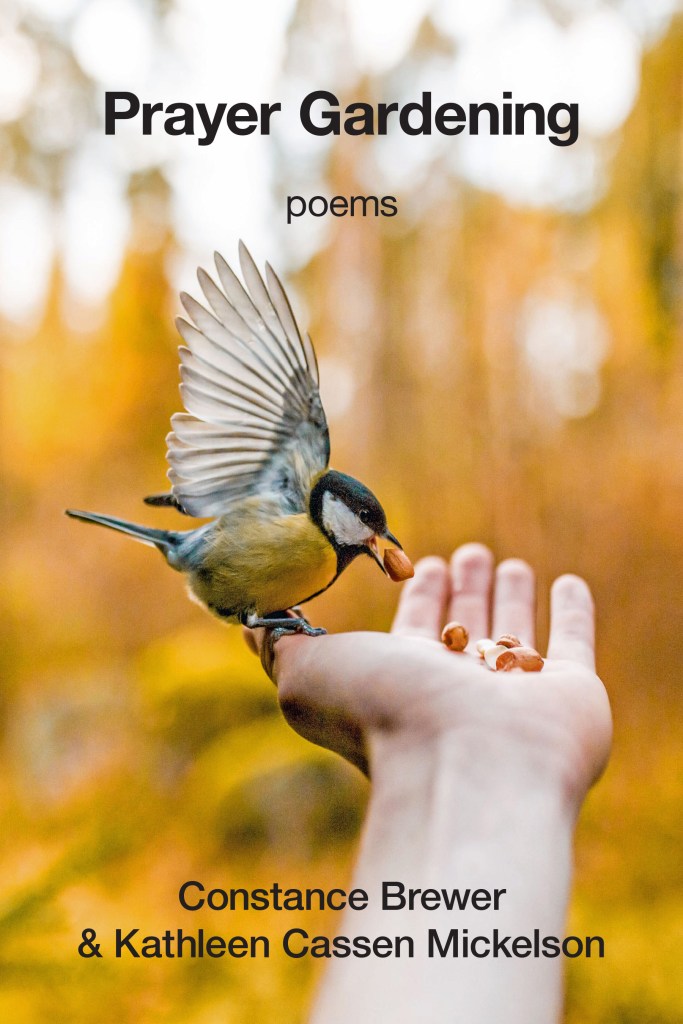
I can’t believe it’s already been a year since Constance Brewer and I celebrated the publication of our co-authored poetry collection, Prayer Gardening (Kelsay Books, 2023). In honor of the anniversary, here is a seasonal poem of mine from the book:
Night Poem #1

A shooting star arced across the eastern sky,
broke into bits beyond our neighbor’s trees.
The dog took no notice, wondered
why I went back toward the street
when she had no more poop to give.
I tugged her leash, insisted
on looking up to witness
meteoric flash-flash-flare-out.
I wanted more, but the only other movement
was our neighbor jogging in the dark.

I thought of you then,
your plane over the Atlantic Ocean.
You would touch down in Europe while I slept.
I wasn’t sad you headed to Italy without me.
I was sad I was home without you,
half of our bed cool to the touch.

Travel doesn’t compel me like it once did.
Contentedness makes it easy
to send roots deeper and deeper.

Tonight fall crickets sing the same notes
over and over without tiring.
The dog nestles beside me, turns and turns
until her bed is ready, plops
into a semi-circle, her breath soft,
her trust in me complete
as I turn off the light.
If you’re interested in purchasing a copy, you can find one HERE. As the weather cools around the country, it’s the perfect time to curl up with a poem or two.
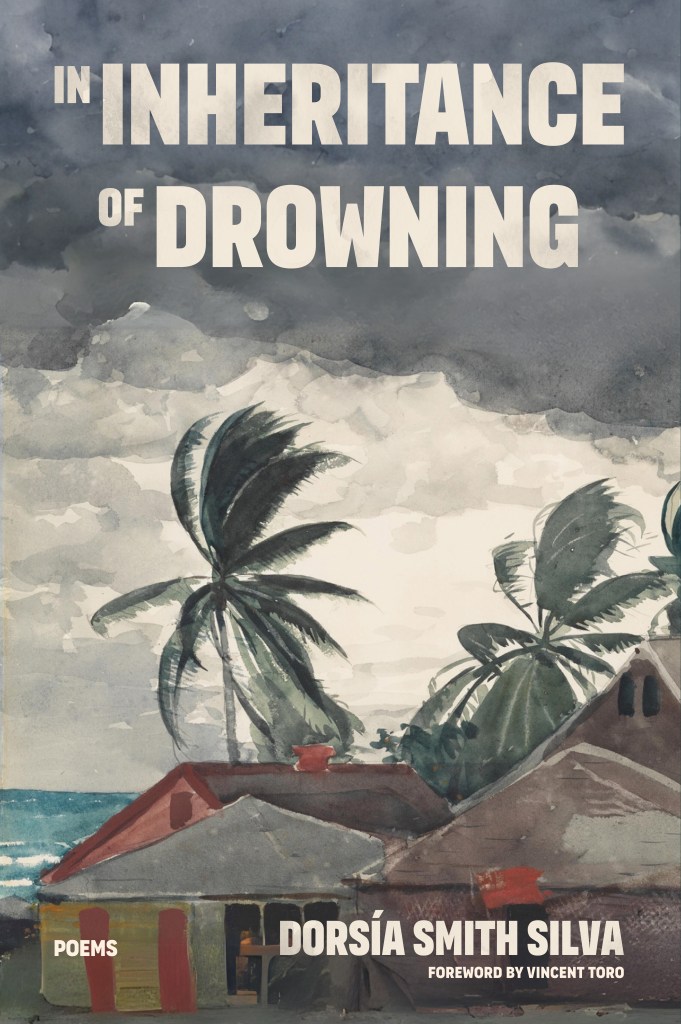
Welcome to another installment in One Minnesota Crone’s Conversation with a Poet series. Today’s poet is Dorsía Smith Silva, poetry editor at The Hopper, editor of Latina/Chicana Mothering, co-editor of several other books, and professor of English at the University of Puerto Rico – Río Piedras. Her soon-to-be-released poetry collection, In Inheritance of Drowning, (CavanKerry Press), is the topic of today’s conversation.
In Inheritance of Drowning, by Dorsía Smith Silva. CavanKerry Press, 2024. $18.
I had scant knowledge of Puerto Rico before I read In Inheritance of Drowning. I knew it was devastated by Hurricane Maria, that the US didn’t do enough for all the people affected. As part of my research while reading In Inheritance of Drowning, I read a Time Magazine piece published shortly after the Hurricane Maria’s havoc which stated nearly half of Americans don’t know Puerto Ricans are American citizens. Crushing debt and fragile infrastructure made – and continue to make – Puerto Rico’s recovery exceedingly difficult. Even though it’s been seven years since Hurricane Maria roared across Puerto Rico, people still suffer. Subsequent difficulties due to the pandemic and earthquakes hammered away further at Puerto Rico’s residents.
But In Inheritance of Drowning is about more than Puerto Rico. It’s about the assorted ways that people, especially people of color, drown. Yes, there is water that rushes over communities during a hurricane. But people also drown from debt, oppression, racism, misunderstanding. People sometimes drown because of actions by others, actions based in greed or ignorance or, alternatively, from inaction caused by simply not caring. As Vincent Toro says in the book’s foreword, “it is essential that the island’s writers provide us with testimonios that allow us a clearer path to understand what it means to live through and beyond disaster.”
In Inheritance of Drowning is, at its heart, a collection of protest and political poetry. It is a call to action, an insistence to find a more compassionate way of living in this world, a life preserver tossed to any outstretched hand.
It is also a celebration of the resilience necessary to go forward.
I’m honored to offer this conversation with Dorsía Smith Silva about her work.
OMC: Dorsía, thank you so much for having a conversation with me about your work, and congratulations on the upcoming November release of In Inheritance of Drowning. When we first corresponded about this conversation, it was around the time that Hurricane Ernesto hit the Caribbean, causing yet another power outage and delaying the start of public school in Puerto Rico. It’s interesting that In Inheritance of Drowning is coming out during hurricane season in an election year. Was that planned or was that coincidence? Are you pleased with the timing?
Dorsía Smith Silva
DSS: Thank you so much for having this conversation with me, Kathleen. I am very happy and grateful to be here!
My publisher, CavanKerry, decided to release In Inheritance of Drowning in November. I think that was primarily due to the scheduling calendar, but I think the timing has been auspicious. The hurricane poems in In Inheritance of Drowning are all the more meaningful, especially with the anniversary of Hurricane María on September 20th. The political poems in the book also connect to the elections, since they explore the meaning of social transformation. The book will be released after the elections though, since my publisher and I realized that most of the national attention (and rightfully so!) will be on the United States presidential election and several significant propositions. I am looking forward to the book’s release on November 12th, and celebrating the book being out into the world.
OMC: In an interview that you did with Cream City Review, you said that you kept a journal about your experience during Hurricane Maria and its aftermath, and this is what spawned the poems that became In Inheritance of Drowning. There’s a rawness that is captured when writing during an experience, but there’s a refinement that only happens later when a writer gets some distance from the original idea. At what point did you feel like you had sat long enough with those journal entries that you could put them into poems? Or were you making poems all along the way while writing in your journal, poems that you later edited? Did this work help keep you grounded during the initial disaster recovery efforts?
DSS: I was writing poems along the way while writing in my notebook. However, I did not realize that they were poems until much time had passed after Hurricane María. I did not look at my notebook for a long time because I was in survival mode, and I think there was some fear of what I had written. Would it be too painful to revisit those memories? Would it bring another layer of trauma to open the notebook? It took months before I was comfortable to open the notebook, and when I did, I was surprised that I had written all kinds of poems—prose, narrative, and lyric. Other poems were strings of thoughts, random words, and phrases. Keeping the notebook and returning to the notebook helped me feel calm. There was so much uncertainty during the recovery efforts that writing felt like a safe and reliable process. Writing to me is still a process that I trust; it makes me happy.
OMC: You framed the book with the hurricane poems, but the middle section leaves Puerto Rico to examine other ways people, particularly people of color, drown in the United States. As I read these poems, especially Everyday Drowning, I found myself counting the names of people killed by the police in the Minneapolis area where I live – Philando Castile, George Floyd, Amir Locke, Duante Wright. I’d like to quote part of stanza 4 from that poem here:
gone quickly
gone slowly
without prayer
in prayer
gone from history
in plain sight
in quiet
without questions
with questions
at any cardinal direction
waiting
on a cold day
on a warm day
outside the law
inside the law
without air
with air
without blood
in blood
on the news
at anytime
on any day
in our homes
in any city
What struck me is the way you bring in the anywhere-ness of oppression so well here. Any city. My city. Your city. This brings the collection to the front doors of all your readers. What went into the decision to frame the book this way, to shift the focus from Puerto Rico’s boundaries to the broader scope of struggles in the US? I know you’ve addressed this in other interviews and think it’s worth reiterating here.
DSS: The oppression of Puerto Rico is linked to the oppression of BIPOC communities in the United States, especially since it is the same systemic dismantling of identities, violence against Black and brown bodies, and political, social, and racial injustices. I also wanted to show how Puerto Rico has been harmed by the colonialism of the United States in the same ways that BIPOC communities have been affected in the United States. The end results are socioeconomic inequalities, political and financial strangleholds, and the “drownings” of Black and brown bodies. I think In Inheritance of Drowning had to reflect upon Puerto Rico and the United States to show this complex relationship. Sometimes, people are unaware that Puerto Rico is actually a colony (not a territory) of the United States, and this subordinate status begs the question, “When will Puerto Rico be free?” It’s the same question that BIPOC communities may also ask: “When can we be free from oppression in the United States?”
OMC: Thank you. I wish we could say those questions are going to be answered and acted upon right now. There’s work to be done by all of us.
Your book pushes readers to consider what they see in this world, where help might be offered, where beauty can still be appreciated, where rebuilding must happen for a better future for all. What do you consider the most hopeful poem in In Inheritance of Drowning and why?
DSS: Thank you for acknowledging this in the book! I hope other readers glean this important message as well—about beauty and rebuilding. I think the opening poem reveals a sense of hope. Hurricanes do not have to be “skylights of horror,” if we humans made more of an effort to combat global warming. If we saw our connection to the environment—let’s say as kin—, then we would hopefully make better environmental choices, which in turn would decrease the number and strength of hurricanes. The effect would be less destruction, loss of lives, and financial ruin. Hurricanes would then just be beautiful bright colors on a weather map. We could see them as having “intoxicating possibilities and mysteries” without their trauma and widespread damage.
What the Poet is Supposed to Write about a Hurricane

What the poet is supposed to write about a hurricane
should be skylights of horror,
not skip rocks of beauty in walls of wind,
affixed to the puzzle pieces of the vortex eye,
spinning like a lost continent’s soul.
How the lively whips should stun the mouths of gravity,
hissing without hesitation,
engulfing the stench of uprooted dirt and grass.
The poet is supposed to decode the stanzas,
shudder the name María
into frail syllables:
to wish a hurricane a fast and gritty death,
not say its stubborn slow dances
held intoxicating possibilities and mysteries.
OMC: Oh, that’s a perfect poem choice. And your idea of treating other living creatures as kin instead of something separate – that’s something that resonates for me. Our environment is our home. We must take care of it.
Do you plan on continuing to explore the issues examined in In Inheritance of Drowning in future works? Anything on the horizon?
DSS: This is an excellent question! I am currently working on poems that examine the many Puerto Ricans that were forced to flee Puerto Rico after Hurricane María. Some of these poems will be about the precarious political and environmental conditions in Puerto Rico that were exacerbated after Hurricane María, and other poems will be about the social, political, and racial inequalities in the United States. I am also composing some poems that explore the psychological turmoil that occurs when people are displaced from their homelands. I am excited to see where this collection will take me.
To celebrate In Inheritance of Drowning’s birthday, I am going to challenge myself to read a poetry book by a BIPOC author every day in November. I am going to model the challenge after the Sealey Challenge and call it the Smith Silva Challenge. I am looking forward to reading for fun and just diving into a pile of books! There are several poetry books that I cannot wait to begin, including Danez Smith’s Bluff and Eduardo Martínez-Leyva’s Cowboy Park.
OMC: I’ve done the Sealey Challenge; I love that you’re creating the Smith Silva Challenge for BIPOC-authored poetry books! What a great way to celebrate. And I very much look forward to seeing more of your poetry in the future.
Thank you for sharing your process and insights today. I hope you have a wonderful release party planned! Anyone you’d like to give a shout-out to before we wrap up?
DSS: Thank you so much again, Kathleen! I would like to thank Shara McCallum, Frances Richey, Derrick Austin, and Velma Pollard for writing such wonderful reviews of In Inheritance of Drowning. A million thanks to Vincent Toro, the author of Hivestruck, for writing the introduction to In Inheritance of Drowning. The introduction is brilliant; I was ready to cry after I had read it. I also want to thank Poets & Writers for including me in the Get the Word Out and 5 over 50 cohorts. Their support has been life-changing.
It was such a pleasure to have this conversation. Many thanks, Kathleen!
In Inheritance of Drowning is available from CavanKerry Press HERE.
Find links to Dorsía Smith Silva’s interviews and publications through her website HERE.
Follow Dorsía Smith Silva on Instagram @dsmithsilva.
In my last post, I wasn’t ready for summer to end. Today, as I walked on the trails near Snail Lake in Shoreview, Minnesota, there was clearly a tinge of autumn creeping across the landscape. Trees and grasses have taken on a yellowish hue, asters are in full bloom, geese gather together and lift off from lakes in a flurry of splashing water and honking. In our own garden, fall blooming flowers are alive with pollinators, while birds feast on seeds from spent flower heads.
Golden foliage and Canada geese on Snail Lake, Shoreview, Minnesota.
Morning sunlight through yellowing ferns.
A lone great blue heron hangs out in the wetlands near Snail Lake.
Fall-blooming mist flowers in our garden attract butterflies.
A trio of sparrows nestles in the wildflower garden behind our house.
And everything feels just right.
COMING UP ON ONE MINNESOTA CRONE
My Conversation with a Poet series will continue on October 1 with Puerto Rican poet Dorsía Smith Silva. I hope you’ll stop on by!











 One Minnesota Crone