As I write this post, I’m sitting in front of our open patio doors again. This is my favorite moveable office spot in the summer. On this particular morning, it’s rainy and cool. There’s a breeze. The sound of the rain woke us this morning, along with an early morning text message on my partner Mick’s phone.
Most days, I am baffled as to why people feel the need to send texts before 8 a.m unless it’s important, as in my car died and I need a ride to work or I’m in the emergency room or I can’t meet you for breakfast as planned. I love my quiet time, moments to stretch, to ease into the awake world. I love sipping my coffee in silence, listening to the birds, making breakfast, not talking much. Fifteen minutes for meditation, fifteen more for some gentle yoga poses, a few minutes staring at the garden to see what is in bloom. It’s taken me years to understand that I just don’t like much interaction too early in the day, even though I’m a morning person.
That’s why I have long blocked off mornings for creative work whenever possible. And by morning, I mean all the way until 11 a.m. or noon. Many of my friends know this about me and honor it. My friend Zola, however, often forgot. She would text at the oddest times, especially on days when I posted here at One Minnesota Crone. She would send me a message as soon as she read the post, often around 7 a.m. this past year. It never failed to annoy me when she woke me up or texted during meditation or when I had my hands full of paint. I would repeatedly tell myself not to be annoyed because Zola was just excited. She told me that about herself – she would get excited about something and couldn’t wait. I learned to silence my notifications for longer periods of time, just to have some boundaries and prevent myself from getting annoyed for no good reason. How could I be annoyed at a friend who wanted to share something no matter what time it was?
Zola was a friend for over 25 years. She was one of my biggest champions when it came to my writing. We were both graduate students at Hamline University in St. Paul in the late 90s. We were both members of the International Association of Business Communicators back when we both worked in offices. We both loved travel, although Zola hadn’t traveled much these past several years for health reasons. For years, we would meet somewhere, catch up over a two-hour lunch. She would send me her haiku, her photos of flowers, links to other writers, tell me when her music requests were going to play on MPR’s classical music station even though I seldom listened. She would always tell me when the next lunar eclipse or meteor shower was coming up, shoot me a text about the death of a famous artist or writer, ask me if I’d ever heard of the latest new novelist. The pandemic changed our long lunches, of course; no longer meeting in person, we shifted to using Facetime. The first few times Zola used Facetime were quite entertaining, as my screen showed closeups of her nostrils or one eye while she talked. She always had a pile of things to show me, papers and pictures and books that she would hold up too close to the screen to see. But once she got the hang of Facetime, it was great.
Zola passed away this past week.
No more early morning texts from Zola. No more dinnertime calls. No more Kathleen, it’s Zola. Your blog this morning was fantastic. No more emails that tell me the same thing I just received in a text. No more Facetime with my friend who almost always got choked up when she talked to me about how much our friendship meant to her.
No more excitable Zola.
How lucky was I that someone in my life pushed the boundaries and let her exuberance fly? That is what I’ll take forward. Let your exuberance fly. Who cares what time it is?
It’s Friday evening. I have the house to myself. My partner Mick is out for a father-daughter date with our daughter Abby; they’re going to see Beethoven’s Fifth performed at Orchestra Hall in Minneapolis. Suddenly, there’s a ruckus in the backyard. The many blue jays living in and around our yard are in an uproar. I go outside in time to catch the end of blue jays in hot pursuit of a hawk. As the hawk flies off to the north, the jays’ din fades.
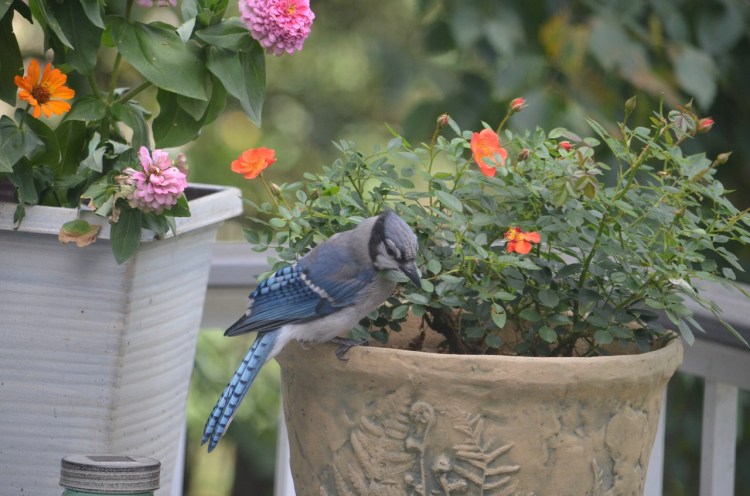
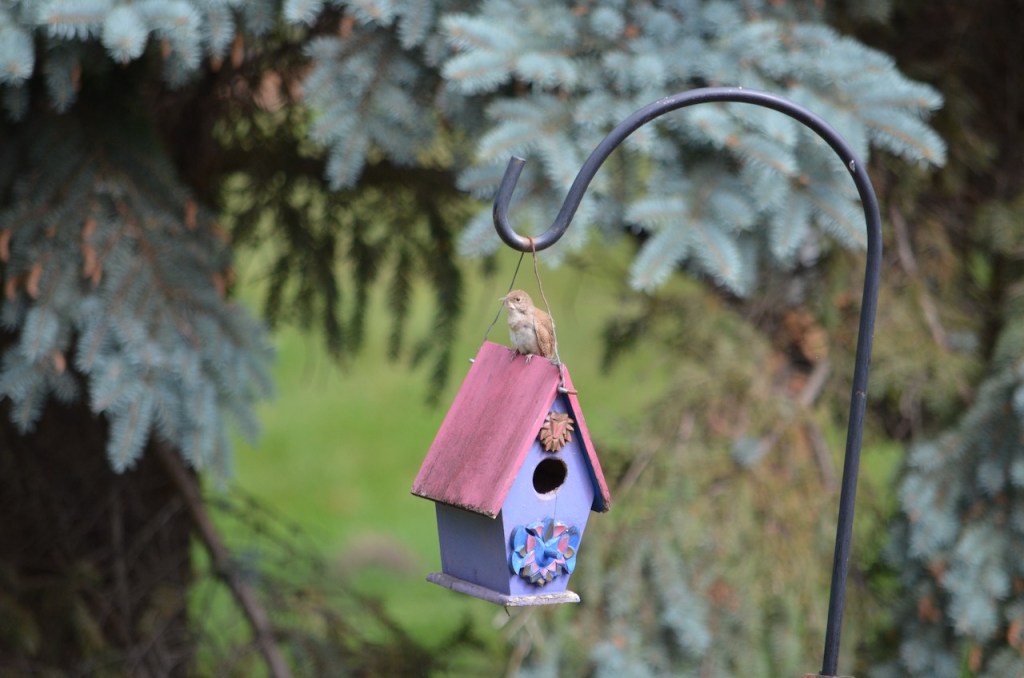
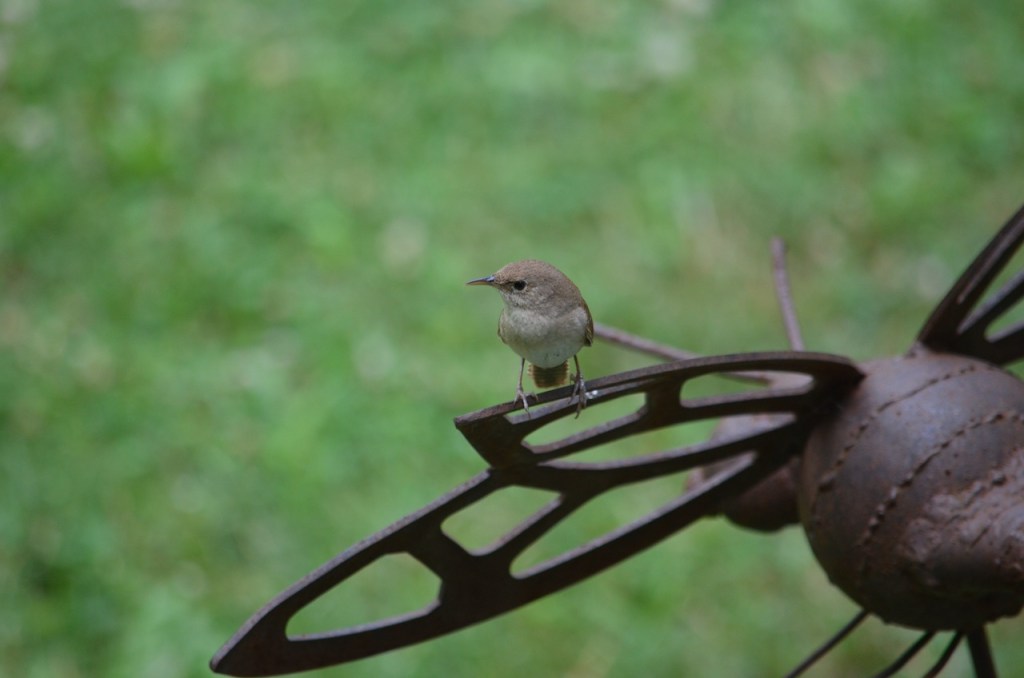
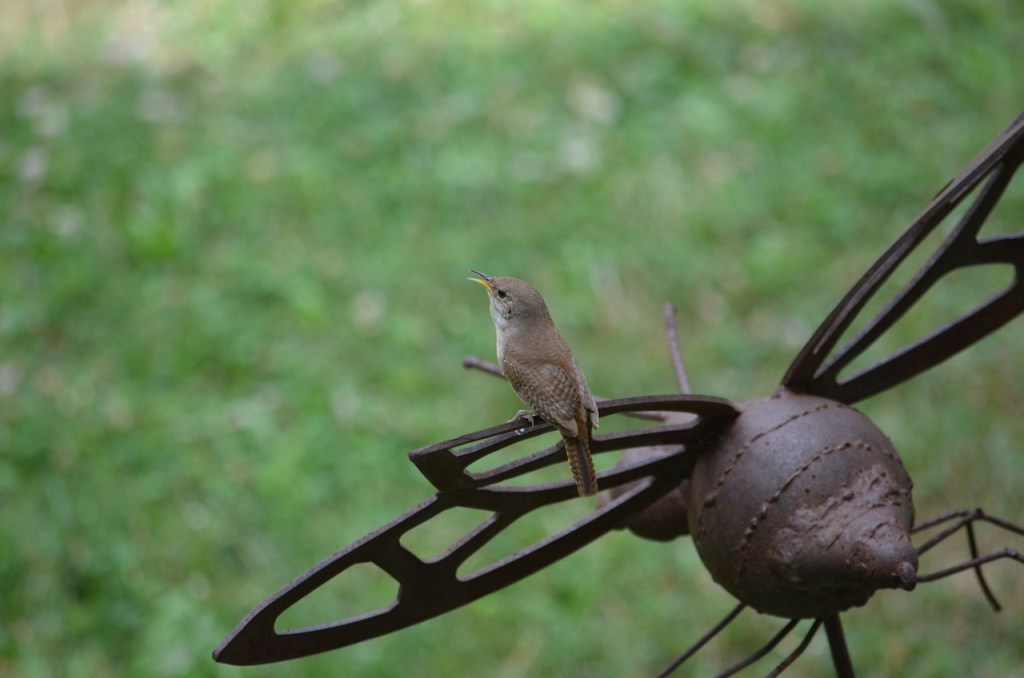
It’s been a magical couple of weeks around here. Our wild backyard has had lots of visitors. For a house in an urban area, we have more creatures passing through than I would have imagined when we moved here 25 years ago. We never get tired of seeing who’s meandering through our flowers or resting beneath our trees or flying into the pot of roses on the deck. The young blue jays seem particularly interested in those roses. The wren who lives in the bird house beneath our deck dive-bombed the blue jay shown in the photo above this afternoon. He was way too close to the wren’s home to go unchallenged. Some days, that wren patrols the entire backyard. We can hear him no matter where in the house we are.
Our resident wren.
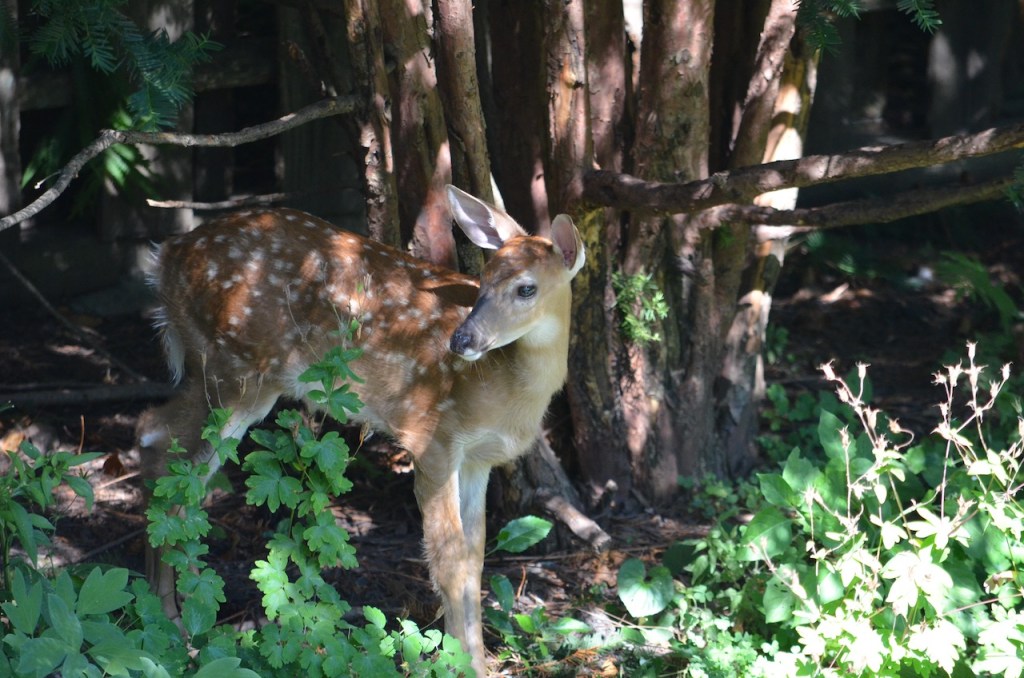
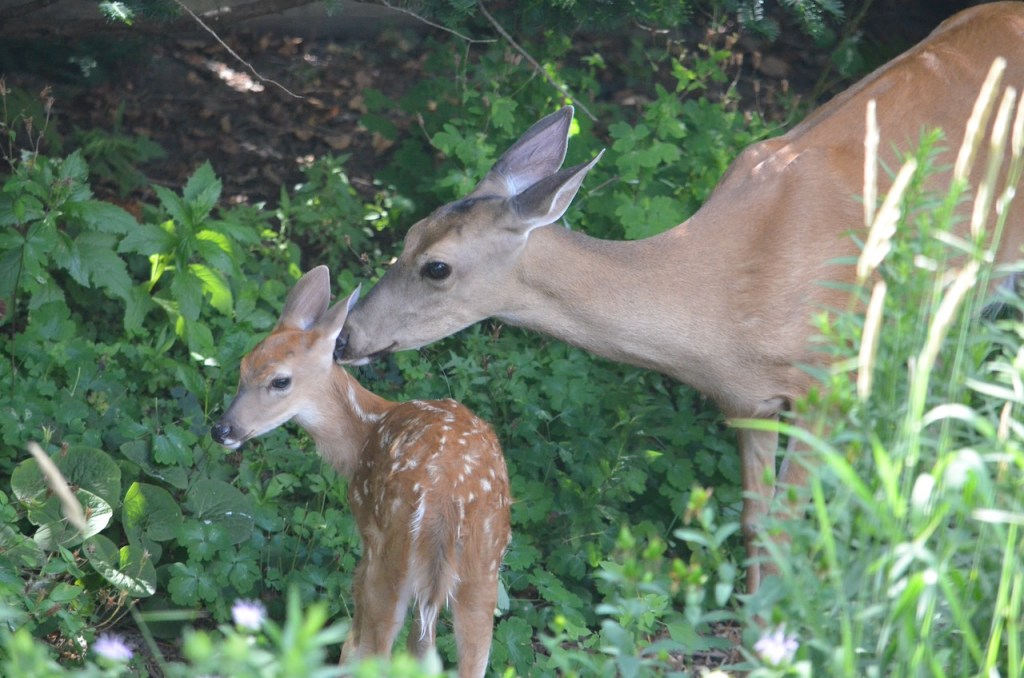
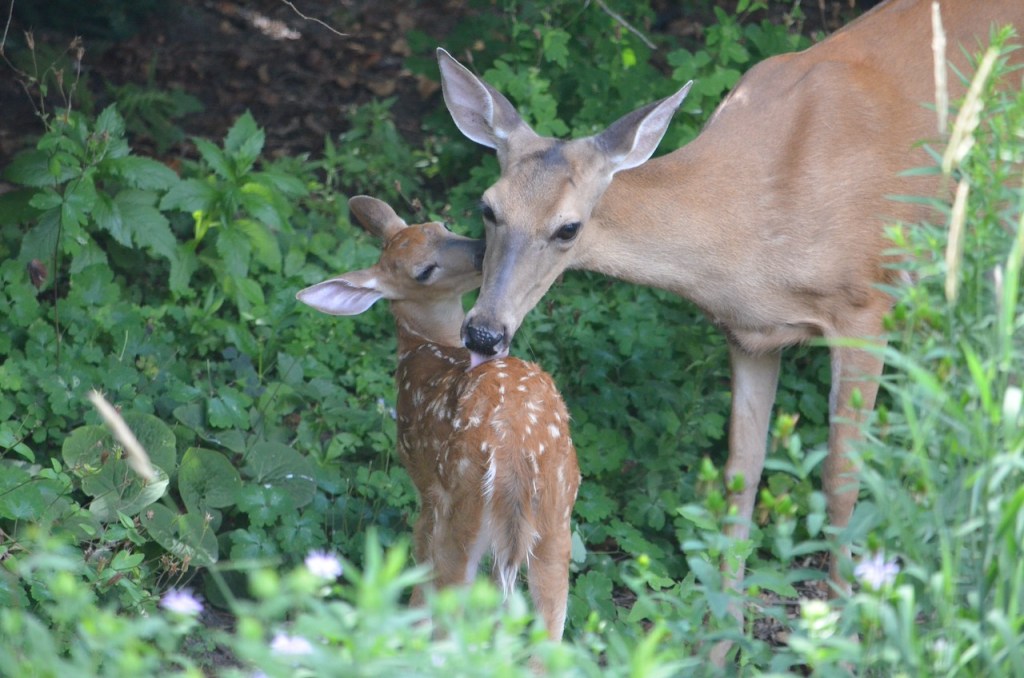
And we have a doe and her fawn who have been hanging around. The doe drops her fawn off some days, the fawn hunkers down in the wildflowers, and the doe returns hours later. She is an attentive mother, but not in the way humans are. Deer know when to let their young be, something I could be better at. I’m sure my kids would agree.
The fawn and her mom.
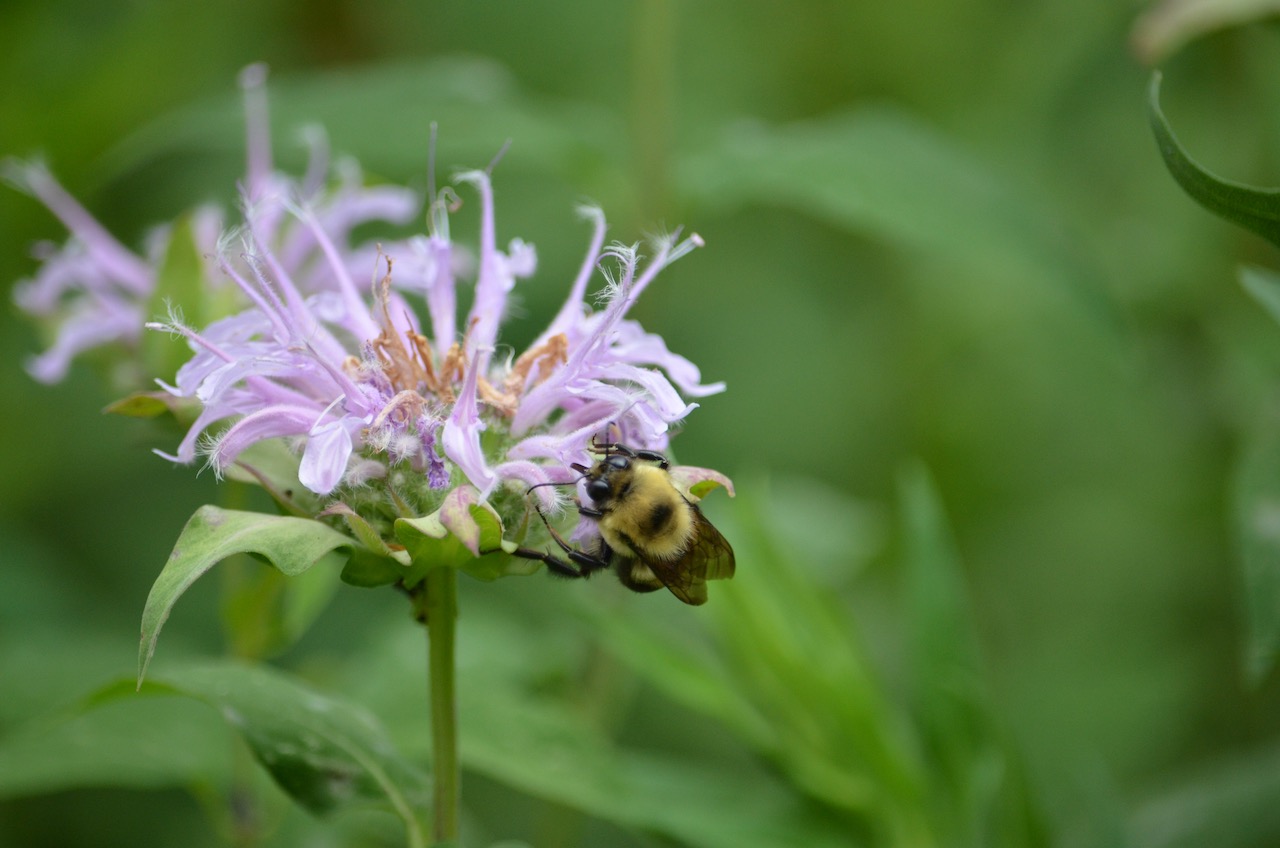
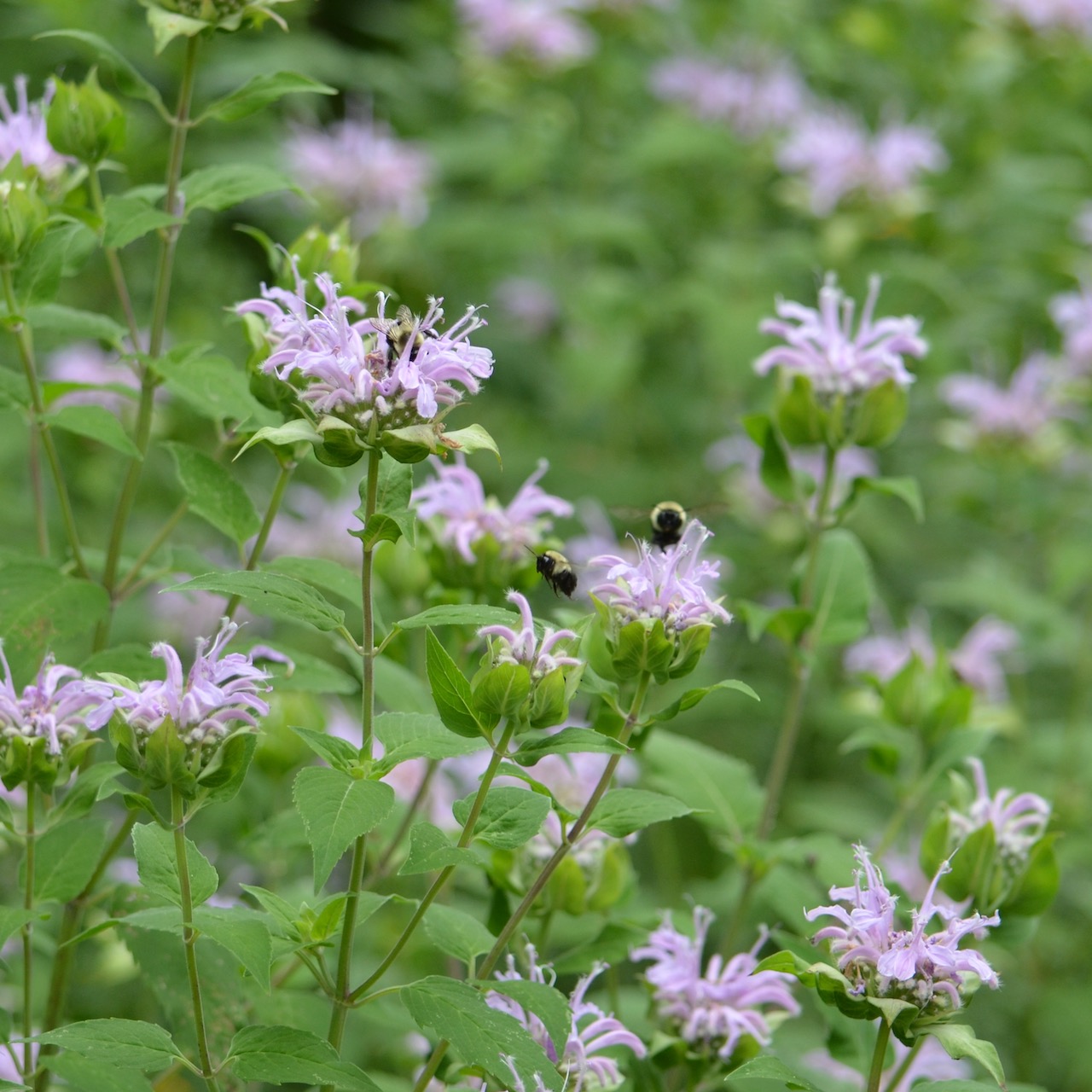
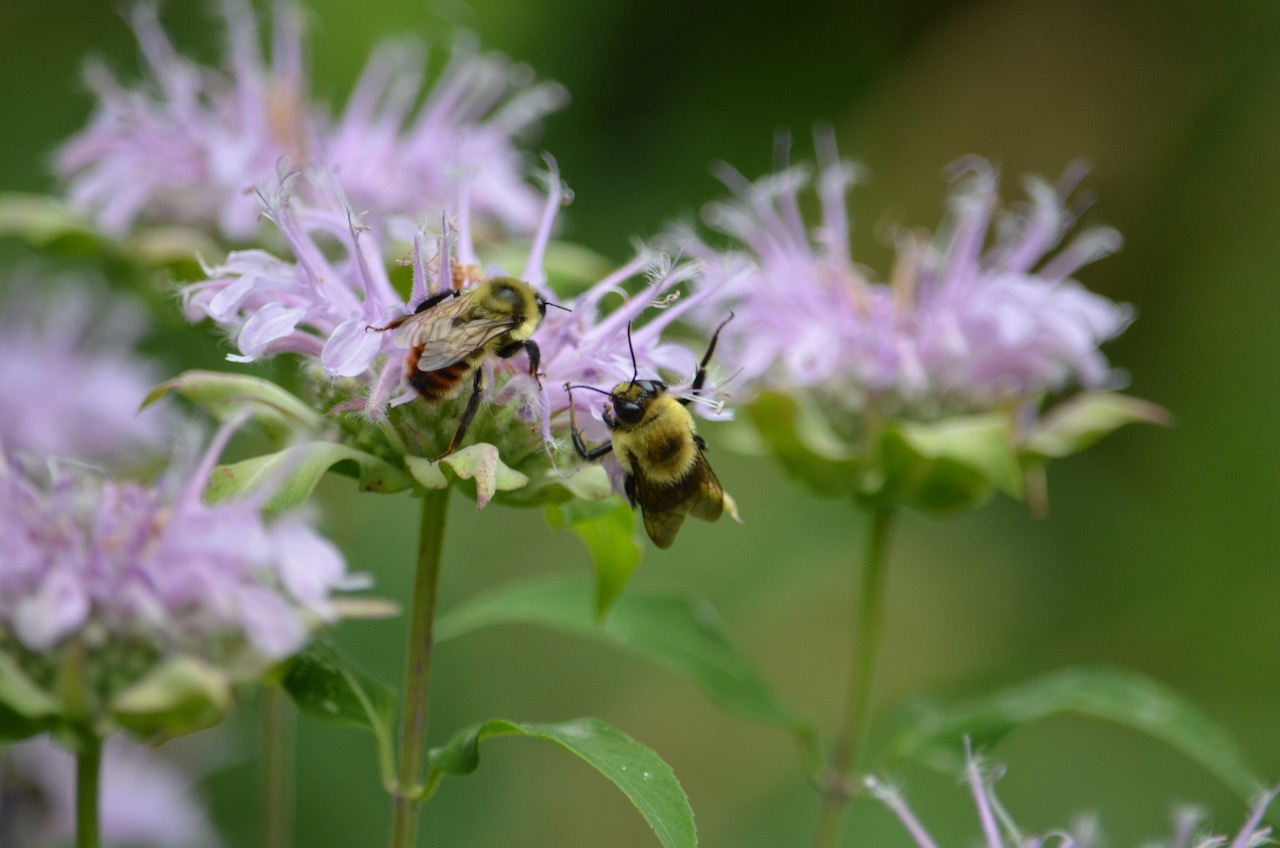
Now that August is here, the garden is full of bees.
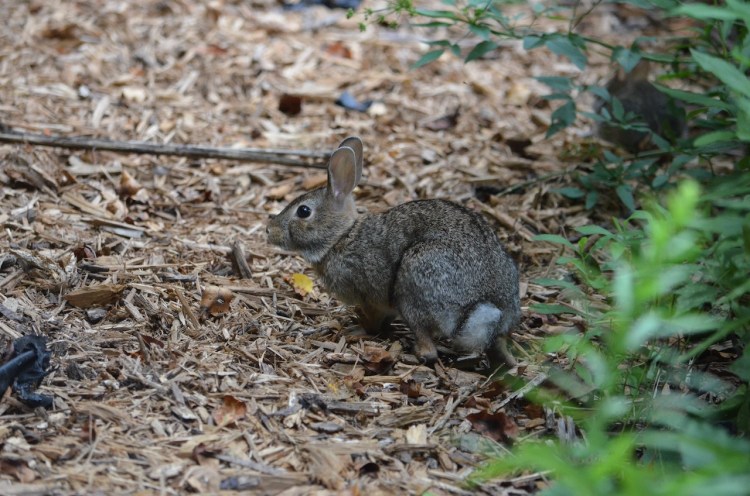
And rabbits.
This rabbit has a lot of relatives hiding in the wildflower garden.
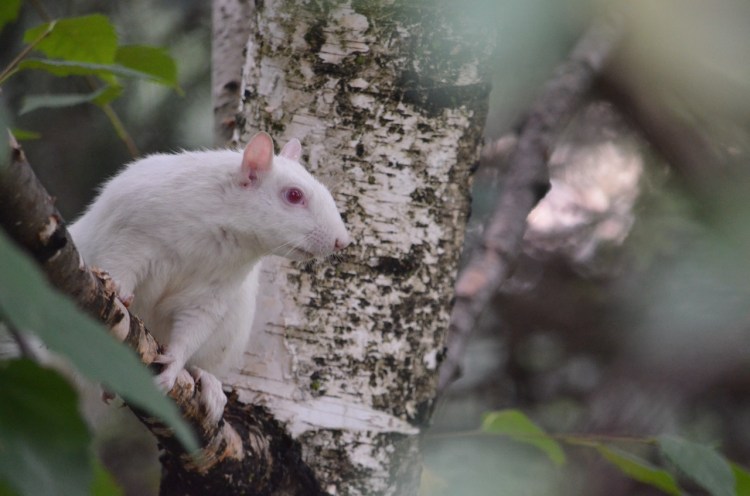
And my favorite albino squirrel.
This squirrel hung out in our birch tree one evening a few nights ago.
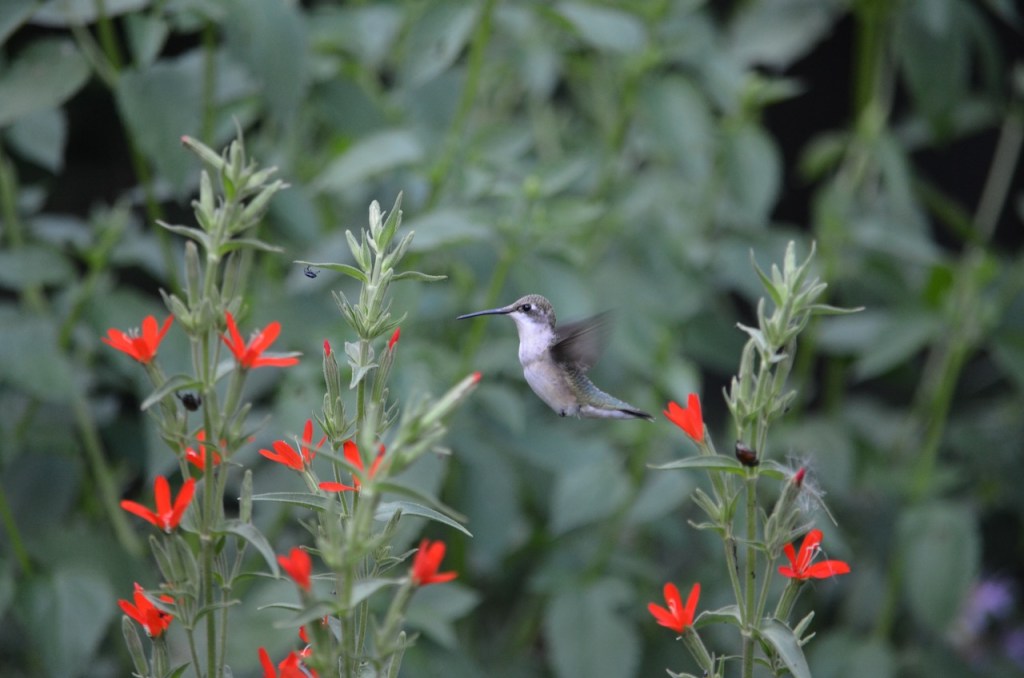
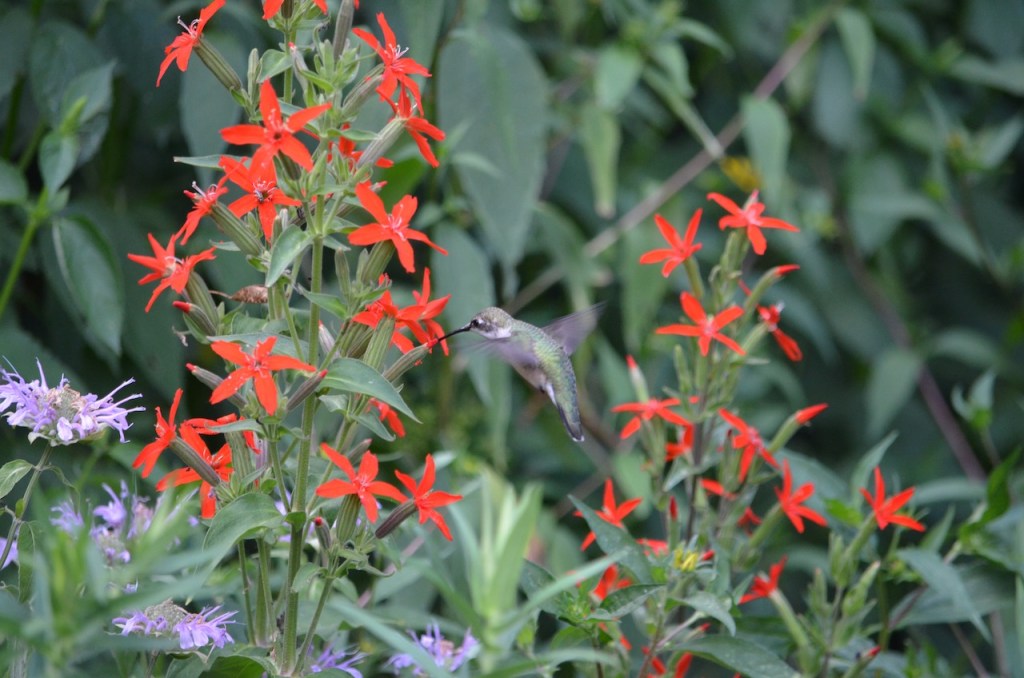
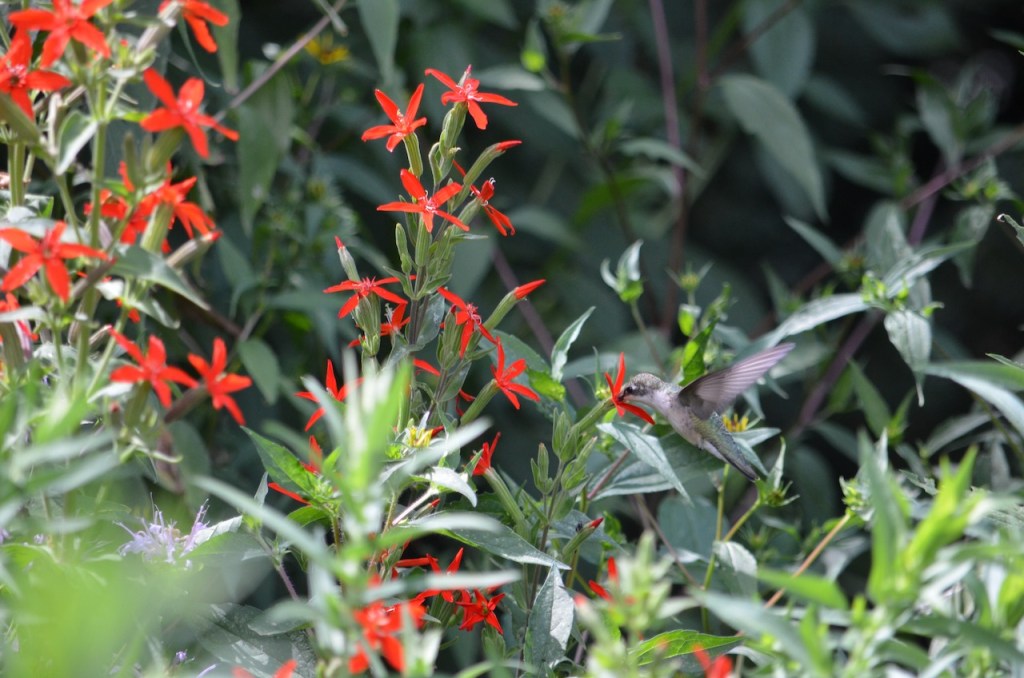
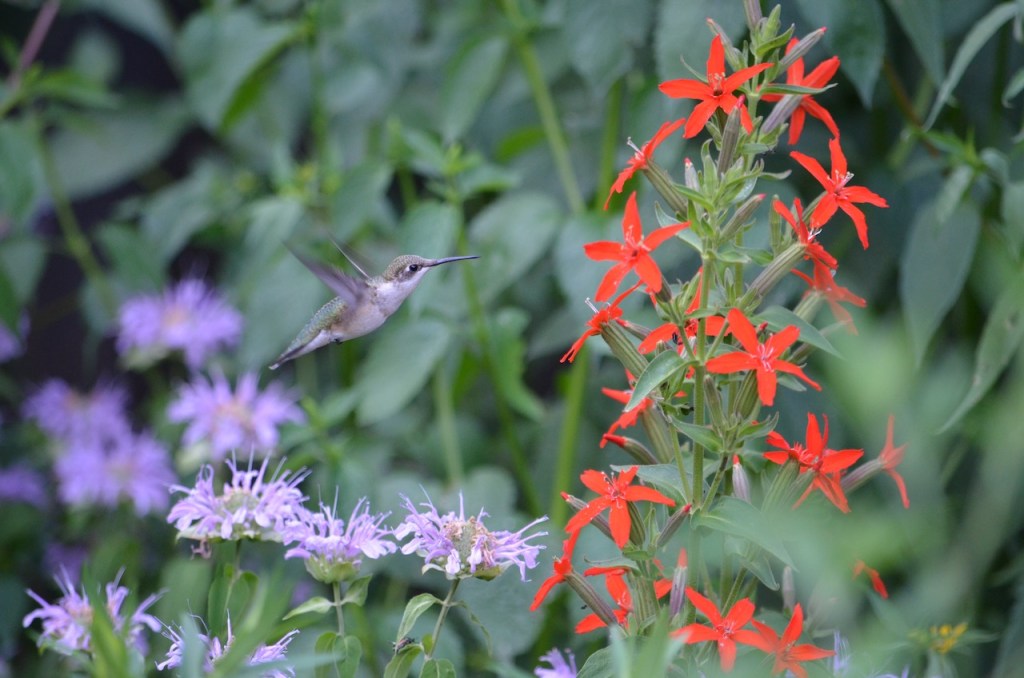
And, finally, I was able to grab a few pictures of the hummingbird that comes to visit our cardinal flowers and wild bergamot.
Summer is magical, there’s no doubt about it. Having so much activity in our own backyard is the best antidote to whatever stresses exist. These creatures don’t ponder whether to do what it is in their nature to do. They simply go forth.
I’m sitting at my dining room table on a Tuesday evening, patio door open to birds twittering their evening songs, air humid, sky rumbling. A big storm is on the way, according to the weather app on my phone. Mick is at band practice; he plays the saxophone in our friends’ old-school rock band. I have the local jazz station on.
I love the feel of a looming thunderstorm. The darkness that swiftly moves in. The hint of electricity all around. How the trees go still, the birds quiet. I wait for that first flash of lightning.
It’s been sticky outside all day. My granddaughter Maeve hung out with us, her little face a delight after not seeing her for two weeks while she and her mother and sister recovered from COVID. She was pretty happy until about 5 p.m. when she slid into universal crabby baby time. I took her to the front step, where there’s a bench and a rug. We sat there, Maeve playing and grabbing my fingers to help pull herself up every so often. She doesn’t seem very interested in crawling, but standing has appeal. I believe she’s going to take off running before long. Her impatience is palpable.
The first drops of rain are falling. And there’s the thunder, small grumbles of it. To the west, the sky is a mixture of sun’s last blush and storm, even though it’s too early for sunset here. The air coming through the screens is cool, caresses my bare toes.
The fairy lights in the glass jar on the patio table just went on. It shouldn’t be this dark for another 40 minutes.
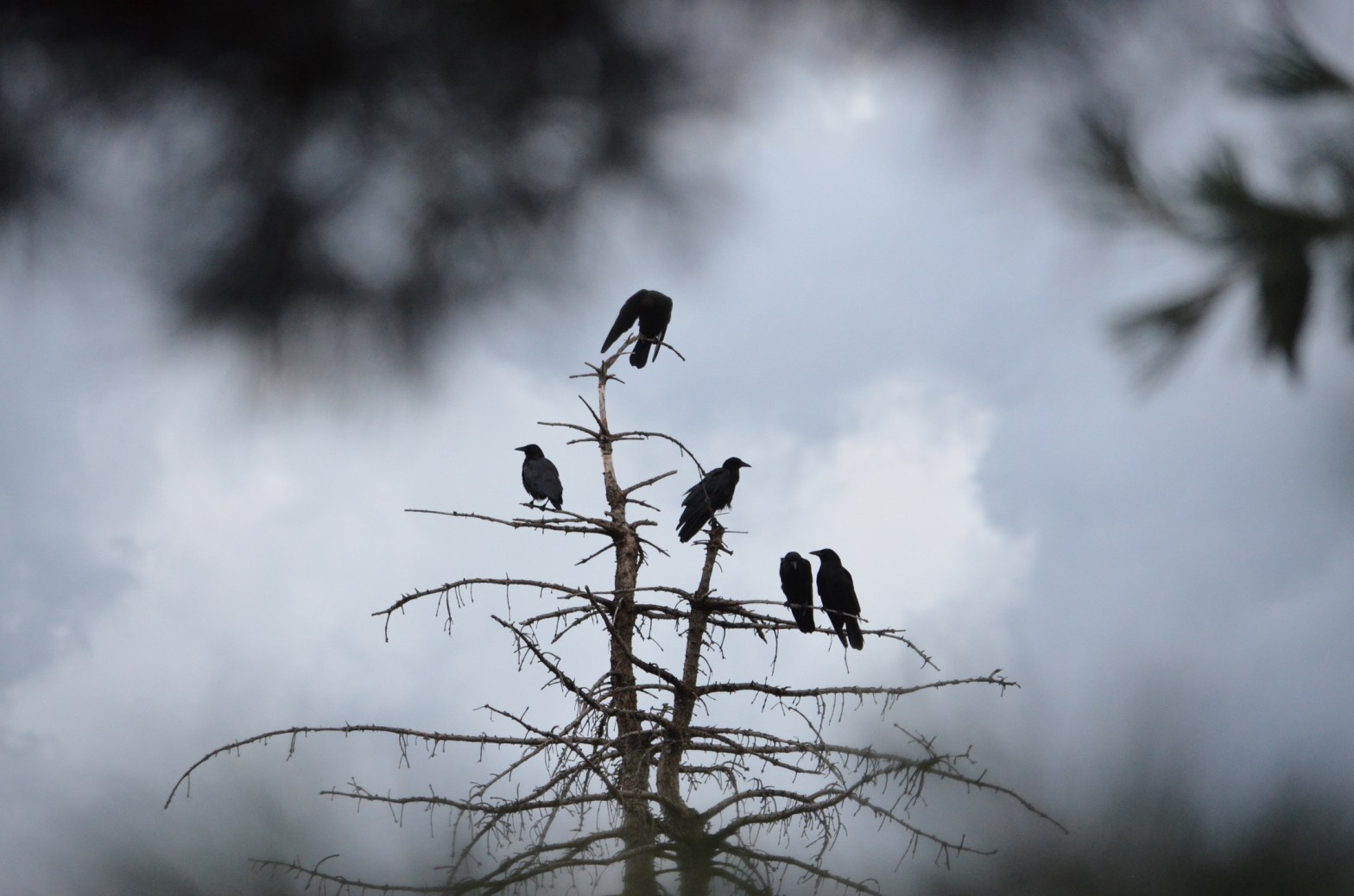
Half an hour ago, I washed some dishes at the kitchen sink. When I looked out the window over the sink, I saw five crows in the dead pine tree on the other side of the neighbor’s yard. They were perfectly outlined against the broiling clouds. I stopped washing the dishes, got out my old Nikon and the long lens. Who can resist crows? I shot four wonderfully moody photos that matched what I was already feeling: a little wild, a little turbulent. Just like the world feels most days now.
I think a lot about what kind of world Maeve is growing up in, worry about the fact that she’s a female child whose life is constantly challenged and shaped by how women and children are treated. I hope she’s a storm of her own, a force whose strength moves her along no matter what gets in her way.
The other solar lights on the patio just went on, a string of six white globes that turn different colors in the dark. Neither Mick nor I can figure out how they change colors without taking apart one of the globes, so we just enjoy them. They can be a mystery. More lightning, more thunder. Not much rain yet.
And there goes the weather app again: severe thunderstorm warning until 9:30 p.m. Nickel size hail. We’ll see. Hail is hit and miss – no pun intended. The last time we had hail, back in May, we had drifts of it pile up. It was the worst hail we’d ever had. I’m guessing this won’t be that bad, but what do I know?
Did I say there wasn’t much rain yet? Now there is. Time to lower the west-facing open windows. The trees are no longer still, but bending with the wind, leaves flipping on the branches.
Over the weekend, we went camping in Itasca State Park with four friends. On Sunday morning as we were taking down our tents, getting ready to head back home, our friend Kent’s weather radio gave warning of severe storms directly west of us, coming out of North Dakota. We finished packing up, followed each other out of the park and onto the nearest state highway. It wasn’t long before we were driving in torrential rain, beneath skies with all variations of swirling, hulking dark clouds. It was close to an hour of that kind of driving, where you can feel the water hit your tires as if you were driving into breaking waves. As we navigated wet roads and occasional wind gusts, Mick wondered aloud what the campground looked like at that moment. Neither of us is an experienced camper (our friends are) and we weren’t sure how we would have handled being caught in a storm like that with just a tent between us and the weather. Even though I love storms, I might have been a tad uncomfortable sitting in a tent while thunder boomed and lightning flashed.
But sometimes there’s nothing between us and the world: not a tent, a house, any solid shelter. Think of things like terrorism, war. The kids who died in Uvalde from the short, sharp thunder of a madman’s gun. The people of Ukraine living and dying with the booms and flashes of Russian missiles and bullets. What can stand up to that? What can move between the people dying and those inflicting death? Ah, that takes the whole world’s efforts, doesn’t it?
Now it sounds like the rain has already let up a bit. The trees are still again. This was just a little storm, moving quickly, doing what summer thunderstorms do: giving us a little darkness, a little danger, then moving away until only flickers and whispers were left of the disturbance. I know Maeve is safe in her crib now. I wish I could say the same for all the children, everywhere.
I’ve struggled with what to say in today’s post because, like millions of other Americans, I’m carrying so much disappointment, anger, frustration, and more over the recent Roe v. Wade decision. I’ve also been thinking how important refuge is right this minute – places where voices can fade away and arguments be suspended to allow a breath to be fully expanded, a body to gather a bit of rest, a mind to slow down and renew its agility. We – by which I mean feminists and LGBTQ+ and pretty much anyone who isn’t an old white man or a far-right Republican – have an awful lot of work ahead. Refuge, haven, sanctuary, sanctum: these are essential to keep ourselves going.
Window in an old log on a restorative hike in Flandrau State Park, New Ulm, Minnesota.
I’ve written before about the refuge I find in my own garden and on hikes through the woods, along rivers, near lakes. There is refuge in meditation, whether it’s sitting still on a zafu or walking silently with intention. There is refuge in cooking, especially if it’s for someone else – slowly chopping vegetables, taking time with the cooking method and to smell the aromas of food cooking because to hurry through such preparation only adds to tension. There is refuge in going to the farmer’s market, mindfully choosing only what will be used and conversing with the person who grew it or made it. There is refuge in an evening glass of wine with a backdrop of birds settling in for the night and the perfume of summer blooms. There is refuge in holding the hand of a loved one. There is refuge in playing music, writing poetry, reading.
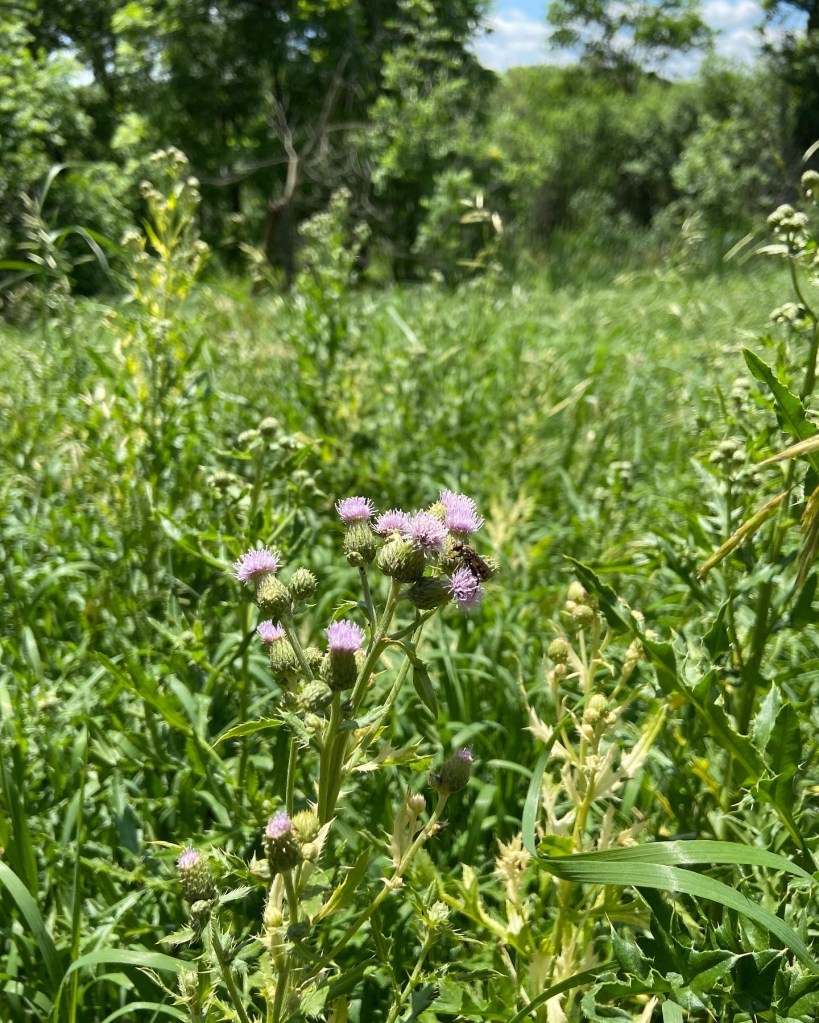
Watching pollinators visit thistle on a hike in Flandrau State Park, New Ulm, Minnesota.
The older I get, the more I naturally slow down in the face of strife, of unrest, of dissent. The importance of taking time to gather thoughts and strength, to get the argument right, feels greater. Certainly quick reactions are needed at times: for self-defense, to stop a disaster from wiping out everything. Nuance also has its time: persuasive arguments, long-range plans. The gift of being older is more experience with just how long things really take, how a seemingly small decision today becomes a movement in a few years, how unlikely people are to change their minds in the short run, how much patience and vision matter, the backlash that happens when a system is dismantled quickly.
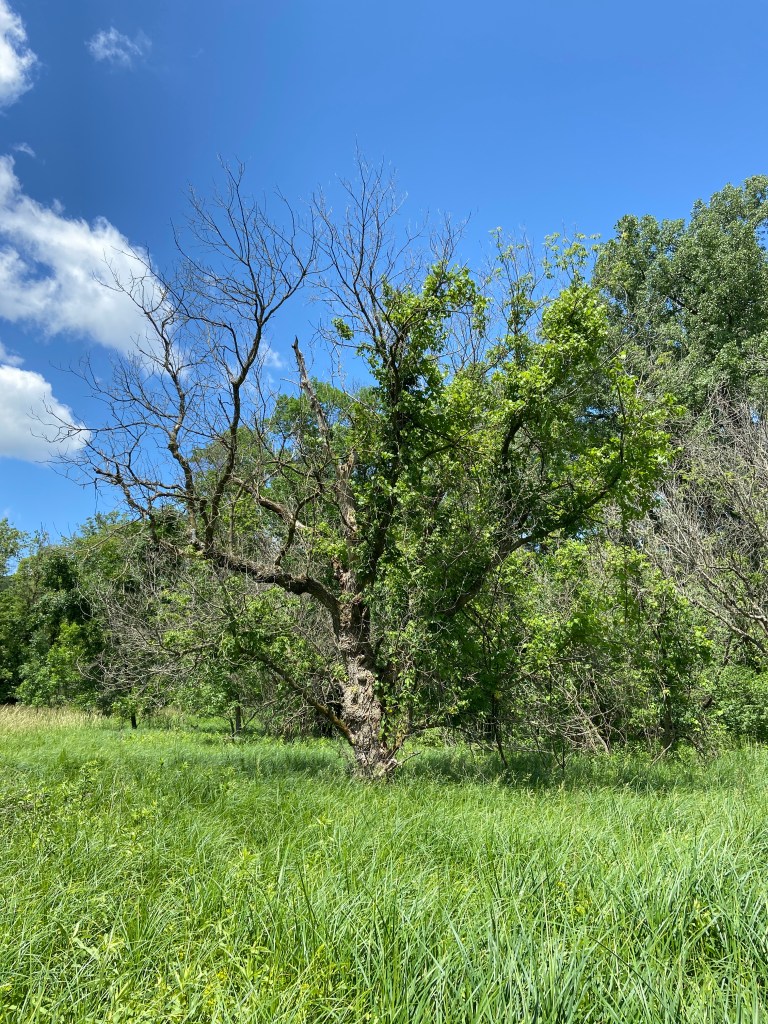
This old tree supports vines and offers refuge even as it dies off. Flandrau State Park, New Ulm, Minnesota.
And so. Before I began this essay, my partner Mick and I hiked in Flandrau State Park in New Ulm, Minnesota, two days after Roe v. Wade fell. We both needed to be in the company of trees and birds and water. We were quiet for most of the hike, following it with a flight of beer at the nearby Schell’s Brewery. Later, in the middle of writing this post, I took time to walk around Como Lake in St. Paul with my daughter. Our conversation certainly included Roe v. Wade and women’s health and rights, along with other rights we are both worried about. I assured my daughter I would help her in the future if there was any women’s healthcare she had trouble accessing. But we also sat quietly at the Como Lake Pavillion, sipping beverages and eating blueberry muffins. Later that same day, I meandered outside to deadhead coreopsis and salvia, water tender herb seedlings, make the birdbath more level so not so much water slops out one side. All the while, I was thinking, thinking, thinking. Listening to the world around me and to what was inside my own head. I called my friend Luann, talked about our upcoming camping trip in Itasca State Park, and our conversation, too, circled back to women’s rights, human rights, what we as older women could do for our daughters in particular. Then I came back to this essay, still unclear about so much except my promise to be there for the younger women I know and love.
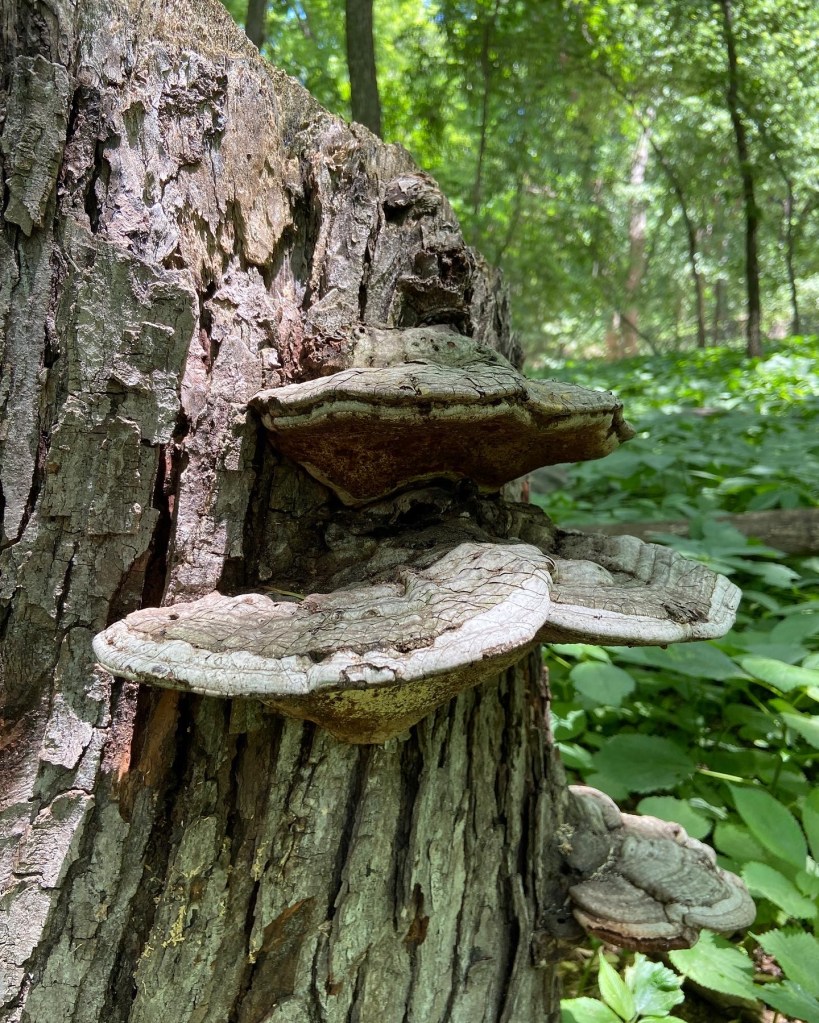
Shelf fungus lives on an old stump, Flandrau State Park, New Ulm, Minnesota.
But answers will come. I’ve found a place – The Brigid Alliance – to donate funds to help women anywhere in the country gain access to the care they need. I’ve learned that there will be a Women’s March Minnesota event at the State Capitol on July 17. These are two things I can do this summer.
I have my sanctuaries that sustain me. They help assure that I can be one more strong thread in a huge fabric of human rights advocacy, the fabric that holds up women and, by extension, every other human being. Even those who disagree.
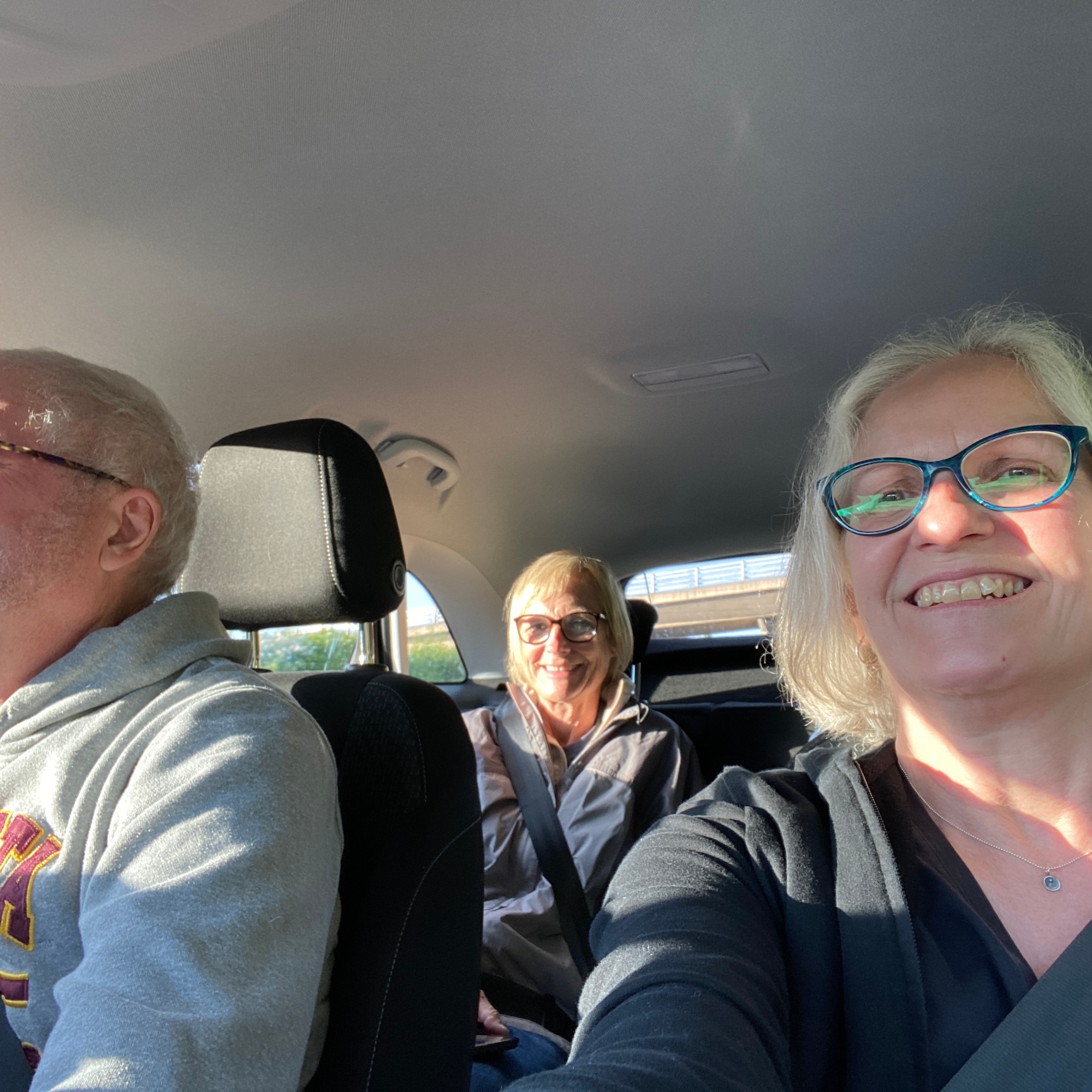
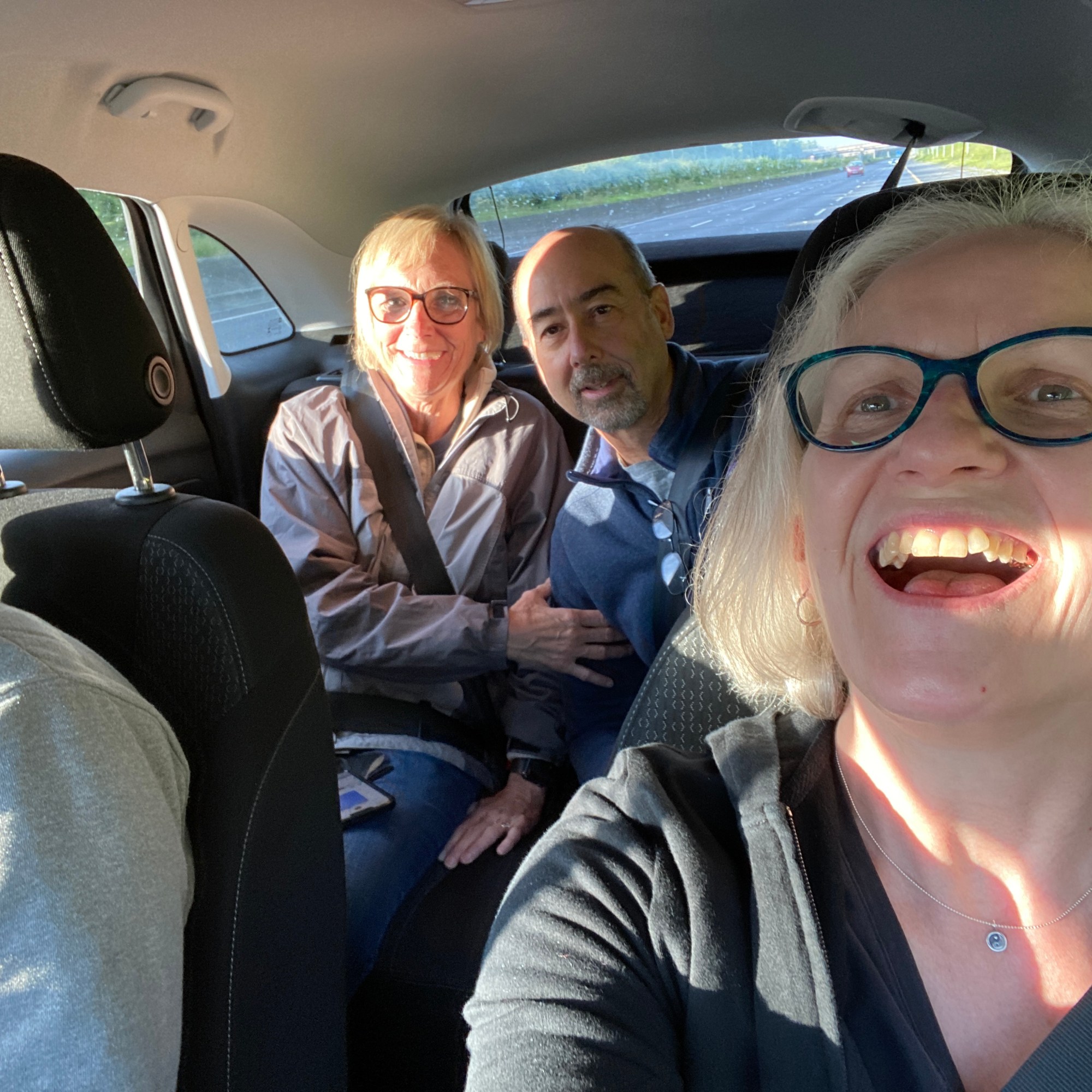
It was with a certain amount of pandemic-induced trepidation that I packed my 40-liter backpack for 10 days in Ireland the evening of May 27. In the morning, my partner Mick, our friends Mark and Mary, and I boarded a plane to Chicago, landed at O’Hare, boarded another plane to Dublin. We arrived in Dublin at the crack of dawn on a Sunday, then headed north in a rented Opel Crossland with a manual transmission.
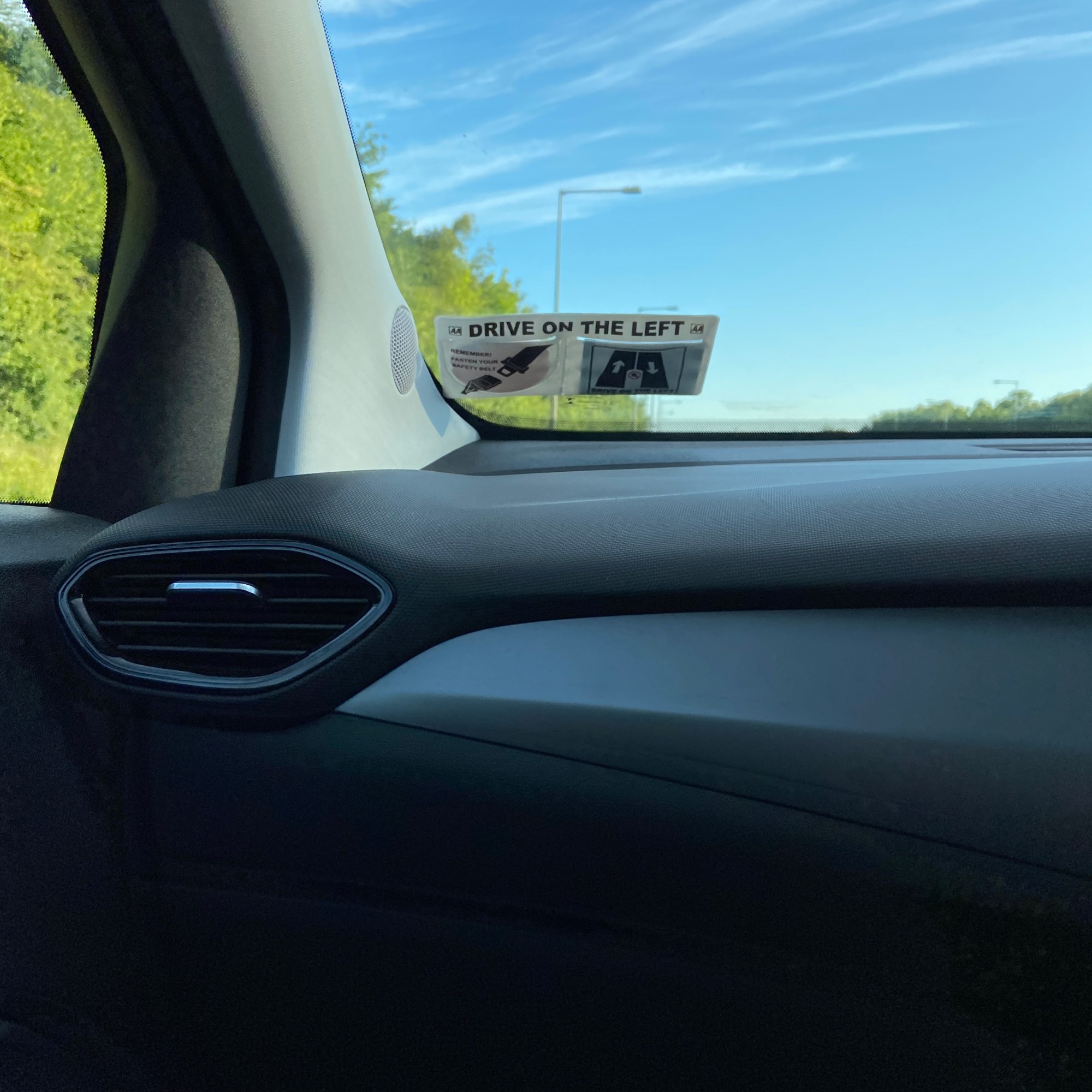
I thought there would be more formality as we crossed the border into Northern Ireland. Our first clue that we were now in the United Kingdom was a Union Jack flying in the stiff breeze near a building that my jet-lagged brain filed under petrol station. That may be incorrect. Our second clue was the change in the speed limit number. We had been traveling at 120 kilometers per hour. Suddenly, we were directed to travel at no more than 60 miles per hour. Our rental car’s speedometer showed only kilometers.
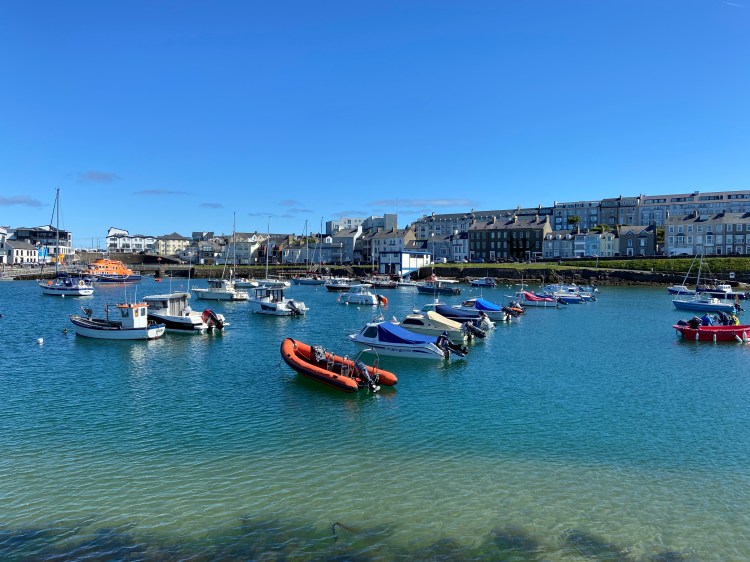
Portrush is the town my friend Oonah once lived in as a young adult. I was unprepared for the big Ferris wheel by the beach and the famous royal golf course. In my mind, there had only been the beach at the top of Northern Ireland. Our B&B was run by a couple named Sam and Tim. They were delighted to answer our questions about local attractions.
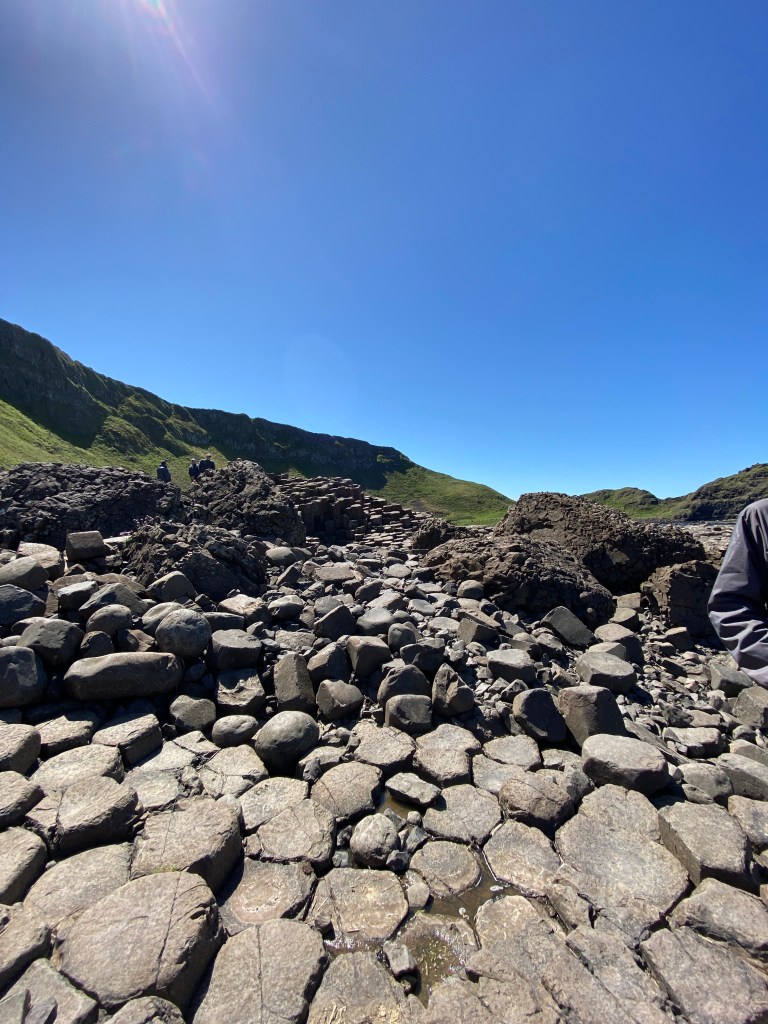
Portrush was the base from which we saw the otherworldly basalt formations that are the Giant’s Causeway, ordered a flight of whiskey at Bushmills Distillery, strolled among the Dark Hedges, decided not to cross the rope bridge at Carrick-a-Rede, looked down on the remains of Kinbane Castle from a long stair-laden path. We acquainted ourselves with the narrow roads we’d be on for so much of our trip, roads on which a manual transmission was a gift.
Portrush, Northern Ireland
At the Giant’s Causeway
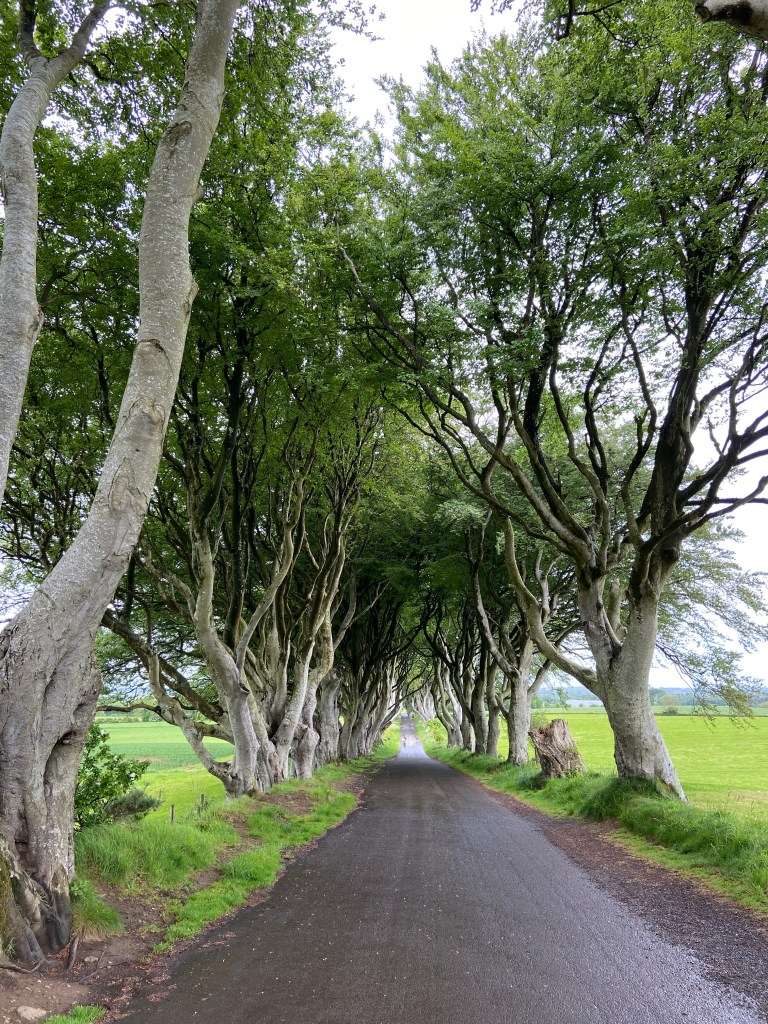
Dark Hedges
Stairs to Kinbane Castle ruins – ruins are visible at the bottom
Flight of whiskey at Bushmills distillery
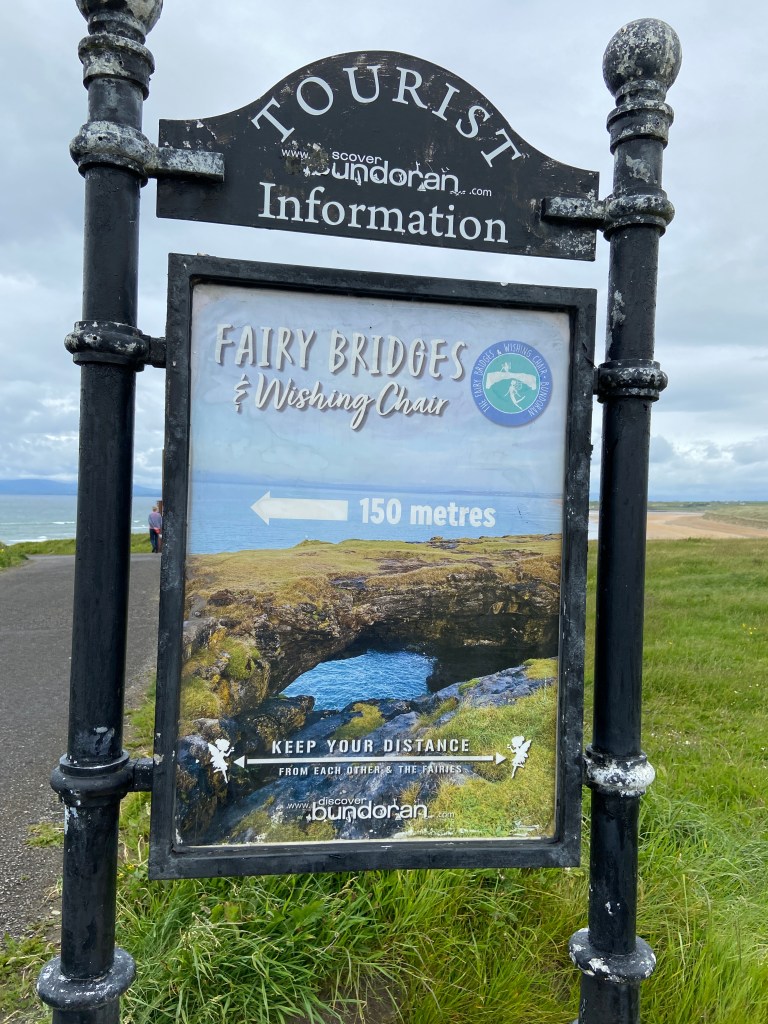
Our last stop in Northern Ireland was at the Fairy Bridges in County Donegal. No. I’m wrong. County Donegal is not in Northern Ireland. The Fairy Bridges are not in Northern Ireland. We crossed the border at Derry (Londonderry to some). The fairies paid us no mind, but they know that the Fairy Bridges are further north than much of Northern Ireland itself. Borders are slippery, irregular things.
Arriving at the Fairy Bridges
Fairy Bridges
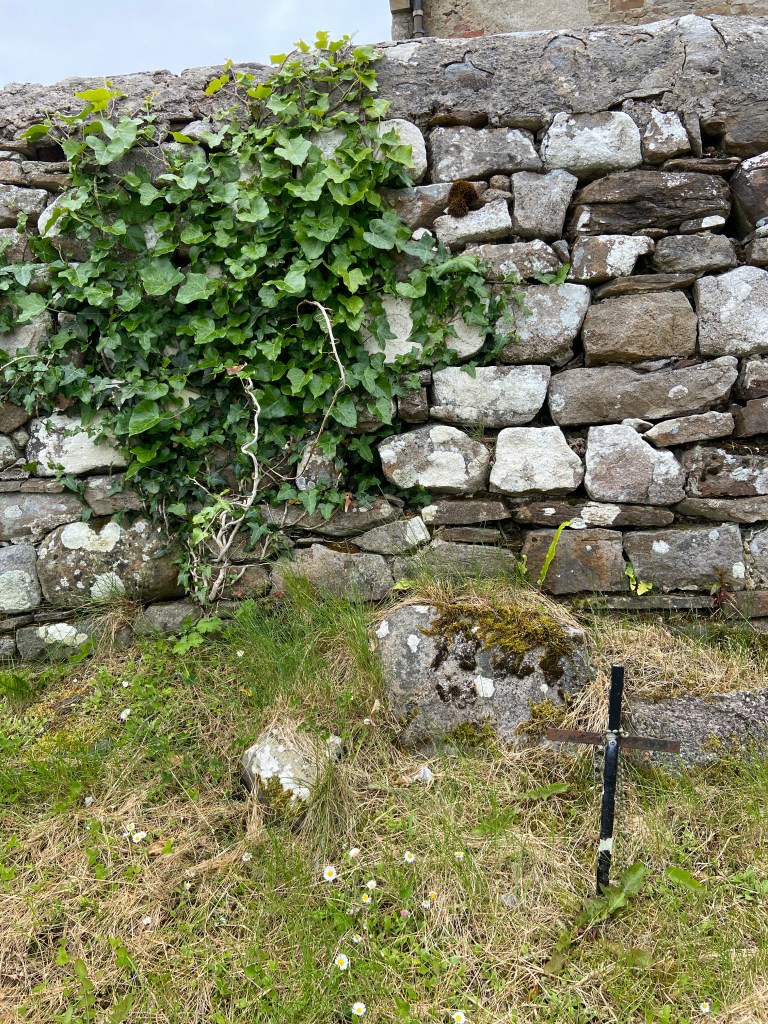
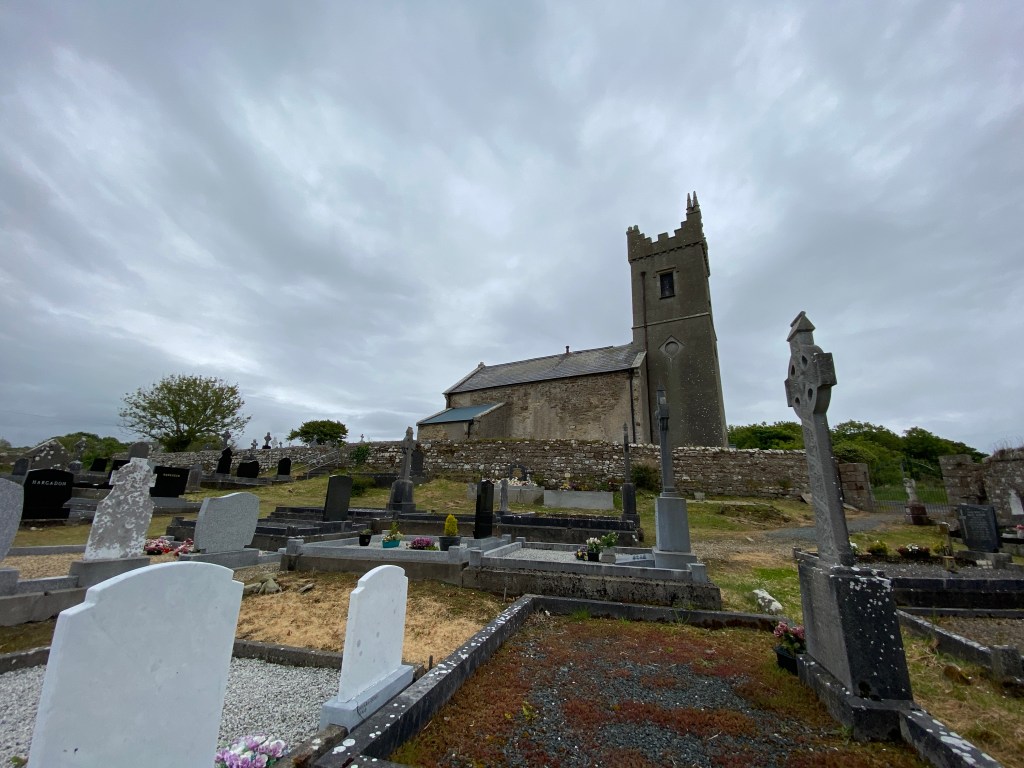
Old cemeteries invite contemplation. Just before we got to Sligo, the four of us stepped delicately around a cemetery outside an abandoned church. The cemetery held a fresh grave in spite of the church’s disuse. A baby kestrel greeted us with rumpled fuzzy feathers and bright eyes as we rounded one side of the church. We looked at headstone after headstone, searching for a surname that was in Mark’s family tree. He found it, took a photo, paused for a moment.
There was no one else in the graveyard until just before we left. A middle-aged woman came through the weathered iron gate, stood with head bowed before a newer grave. We kept our distance.
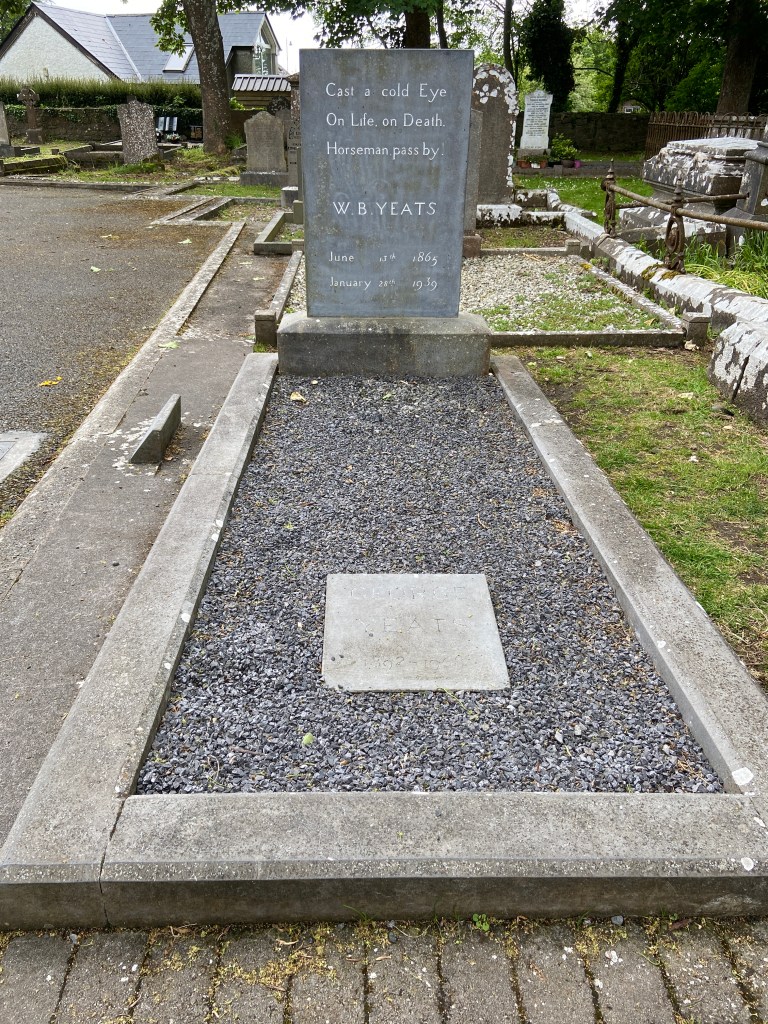
From there, we drove to W.B. Yeats’ grave. That cemetery was, of course, well-tended for the tourists. I preferred the other one with all its crumbling old stones and weeds. After that, we’d had enough of death and remembrance for one day. On to Sligo, to clean rooms, a pub.
A cemetery just north of Sligo
I loved the simplicity of this site
The church building fallen out of use surrounded by the graveyard
WB Yeats’ grave is quite well-tended
The view from our hotel room in Sligo
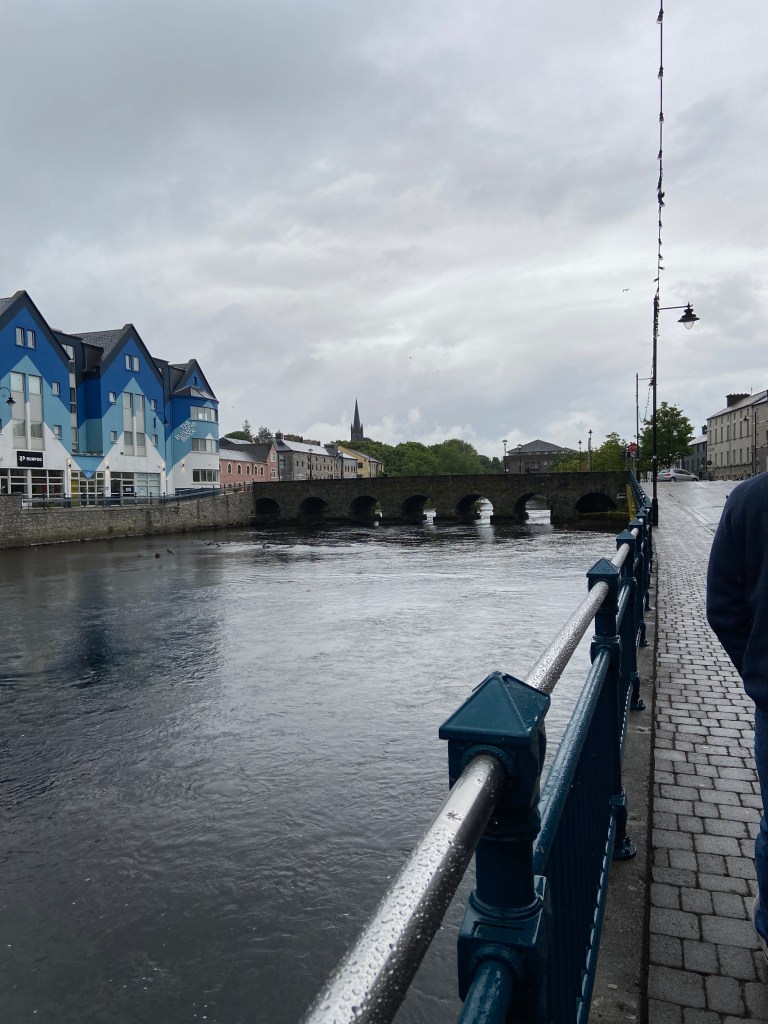
There’s an old-school bar-restaurant in downtown Sligo called Walker’s. We found it in the rain on a Tuesday night after the restaurant recommended by our hotel bartender turned out to be closed. It wasn’t too crowded, one of our deciding factors for dinner spots on this whole pandemic-affected trip. In fact, it was perfect. Dark wood, a long bar, small tables. Wood-framed windows looking out on the rain-slicked street. A charcuterie board for the four of us, a shared burger for Mick and me, some wine, some beer. We took our time. There was nowhere else we had to be.
A rainy evening in Sligo.
After Sligo, we navigated narrow, shoulderless roads to Connemara National Park. An unconcerned sheep stepped out in front of Mick as he sped along, causing all of us to perk up a little more. We later learned the sheep like to lay in the road because the asphalt is warm.
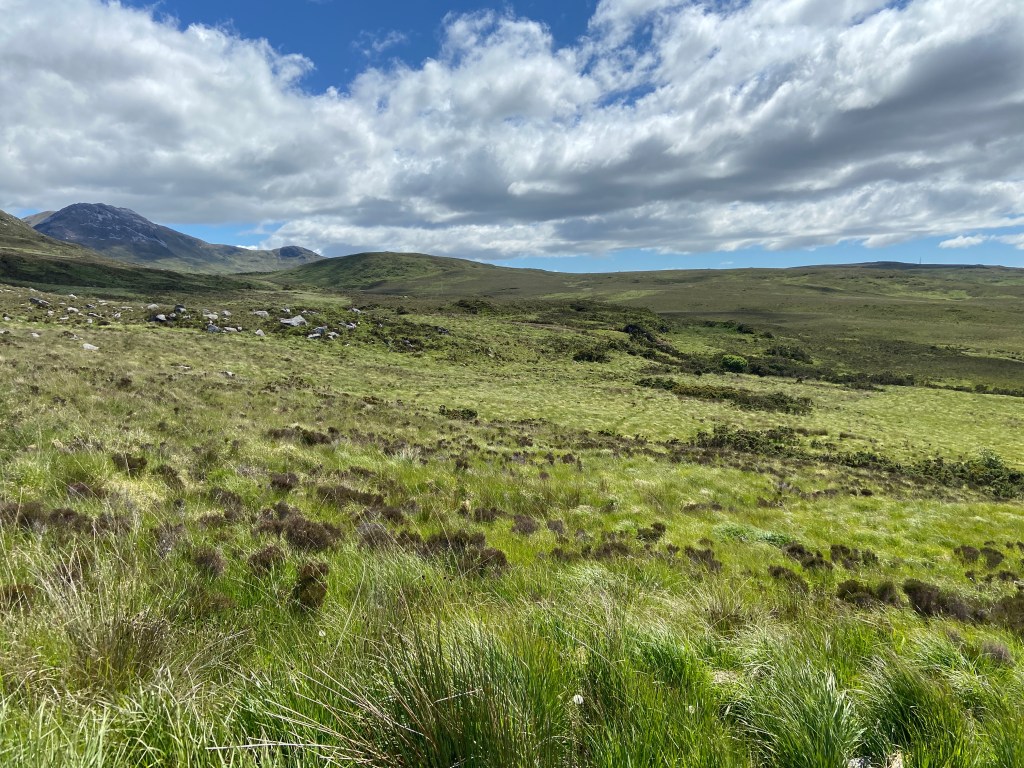
The park had several walking paths from which to choose, all color-coordinated to indicate level of difficulty: yellow, blue, red. We chose blue, walked beneath great swaths of bright Irish sky, gazed at low mountains, laughed at a playful foal and a fuzzy lamb. We tsked over someone who let their dog run loose in spite of postings not to do so for the sake of the sheep. The park cafe beckoned when our walk was complete.
From there, we drove on to Clifden and Abbyglen Castle, where Mick nearly met a car head-on as it barreled up the skinny driveway toward us. He backed up in a hurry, jamming the transmission into reverse and spitting gravel around a sharp uphill corner, then tried again once the car was gone.
Connemara National Park
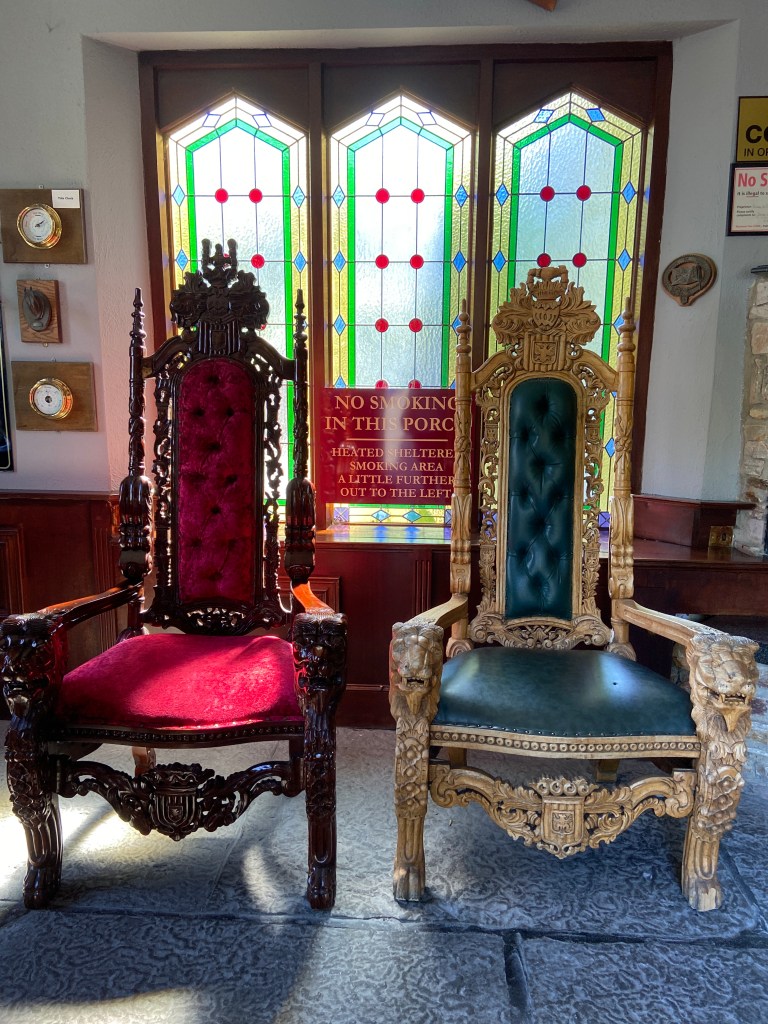
A night in a castle. Throne-like chairs in the entryway for photo ops. A champagne reception in the main floor piano bar/pub. A delicious dinner in the upstairs dining room where we waved away the person who tried to put an American flag on our table; we just wanted to be fellow travelers. A post-dinner stroll into the center of Clifden, a town known for the first transatlantic radio signal transmission and the first successful transatlantic flight landing. That the flight landed in a bog does not diminish its importance. We found a pub and listened to two guys with guitars play popular songs while we sipped our pints. Back at the castle, the piano bar morphed into a late-night disco. We chose the quiet of our rooms, that quiet being relative. Castles, it turns out, aren’t entirely soundproof.
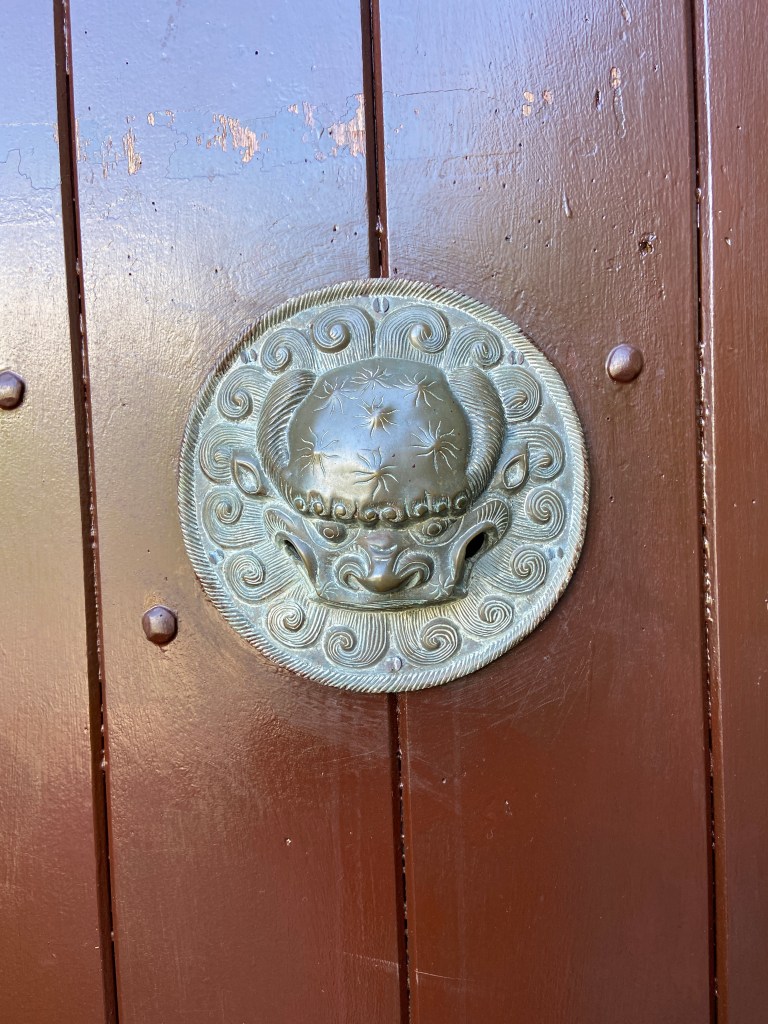
On the door to Abbeyglen Castle
Abbeyglen lobby
The wonderful royal chairs in the entryway at Abbeyglen
Yeats quote inside the entryway
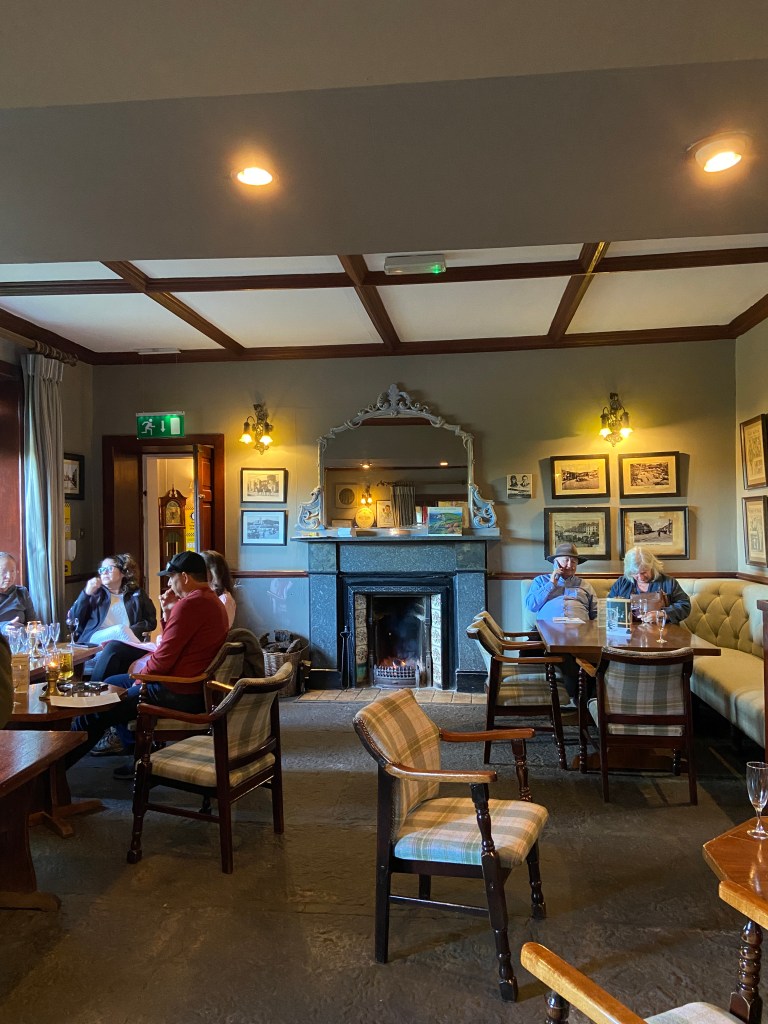
The Abbeyglen pub where we attended a champagne reception
Seen on our stroll into the center of Clifden
All of us walking through Clifden
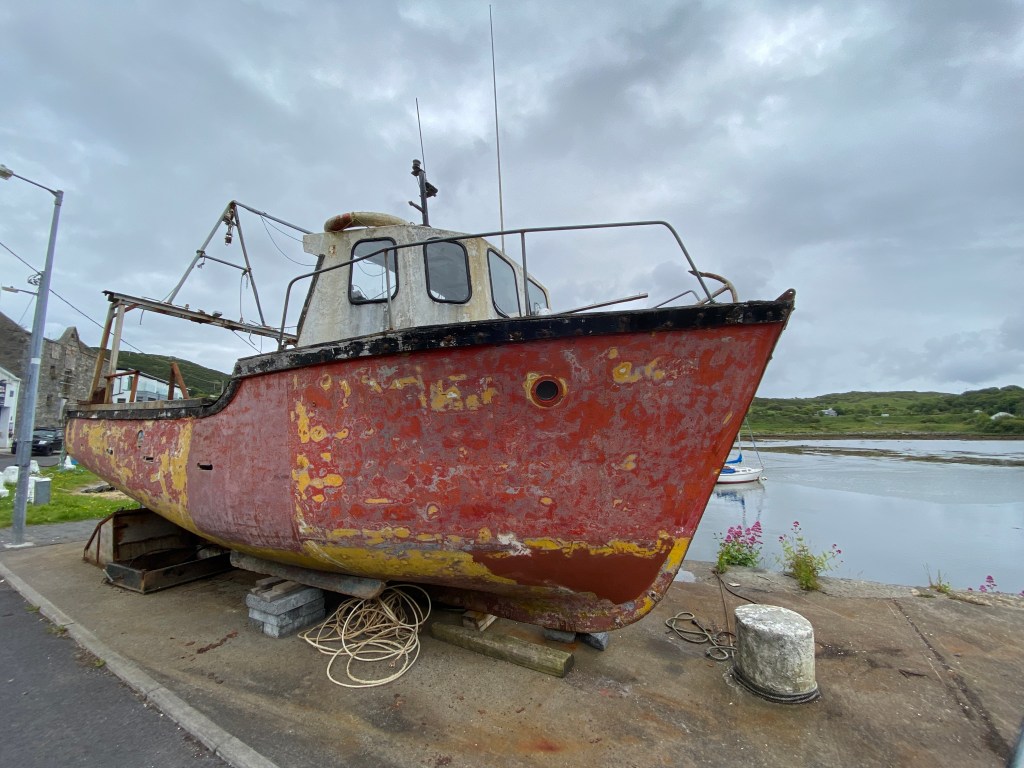
In Clifden’s harbor
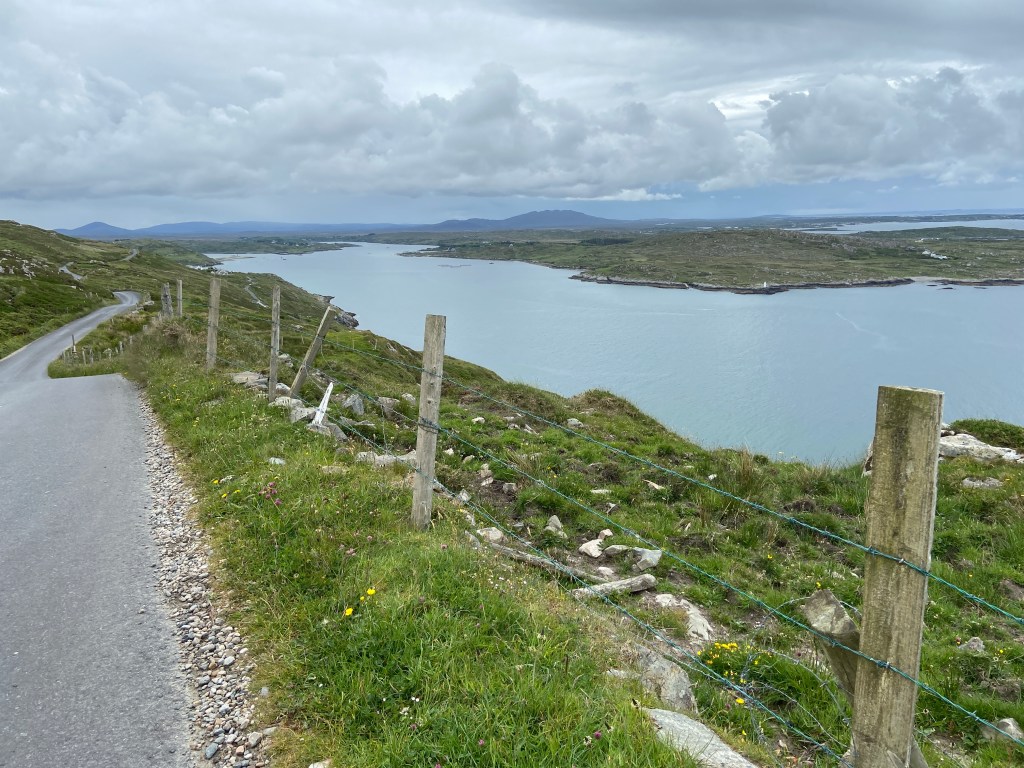
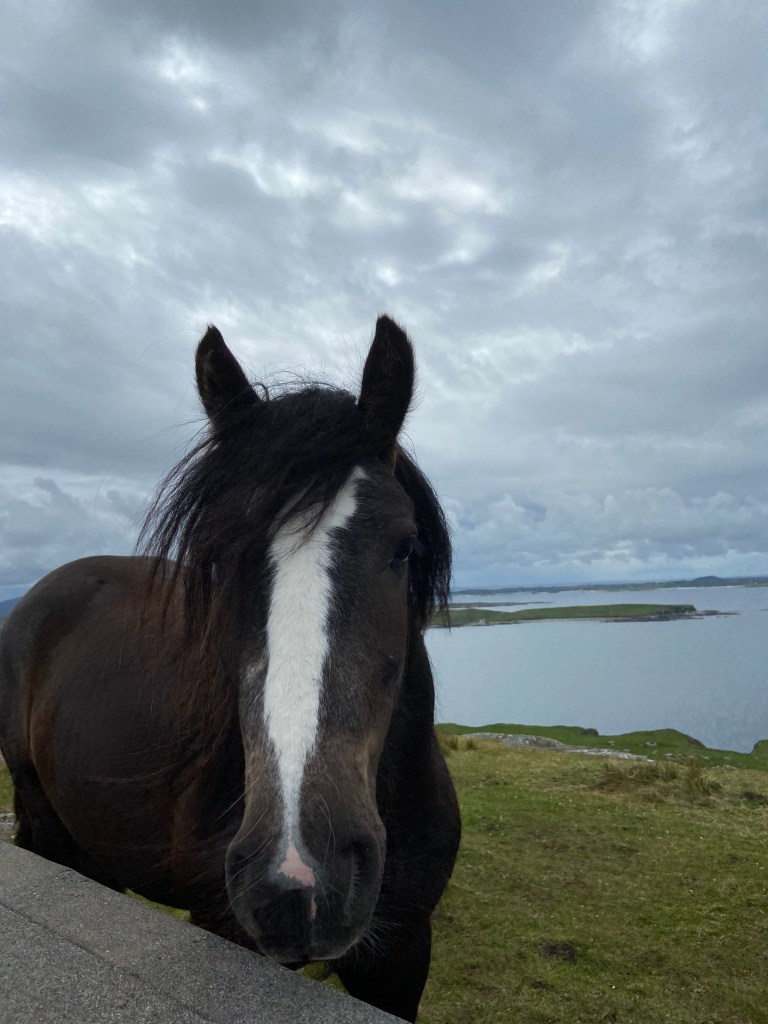
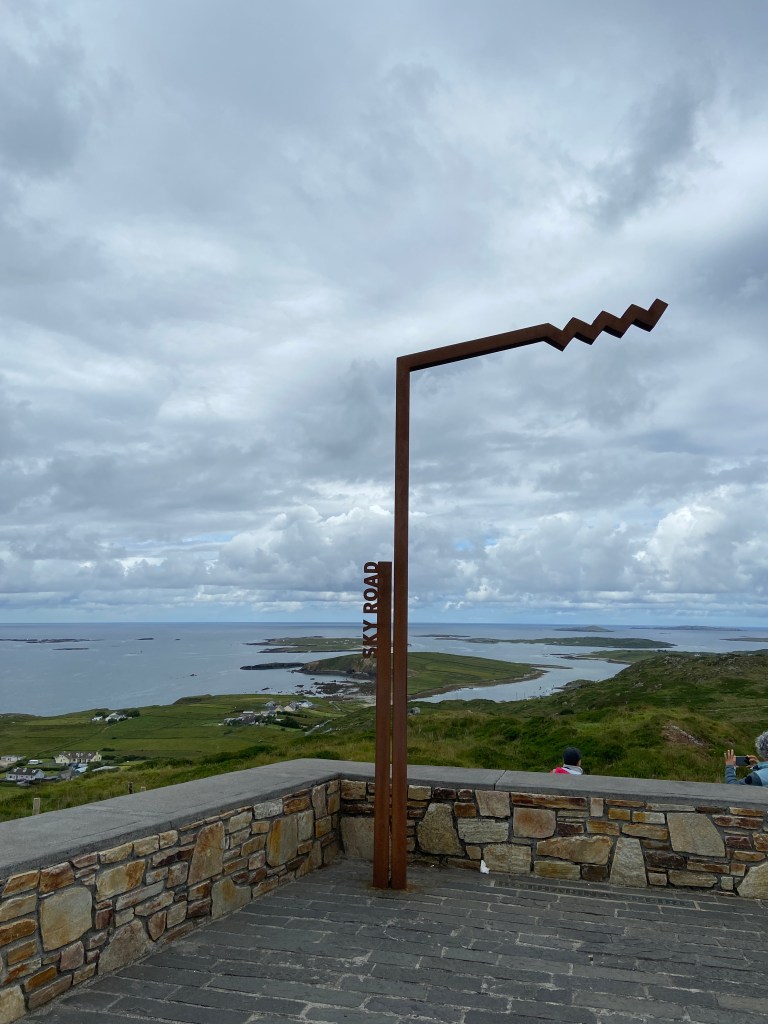
Galway wasn’t far from Clifden. We took our time, bought small gifts in Clifden before we left. Drove the nearby Sky Road, gazed over the sea, found some friendly horses. One of the horses nibbled on Mary’s hand.
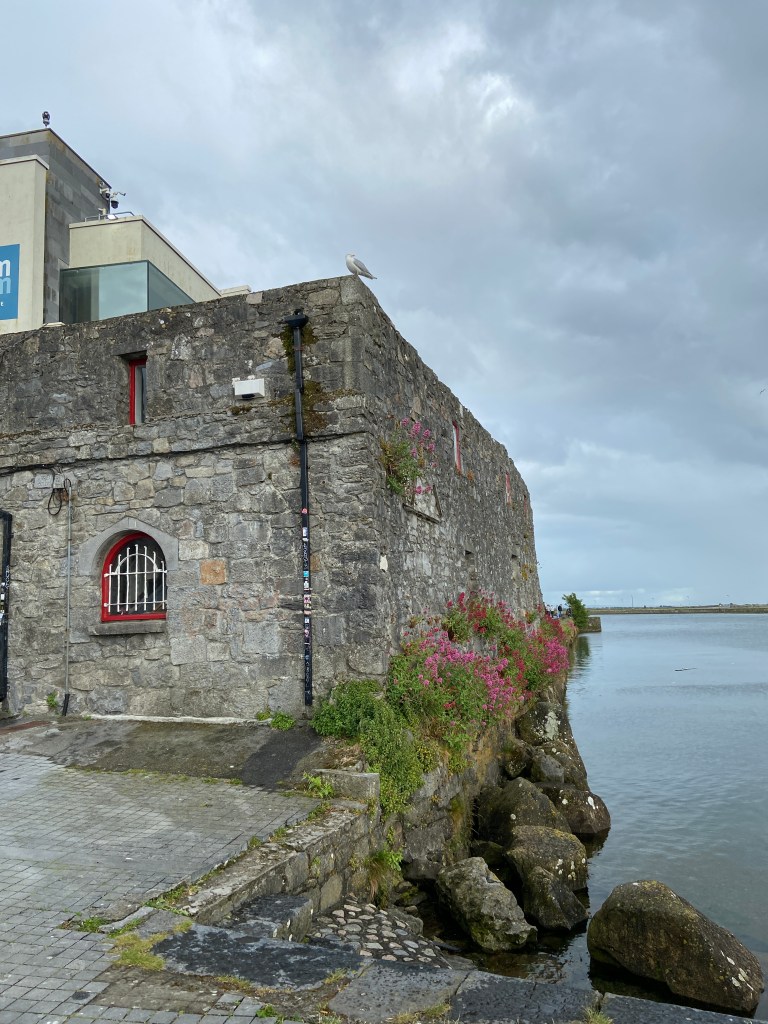
The hotel at Galway was huge, a conference center. It was my turn to drive that day. The GPS directed me right past the hotel and into a nearby neighborhood. Once I parked the car in the hotel parking lot, I didn’t drive it again for two days. Taxis were plentiful and it wasn’t that far to just walk into the area near the Spanish Arch in the old part of Galway.
We took a walking tour, one that we thought began at noon. At 11 a.m., we stood in front of the pub where the tour participants were supposed to meet up, discussing whether this was the correct spot when man named Brian came up and asked if we were waiting for the Horrible History Tour. He directed us to a man named Gary by the fountain across the park and said Gary would take us starting in a few minutes. Gary, it turned out, had studied history quite a lot and was willing to talk and talk and talk while we walked. Had we been on time, we would have missed it all.
Galway’s pubs are charming, music-filled places. There were patios situated outside open windows, so we heard musicians without having to stand shoulder-to-shoulder inside the pub. Pre-pandemic, we would have been in the midst of all those shoulders without a second thought.
I’m not sure I’ll ever be ready to be in a crowded place again. But I’m quite sure I’m not the only one.
On the Sky Road
Friendly horse along Sky Road
Part of the Spanish Arch, Galway
Lynch’s Castle, part of our walking tour in Galway
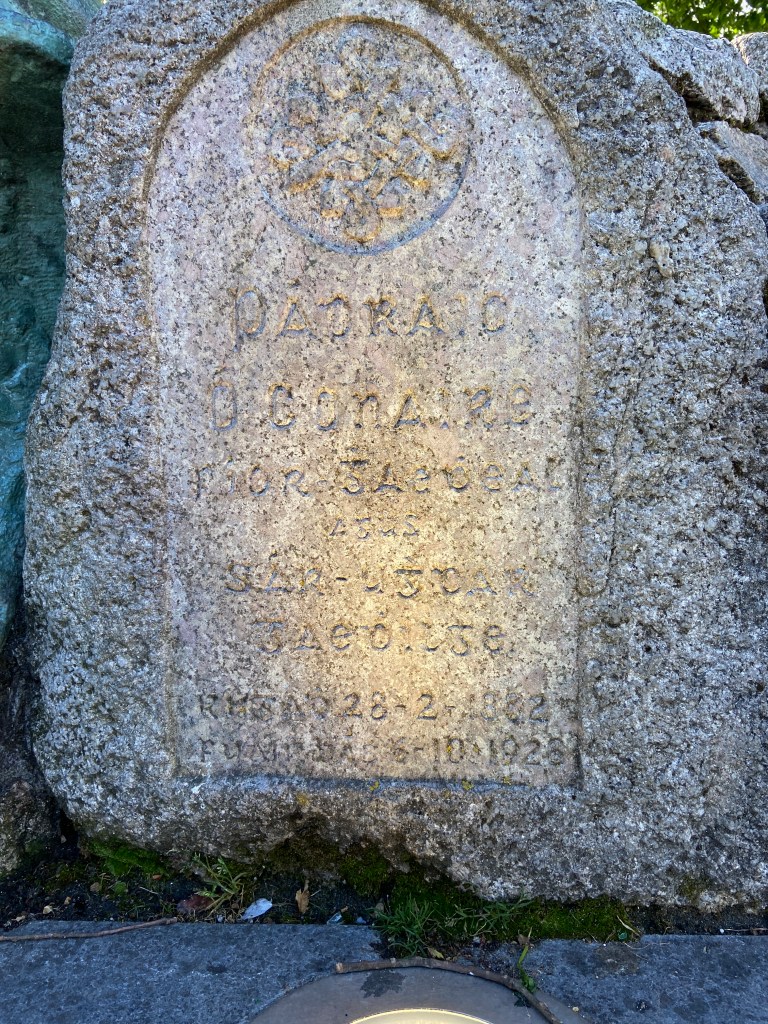
In remembrance of Irish writer Padraic O’Conaire
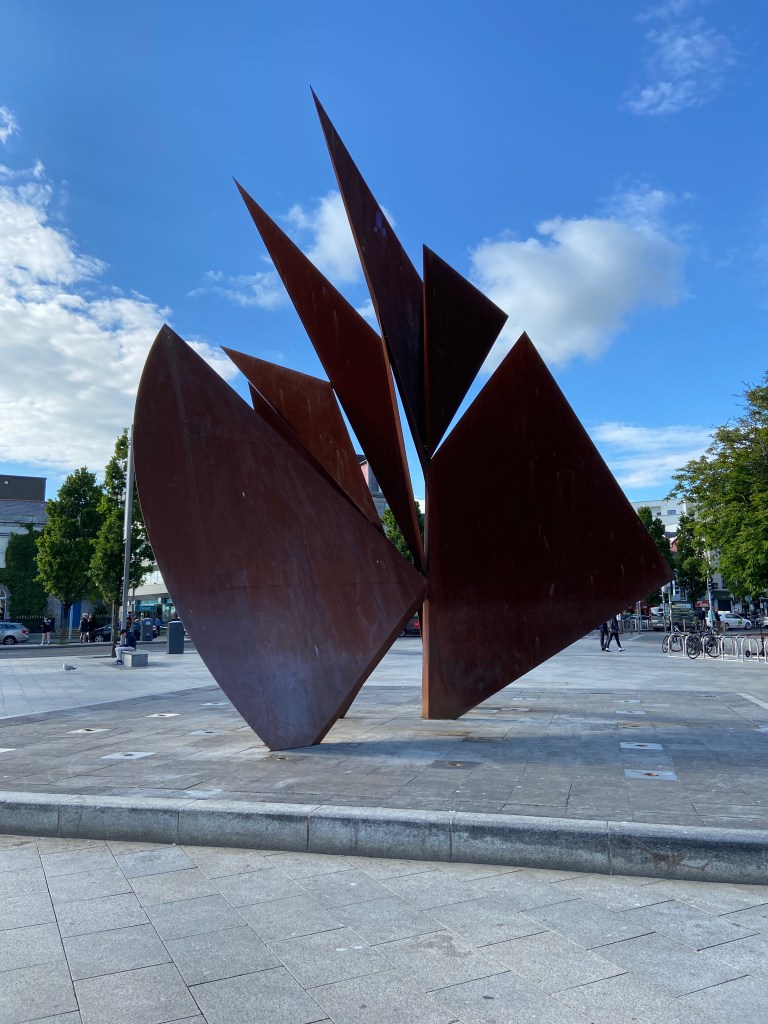
Galway hooker sculpture in Eire Square. A hooker is a type of fishing boat with sails.
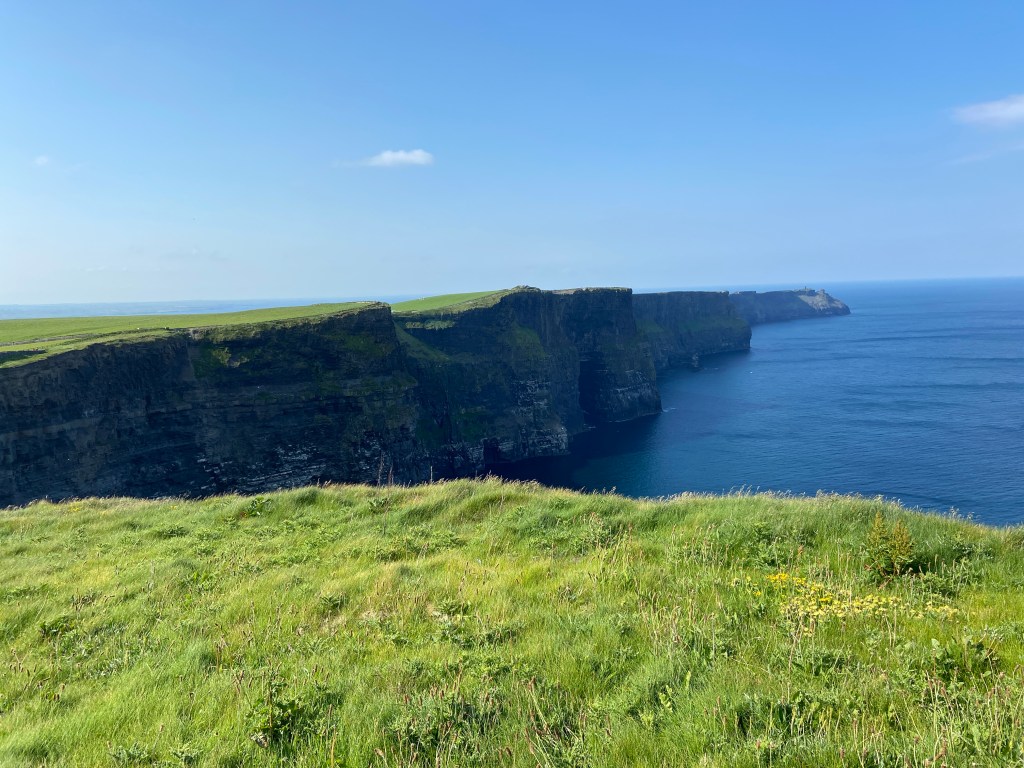
The Cliffs of Moher are among the top attractions in Ireland. We left Galway on a Saturday morning, drove winding roads through The Burren, arrived at the Cliffs early enough that the parking area was not yet filled with tour busses. The wind whipped our clothes and hair, scoured our cheeks. Everywhere we looked, we found photo-worthy views.
The last time I was at the Cliffs was in 2005. The year my father died. My daughter Abby, almost 11 years old at the time, traveled with us. And here I was again, no daughter with me, but a granddaughter back home in Minnesota who is the age Abby was. I wondered how Camille would like this wild beauty that defines the west coast of Ireland. I was surprised to have made it back to see it a second time.
Cliffs of Moher
We returned the rental car as soon as we got back to Dublin, found a taxi to our rooms at the Clayton Hotel in the Ballsbridge area. As we approached it, I thought it looked like another castle. It’s what I would call a grand hotel, elegant and stately and old. There were rugby players all over the place; we’d arrived on the day of some important game. The following day there was a women’s half-marathon. It rained. We toured the Guinness Storehouse, stayed relatively dry.
Dublin’s noise and traffic were a bit jarring after the west coast. But we stopped in several pubs, admired the dark wood bars and plank floors they all seemed to have. We went to Trinity College, looked at the Book of Kells, visited the Long Room in the Old Library Building. We wore out the soles of our shoes walking, walking, walking.
And then it was time to go home.
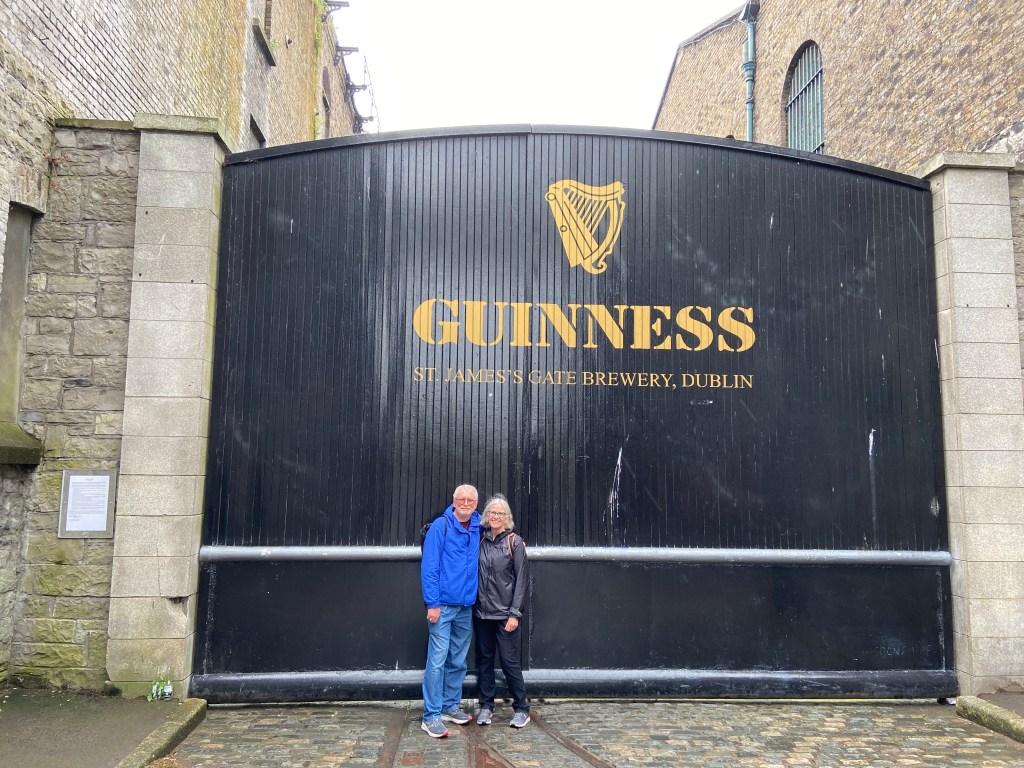
Outside the Guinness Storehouse, Dublin
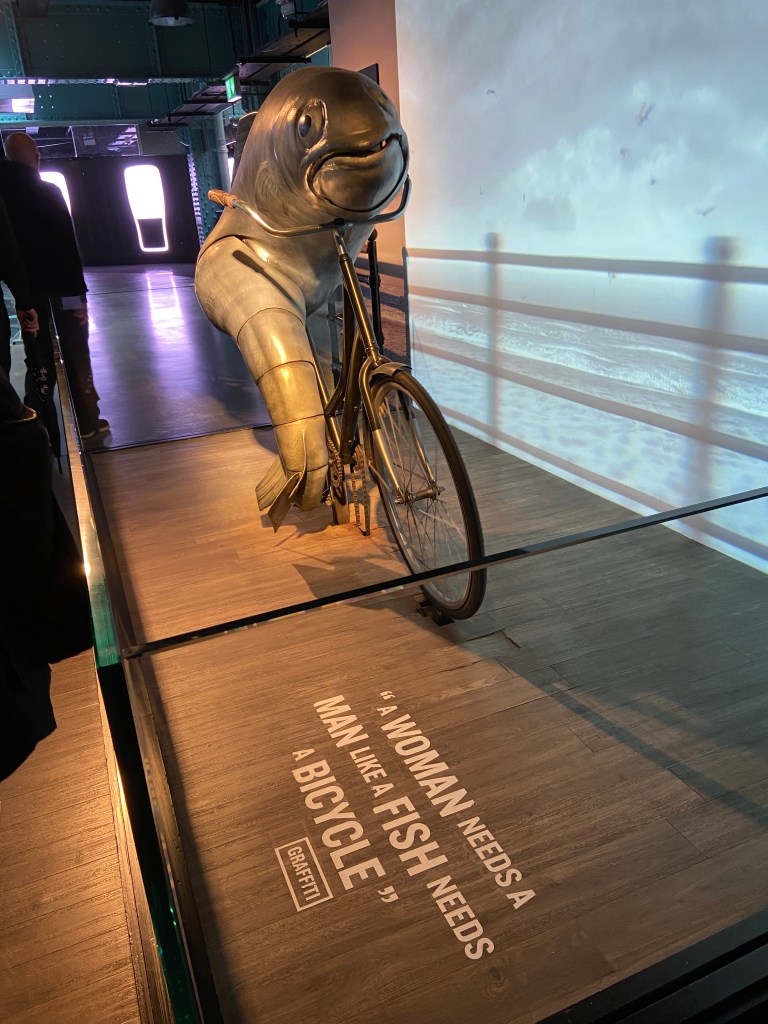
In the advertising memorabilia area on the Guinness tour
An outdoor exhibit in the Temple Bar area of Dublin
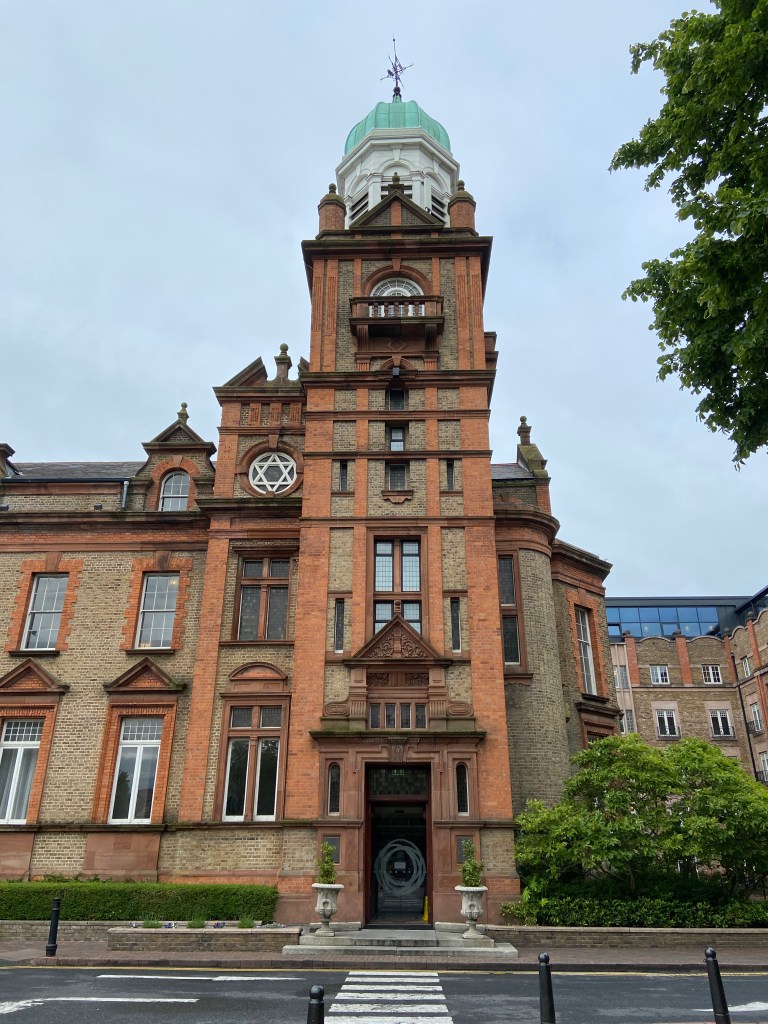
The Clayton Hotel, Dublin
Inside the Long Room, Old Library Building, Trinity College, Dublin
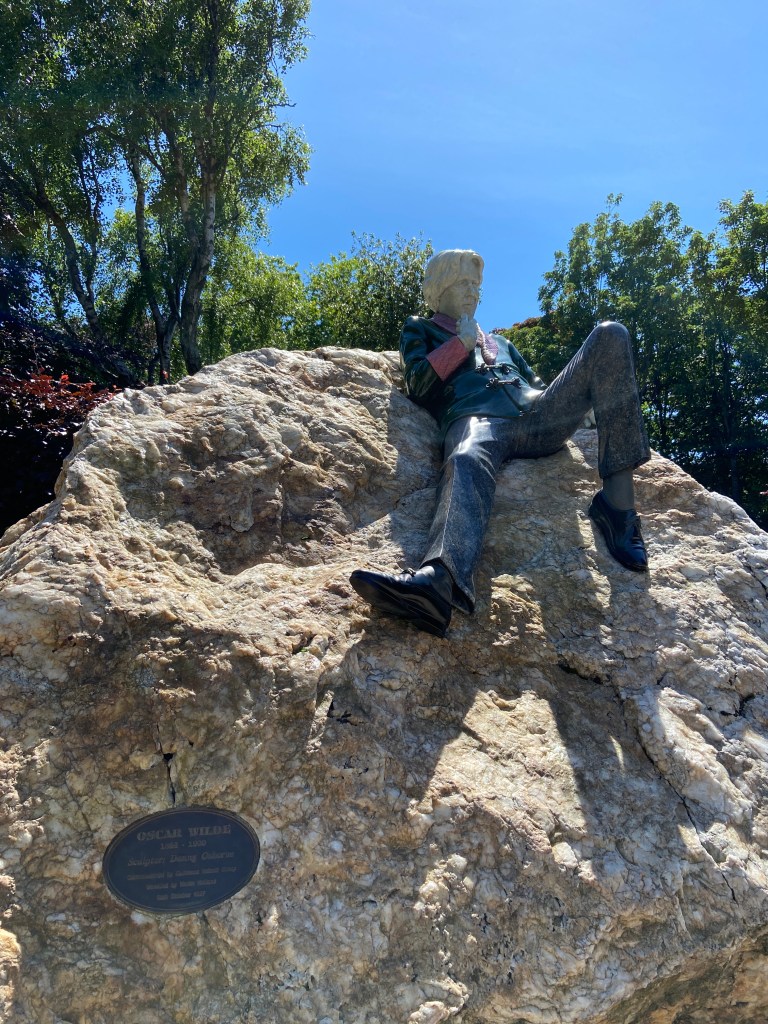
Oscar Wilde monument, Merrion Square, Dublin
I always feel a little thrill when I get my first glimpse of Minnesota from the window of an airplane coming into the Minneapolis-St. Paul Airport. This time, my feelings were mixed. Ten days out of the country, with limited attention to US news, was a much-needed tonic. As the plane descended, I thought about what it was that we were returning home to: a violent country with much division, with too many guns and too much money in too few hands.
But my children are here. My grandchildren. My friends. Mick and I have a home here. Much as I would like to live elsewhere, this is where I’m rooted.
Travel is a great teacher. I’ve been shown again and again that there are a lot of ways to live on this earth, a lot of choices we can make for the good of all. Now that I am back home, I’ll see what lessons I can glean from this latest trip, figure out how to apply what I’ve learned, and what bit of Irish beauty I’ve brought back with me.
Today’s post is on the fly. One Minnesota Crone is on the road.
Beach at Portrush, Northern IrelandSpectacular basalt formations at Giant’s Causeway, Northern IrelandFrom above Giant’s Causeway Fairy Bridges, Northern IrelandDark Hedges, Northern IrelandYeats’ grave near Sligo, IrelandOn the blue trail at Connemara National Park, Ireland
Whatever you’re doing as June kicks off, may it be something that opens your eyes.
The day after Mother’s Day, I decide to putz around in the garden. It’s been a long, cold spring; everything is emerging later than usual. My patience has worn thin, but not with the garden. With people.
This particular Monday is the warmest day of the year so far. A little humid. My ear is plugged thanks to spring allergies. I stopped taking medication for them after the dog died. It’s been more than 20 years since I met a spring without something to stop snot from clogging my head. We’ll see how this goes, but so far it’s not too bad.
There are gigantic dandelions already taking up space in parts of the garden. I decide to remove them since there are some other things blooming now. If there was nothing else, I would leave them for bee food. The ones I remove are snuggled up against emergent daylilies, nettles, Irish moss. The ones in the lawn can stay there. Neither my partner Mick nor I care about having a lawn. That’s probably why little sweat bees have taken up residence out front, their bee nursery evident for the fourth year in a row. We’ve placed a plant stake right by it so we don’t mow over the bee nest. They amuse me so much with their little green faces and the way one bee hangs out just inside a doorway to the nest when one of us walks by.
When I’ve removed enough dandelions and the errant daisies that popped up in the moss garden, I stretch my back, grateful for the respite the garden has given year after year after year. It is my haven, my safe space, the room where I think.
The week before Mother’s Day felt truly awful with the leaked Supreme Court draft opinion on Roe V. Wade. Mick and I had a few discussions about what it really means to have a high court with such unwillingness to interpret law for a twenty-first century population. I vented in a draft essay that I thought I might publish here, but which I then left sitting on my laptop. Venting is what most of the people I know have already been doing. Venting again here won’t help.
I did buy myself a Mother’s Day present: a pin from Dissent Pins that says, “Another grandma for abortion rights.” Half of their proceeds goes to women’s reproductive health care organizations. At least that’s one small thing I can do right now.
I’m worried about my daughter, my granddaughters. I’m worried about the repercussions that will reverberate in other legal matters, other protections and rights that we all thought were settled as we mistakenly assumed we did not still live in the Dark Ages.
My youngest granddaughter Maeve is just about seven months old. She is fascinated with her own hands, holding them in front of her eyes while she sips from her bottle, turning them as if wondering who they belong to. She grabs for everything while we hold her in our arms: glasses, earrings, necklaces, Mick’s beard, my lip. We’ve been teaching her what flowers are. Now that’s another thing she reaches for.
Maeve hangs out at our house a couple of days a week while her parents work. The other weekdays, she stays with her other set of grandparents. All four of us are clear that by providing daycare, we are not just helping with expenses – we are keeping Maeve as safe as we can while the ongoing pandemic shifts and twists all our lives. My son and his wife are both teachers; we won’t do regular daycare over the summer. We’ll pick it up again in the fall and do it for another school year. Then we’ll see how the world looks.
Maeve and her big sister Camille were choices, welcomed into our family fold. They are lucky to have all their grandparents alive, nearby and willing to offer care; my son and his wife know this is not the situation for most people. I’ve thought about how families manage to afford daycare at all, at the same time that I’ve wondered how people who work in daycare settings can afford to pay their own rent. Our daughter Abby worked at a local Kinder Care for a year and the pay for caring for small human beings, being responsible for their safety, wasn’t nearly commensurate with the responsibility.
I think about Maeve’s and Camille’s futures and wonder if any sense of progressive governance will be in place. And I think about getting them passports as one option for their immediate futures. My wish for my granddaughters is that they have access to other cultures, other ideas, other paths toward happy lives. They need to know their options.
It is a grandparent’s privilege and, perhaps, obligation to offer whatever they can to make the world an equitable and reasonable place for future generations. The closer we come to our own ends, the more obvious it is that trying to amass a fortune or keep everything as it was when we were younger because it worked for us (did it? did it really?) is a silly and useless way to inhabit the world.
Some days, meditation followed by a morning walk is the only thing that gets any lingering anger, fear, and anxiety out of my bones. The older I get, the more I clench my jaw and fists over what our American patriarchy has done to women, children, or anyone without privilege. I watch my adult children struggle to find jobs that pay enough to live on, secure housing, afford health care. I watch the juxtaposition of the desire for a child up against the reality of systems that don’t accommodate families, that don’t give a rat’s ass about parental leave or work-life balance. I shake my head at the women who buy into the system, who don’t stand up for other women, who would refuse the rest of us our choices around how and when to have a child knowing that there’s no mandated support system once a woman decides to carry a baby to term. Knowing that there are plenty of situations in which access to birth control and abortion make the difference between surviving and not in this country.
That there is such a divide between those who understand and oppose the implications of legislating a woman’s body and those who prefer to be Taliban-esque toward women because of some religious belief that should not influence secular law is one of the great failures of the American system. Better nationwide education with hefty curriculum on critical thinking and human rights might help.
While I pulled dandelions, I thought of my mother for the umpteenth time in the past few weeks. She’s been on my mind a lot. When I was a kid in the 1970s, while Roe V. Wade was decided, Mom was very clear that abortion was a sin. Our Catholic family was not allowed to support such an idea and a law that legalized it was a terrible thing in her eyes. I believed that for a while.
And then I grew up. I had my own children. I understood the toll parenthood takes on people even as it brings incredible joy. Motherhood is not something to go into lightly, but sometimes it appears on the horizon when we least expect it, even if we’ve tried hard not to get pregnant. And it’s nobody’s business whether we carry a child to term but our own.
My mother would not approve of my current philosophy. That makes me sad, but it will not make me change my mind. I know she was not a woman who was capable of breaking free of the thinking that the Catholic Church insisted upon. She was not able to see religion from a distance, as something one chooses for their private path forward.
I remember how she thought my going to college would ruin my adherence to my religious upbringing. She’d be quite surprised, I think, to know that it wasn’t just college and the critical thinking skills I acquired. It was becoming a mother and watching my kids suffer that really did it. It was the lack of people in power applying all those lessons I learned in catechism about helping the poor, the needy, the bullied, the lonely, and others. It was living life as a woman.
My gardening journal goes back to the year 2000. I began it before my mom died. This was a startling realization as I began writing the section for this year, 2022. My need to document the evolution of our garden is about a lot of things: my growth as a gardener and a steward of this little bit of earth upon which Mick and I live, climate change as it happens right in front of us, changing ideas about what is an acceptable practice for a yard that offers a haven for living things.
It is the haven for living things that I keep coming back to as I think about our country and our courts, about how we care for each other and how we harm each other, and what we depend on laws to do: keep us safe, keep us alive. But there is no consistent haven. There is only each one of us and what we carry, what we plant. There is this world that changes and will continue to change. We must adapt our habits to meet those changes, to mitigate repercussions from the harm we’ve already done, and let go of old systems that no longer serve us. Rigid adherence to old ideas only makes us brittle.
Eventually we break. Our rigid world crumbles with us.
Here in Roseville, Minnesota, it’s been a long cool journey from winter to this month of flowers popping open, trees in bloom, nesting birds, and Mother’s Day. This year, snow fell here the day after Easter and again some days after that. It was so disappointing, even if it did melt immediately. But May Day is upon us. We are unquestionably on our way to summer. And I’m thinking about motherhood. May does that to me.
Mother’s Day is a day I’m very fond of – as a mother and grandmother, I’m keenly aware of the time and energy parenting requires, of the sacrifices that get made every day, of the fierce connections parents have to their children. When we are in the midst of childrearing years, creative pursuits often get sidelined or enjoyed infrequently as we address more pressing needs. And yet, the importance of honoring our creative selves remains. We store up things for later while supporting the development of another human being, our creativity occasionally peeking through as we find ways to teach our children well.
Those lessons of parenthood – grabbing moments when you have them, shifting gears on the fly, letting go of perfection – stay with us. For me, those lessons nudge me to value this time I have right now, revel in the freedom to pour paint or write essays or travel because these moments won’t come around again. I remember many instances of thinking I’d have time later to [fill in the blank]; that isn’t always true. It’s not just true for pursuing whatever creative projects I wanted to do; it’s also true for saying I love you. Those kids who demand so much of us grow up, move away, and that part of the conversation is over. Our own parents who bugged us about our choices are gone forever.
So, if you’re honoring a mother or you are a mother in need of honoring, have the conversation about what parenthood has required, the sacrifices you’ve made or the ones you recognize as being made for you. Celebrate both. Find the joy that underlies it all. Say I love you.
———————————
I recently had an email conversation with almost-crone Lizzie Bowen (she’ll turn 50 this year) after she contacted me through One Minnesota Crone a couple of months ago. In her initial contact, she wrote of how she, “…had always wanted to be a wildlife biologist, then went on an 18-year-detour of motherhood, and now finally acknowledging that the part of me that wanted to be a biologist was really most interested in the creative and artistic aspect of biology (nature, writing, photography, artwork, interpretation of scientific language to layman’s terms, etc).” Here was another woman who did the hard work of parenting and was now figuring out how to honor her creativity in different ways. During the course of our conversation, I asked a few interview-style questions about what’s next for Lizzie. She agreed to share them for publication here in the hope that other women who are on the brink of their post-childrearing years might recognize something of themselves.
Lizzie lives in North Carolina and runs a blog – Cooped-Up Creativity (https://ultimatecreativity5.wordpress.com/) – where she publishes her own nature photos, sometimes with accompanying writing. My questions to her are in bold print. Lizzie’s answers are unedited.
You run a blog called Cooped-Up Creativity which you started at the beginning of the pandemic to inspire yourself and others. Did your daily posts do what you’d hoped? Did you rediscover your own inspiration and hear from others who also found inspiration there? How did your efforts change over the last two years?
I’ve always enjoyed creative pursuits. At the beginning of the pandemic, everything was canceled. It didn’t feel like much of a loss (I didn’t mind less time in the car!), but rather more time for creativity. Realizing I had a lot more time at home, it seemed like an ideal opportunity to seriously explore my creative side. So yes, I certainly inspired myself!
I have never been a specialist in any one particular artistic flavor. I enjoy drawing, painting, doodling, writing, creative problem solving, making music, gardening, and photography, so during the early days of the pandemic, I tried to do something (anything) creative every day.
No one has told me that I’ve inspired them, but while I’m outside doing sidewalk chalk art, I get a lot of positive feedback from passers by. Basically I enjoy working on my little projects, and if someone else also enjoys the end product, that’s a bonus.
When you contacted me, you mentioned that you’ll turn 50 this year. How do you see this time in your life? What do you find yourself leaning towards?
I feel like a kid when someone asks, “What do you want to be when you grow up?”
I’m all grown up now, but still trying to figure out what I want to “be.” I see this time as an opportunity for exploring my interests. Some part of me has always wanted to “be” an artist, but I didn’t think I could earn a living as an artist (haha, so I chose wildlife biology instead, which wasn’t any more lucrative than being an artist). One life goal I have is to write and illustrate a children’s book. I have several ideas for this, and a couple of started projects, which I hope someday to finish. In the meantime, doing the UltimateCreativity blog allows me to get in touch with my artist side.
Is there any grief with your transition to a new phase of life? Talk about that a little bit.
I can’t say I feel grief. Every phase of life is simply another phase. We’re always in some sort of transition from one phase to the next. It just keeps us wondering, “What’s next?”
Shifting gears a little bit, what parts of your younger self that you gave up because life demanded it do you want to reclaim now?
Interesting question. For the past 18 years, I have been in Mom Mode. It has been a most amazing adventure raising kids, who are now teens. When they are off living independently in the world, I will feel a great sense of accomplishment. Then I look forward to autonomy. It feels selfish to say, but I look forward to a day when I can do what I want, when I want, just because I want to. This doesn’t have to be complicated, but if I want to spend the day outside working in my garden, then maybe I can do that. Or if I want to take a spontaneous day trip to hike in the mountains, then maybe I can do that too.
What makes you feel powerful?
Powerful? I am not sure I’ve ever felt powerful. Perhaps when I feel self-confident, confident in my abilities and confident in my knowledge, like when I have successfully tackled a challenging project.
What brings you joy?
A hike in the woods
Playing mandolin
Sharing a laugh with a friend
Finishing a project
Having a good conversation with my kids
Being outdoors
Feeling a sense of connection
What are you going to do just for yourself today?
Go for a walk with my camera.
Finally, what do you want to offer the world in this moment, especially other women heading into their wise years?
Have fun getting to know yourself. My favorite quote that I saw recently says it pretty well, “Life isn’t about finding yourself, it’s about creating yourself.” (George Bernard Shaw)
Self-portrait courtesy of Lizzie Bowen 2022
—————————
Here’s to all the fierce, beautiful and creative mothers out there, who work hard every moment, who are both anxious about and look forward to the day when they have more time for themselves.
Just in time for National Poetry Month, poet Joanne Durham’s new book, To Drink from a Wider Bowl, is a generous, life-spanning collection of work that invites readers to drink in the world. Today, I’m offering readers an interview with Joanne that I hope will shed light on the poet behind the work. Questions from One Minnesota Crone are in bold print.
Author’s bio:
Joanne Durham is the author of To Drink from a Wider Bowl, winner of the 2021 Sinclair Poetry Prize (Evening Street Press, April 1, 2022). Joanne is a retired educator living on the North Carolina coast. She draws on the rich experiences of seven decades of life to write poems that have been published or are forthcoming in Poetry East, Calyx, One Art, Gyroscope Review, Kosmos Quarterly, Quartet, Rise-Up Review, Juniper, and many other journals. Learn more about her background, publications, and awards at https://www.joannedurham.com/
What do you want people coming to your poetry for the first time to know about you?
First of all, how happy it makes me that they have come to my poetry! Poetry has enriched my life so much, and I want it to do the same for others. I’ve had a number of friends tell me that they never liked poetry, so they were surprised that they liked my poems. I think school ruined it for them, so I try to make up for some of that. When I was a teacher, I would never assign my kids to put, say, two metaphors in a poem. I would tell them instead, try to write a poem where you can’t quite bring out the joy or anger or sadness you felt unless you compare it to something else. I want people to know that I try, through my poetry, to bring something we need to live our lives more fully and richly – something we can’t quite express just in passing conversation.
A lot of us had poor experiences with the way poetry was taught to us. Your example of how you taught metaphor to kids is a lovely approach, clear and concrete. And offering poetry as a way to live more fully and richly feels like a spiritual approach, drawing from the very core of who you are. Which brings me to this: To Drink from a Wider Bowl strikes me as a Zen-like title. What philosophies feed your work?
The title is from the last two lines of the prologue poem of the book, “Old Folks”: “We are thirsty still/but drink from a wider bowl.” It’s interesting, your blog epigraph says pretty much the same thing: “Older women don’t disappear; they branch out.” Either of us could have written a long explanation, but we’re poets, so we choose to leave the reader a place to enter into the thought, to make it their own, to ponder what wasn’t said as well as what was, and to gain a deep satisfaction through metaphor and language attentive to the moment. I guess you could call that kind of Zen.
To Drink from a Wider Bowl is a kind of memoir in poetry, although I take a lot of poetic license with the facts. The poems flow from my ancestors through childhood, adolescence, loves and losses, work, progressive activism, and winding up full of the wonders of grandkids and more concerned than ever about the world I will leave to them. There’s a prose poem early in the book called “Carpool Politics, 1966” where, as a teenager, “I think for the first time that the world is a giant jigsaw puzzle and someone has hidden the picture on the cover of the box so nobody can agree on where to put the pieces…” My book is about a lifetime of trying to fit the pieces together.
Are you saying, then, that the philosophy that feeds your work is to invite contemplation of the larger world? Is there a little more to it?
If there is a theme that runs throughout my book, it’s “connections.” I believe we are all fundamentally connected to each other and to the natural world. The moments when I sense those connections most intensely are the seeds of most of my poems. We live in a society that values individualism and competition over community and collaboration. So our connections are constantly obscured, and poetry is one way to rediscover and nourish them. Reaching deeply into ourselves, connecting deeply with others, and trying together to change the circumstances that keep us in a world of conflict instead of unity – those are all connected too.
At what point did you realize that To Drink from a Wider Bowl would take the form of poetic memoir that encompassed your entire life? Was there a particular poem from the book that tipped you toward that scope versus a tighter focus?
I’ve been writing poetry all my life, but never tried to publish anything except a few poems that came out in teaching journals. But I kept all my folders and notebooks. When I retired, I decided I was going to give poetry its due. So long before I even thought about writing a book, when I was just testing the waters to see if my poetry would interest anyone besides me, I wound up writing about all these memories I had jotted down over the years. There are a couple of poems in my book that I actually wrote 30-40 years ago. There are other poems that I totally rewrote, but the original poem allowed me to keep some of the immediacy of the experience. In “Carpool Politics,” which I referred to earlier, the quote from the men in the carpool is verbatim what they said fifty years ago! After a lot of my poems got accepted in journals, I realized that I more or less had a book that traced my life over time. It was a very satisfying feeling, to think I could make this mosaic of my experiences and there was something universal in them as well.
The poem that glued it all together was “Old Folks.” I had been thinking about writing a poem about getting older for a while. I felt a lot of gratitude for getting older and annoyance at how old people are viewed in our society, and I wanted to celebrate cronedom! Then in a workshop I was introduced to the technique of taking 10-15 random words out of a poetry anthology and using as many of them as possible in a poem. I did that and wrote “Old Folks.” I never would have come up with “time stretches/like an accordion” or “we are thirsty still/but drink from a wider bowl” if “accordion” and “thirst” and “bowl” weren’t in my word list! But once I had written that poem, I knew it would anchor the book. I could say right up front how I felt about being older, and then travel back and trace how I got there through the sections of the book, each section titled with a phrase from that first poem. Once I had that general approach, I played around with the sections and wrote some new poems to fill out parts that seemed thin.
What does your creative process look like?
I usually write whatever comes into my head and come back to it days or weeks later and see if there’s a nugget of something there to turn into a poem. I keep coming back to see what else it needs, until I’ve gotten as far as I can. Then I take the poem to one or more of my critique groups to find out how it sits with other readers. I sift through their perceptive comments and almost always revise some more. A few poems were “gifts” – they rolled around in my head and came out pretty much fully formed. But that’s rare.
What is the greatest thing about being a poet at this stage of your life?
Time! I have time to really study craft. For years I thought you’d lose the inspiration and emotion of a poem if you tried to revise it! It was a huge moment for me when I realized the difference between writing to release something you need for yourself, which of course is totally fine, and writing to connect with readers. Craft to me is how to make that connection happen, and I can’t get enough of absorbing it from poets I admire. Another great thing is that I have a lot more experiences to write about than I did at twenty. And I’ve been able to connect with wonderful poets all over the country – some in other parts of the world. I get to be immersed in poetry, something I’ve loved all my life, but always put on the back burner. Now it’s right up front!
Which poets or artists have been the most influential in your writing life? Do you have a favorite?
In high school I fell in love with Walt Whitman’s poetry. I still have my hardbound copy of Leaves of Grass even though my dog ate half the cover. As a young woman I discovered the poetry of Adrienne Rich, Marge Piercy, Judy Grahn, Denise Levertov, Audrey Lorde – women poets who spoke directly to me. As a teacher I found Naomi Shihab Nye, first through her poetry for kids and then for everyone, and I always go back to her when I need to reaffirm what I find essential in poetry – a light that shines with compassion into both our inner and outer worlds. There are many contemporary poets I’ve discovered over the past few years, famous and not famous at all, whose poems continually inspire me.
I adore Naomi Shihab Nye. I took a workshop with her in Minneapolis several years ago and have heard her read a couple of times. And there are so many poets who offer work that resonates for all kinds of reasons, it’s hard to choose a favorite. And I find that poetry is a great springboard for other kinds of art. Do you create any other forms of art besides poetry? Are there forms you’d like to try?
I liked to draw as a kid but never pursued it and don’t think I will. I write lots of books for my grandkids, but they often turn out as poetry. I think I’m stuck with poetry.
Lucky grandkids! Do you have any other work forthcoming?
Yes, I have a chapbook, On Shifting Shoals, being published by Kelsay Books, probably at the end of this year. It’s about the southern beach town where I’ve lived for the past ten years. It’s part eco-poetry, part observations about the people who live at or visit the beach, part astonishment at the daily beauty of the ocean I’m so lucky to have as my backyard. I’m always writing and sending poems off to the myriad of journals, online and in print, that allow me to connect with readers and other poets all the time.
Where can people get a copy of To Drink from a Wider Bowl?
Thank you so very much for sharing a bit of yourself.
Two poems from To Drink from a Wider Bowl:
Old Folks
weather things. We hold our tongues
when young women bemoan their first
gray hairs. We doze off to dream
mid-afternoons on worn, cushioned couches,
then lie with unclosed eyes through the deep holes
of night. There's a haze that hovers above
dates, faces, places -- when was the summer
of the beach house in Ocracoke? Which snow rose
over the sills? Memory no longer chirrs
like an eager bird easing into morning wings, sipping
on rain that drips from every rafter. Time stretches
like an accordion, stores lullabies, love songs
and funeral chords between its folds. We are
thirsty still, but drink from a wider bowl.
Maps
Every home
needs a map of the world.
Hang it by the entrance.
Bless it as you might
a cross or a mezuzah
when you come and go.
Trace your finger across continents
not your own.
Say names of countries whose sounds
tickle your throat and move your lips
differently from your own language.
Be curious about who lives there,
sharing seas and stars.
Hope to meet them,
fellow earth-dwellers,
all calling this planet
home.
Do you read poetry? If so, this is the month for you. There is poetry to suit every sensibility and reading level. My preference is for contemporary work, especially that of women poets. I have a few suggestions for you.
My friends over at Gyroscope Review, a quarterly contemporary poetry journal that I co-founded with current editor Constance Brewer, released their spring issue today and I’m thrilled that one of my paintings is on the cover. Constance also used some of my photos inside the issue. Click on the cover below to see a list of the many fine poets published in this issue and to get a copy of your own.
I’m also celebrating the one-year anniversary of the publication of my chapbook, How We Learned to Shut Our Own Mouths (Gyroscope Press 2021). My son’s artwork graces its cover. The book was, in part, a response to the emotional upheaval of the pandemic. The poems are grounded in family and the Minnesota landscape, contemporary in tone and form. You can get a copy by clicking on the cover below.
Recently, I was contacted by poet Joanne Durham regarding her new book out today: To Drink from a Wider Bowl (Evening Street Press 2022). The poems encompass a lifetime of connections with family and the world, covering the phases so many of us move through with rich layers of attention and love. I’m really pleased that Joanne agreed to an interview about her work and to celebrate her publication which will appear on One Minnesota Crone on April 15. In the meantime, click on the cover below to get a copy of To Drink from a Wider Bowl.
I know there’s plenty of other work to celebrate, but we can start right here. That said, I’ll leave you with a poem that I particularly like by Naomi Shihab Nye. Her work always gets my attention for the sense of kindness that runs through all of it, so, of course, I thought I would share her poem titled, “Kindness.” The link for the poem below will take you to the American Academy of Poets website, Poets.org. Enjoy.

























 One Minnesota Crone