
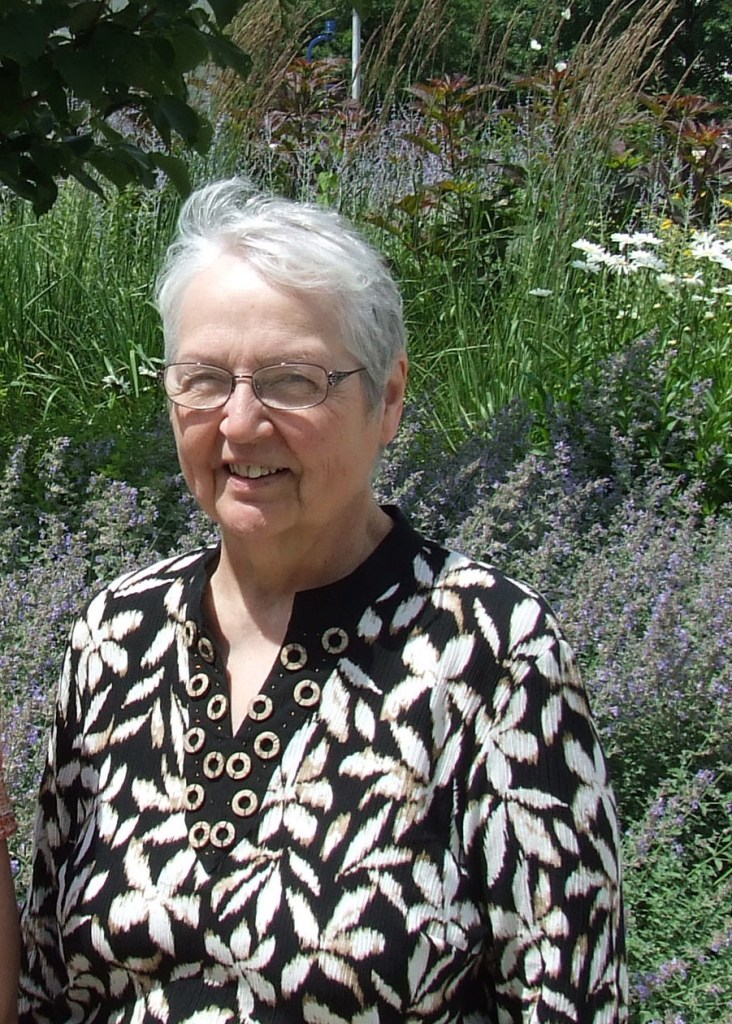
Today, poet Wilda Morris will share her ideas about poetry and the poet’s place in the world as she discusses her work and her pre-pandemic book, Pequod Poems: Gamming with Moby-Dick. Wilda is based in Illinois, former president of both Poets & Patrons of Chicago and the Illinois State Poetry Society. She is widely published and leads workshops for both children and adults.
When Wilda first contacted me about having a conversation that included Pequod Poems, I’ll admit I was hesitant. Pequod Poems is based on Moby-Dick by Herman Melville, a mid-nineteenth-century novel that I have never read. Poems in the first part of the book are each from the point of view of a character in the novel, and I soon found that I needed to have at least a passing acquaintance with Melville’s story to engage with Wilda’s poems. Hello, Cliff Notes, which gave me just enough about the overall themes, story arc, and characters to appreciate the effort Wilda put into this collection. The later poems in the book connect Melville’s themes to present day events.
Herman Melville was born on August 1, 1819, in New York City. Wilda told me she would love our conversation to appear on Melville’s birthday, so here it is. Whether you’ve read Melville or not, you just might find something here that grabs you. I’ve included links at the end if you wish to get your own copy of Pequod Poems or one of Wilda’s other poetry books – which are not based on Moby-Dick.
———-
OMC: Hello, Wilda, and thank you for reaching out to discuss your work. I understand that you came to poetry late in life, after the death of your first grandchild. Can you please talk a little about that turn, how you chose poetry as your creative outlet, and what poetry has done to make your life better?
WM: I always loved poetry and wrote some when I was younger. I published a few poems as a young adult, but after my husband and I adopted five children, I did not find much time to write. During the same period of my life when my granddaughter Florrie was dying, I was spending half of each summer at the Green Lake Conference Center in Wisconsin as a curriculum counselor. I was able to attend their annual writer’s conference (which, unfortunately, is no longer held). I didn’t have enough confidence in my poetry to attend the poetry workshop the first year, but I met with the poetry leader at the end of the week, and she encouraged me to sign up for poetry the next year. I did, and I was hooked. I found writing about Florrie to be healing. She has been gone three decades, but still pops up in my poems now and then.
I find that involvement in poetry means involvement in communities. The Illinois State Poetry Society, Poets and Patrons of Chicago, the San Miguel Poetry Week, the poets who attended workshops at the Green Lake Conference Center, poets who submitted to the monthly contests on my blog, the poets who return year after year to The Clearing in Wisconsin, poets who attend conferences of the National Federation of State Poetry Societies, and the participants in the on-going haiku classes which I’ve been attending have all become communities. We have learned to care for each other. That kind of community-building makes for a better world.
OMC: I love the idea of all these collections of people who come together for poetry becoming small communities. I’ve seen how the poetry community as a whole is full of generous people who help each other out, and this nicely illustrates how community-building is an important reason to seek out poetry groups and conferences.
Pequod Poems came out just before the pandemic shut everything down. One of the things you told me earlier was that the pandemic prevented you from doing the in-person readings that would have been natural when your book was just published. So, let’s dive right into talking about the book.
As I read through it, I kept thinking about how an obsessive desire for revenge, even when it’s to the detriment of everyone involved, is certainly illustrated here and can be seen in what’s happening in this very divided world around us. I also appreciated mentions of the near-destruction of entire species due to human greed. My favorite part of the book came later, for example with the poem, Father Mapple’s Message for the 21st Century. And in your poem, Lamenting Fate, you wrote about assigning Moby-Dick to college students: “It’s a / must-read for anyone who wants to understand the / play between free will and fate.” What themes examined in Pequod Poems as well as in Moby-Dick do you believe are most important right now and why?
WM: Melville was writing as the U.S. was moving headlong toward civil war. Our country is probably more divided now than any time since that era. Ahab tacks a gold coin called a doubloon up on the mast and offers it as a reward to whoever first spots the white whale, In Chapter 99, several characters pass by the doubloon and comment on the various aspects of its design—each one seeing something entirely different. Melville is indicating that we each see what we want to see and interpret situations in ways that please us. We can see this, too, in the various ways the white whale is still interpreted: some see him representing God; others see him as representative of the devil. I think we can see how that is happening in this country today.
A related theme—centered in the personality of Ahab—is the importance of responsible leadership. Ahab is a demagogue. He’s narcissistic, sociopathic, monomaniacal, and vengeful. To get vengeance against the white whale for biting off his leg, he is willing to sacrifice everything and everyone else. He brings down the ship and whole crew (except for Ishmael who escapes to tell the tale). I believe the Pequod represents the “ship of state.” There were 30 states in the US when Moby-Dick was written—and 30 crew members on the Pequod. Surely that is not a coincidence! Starbuck, the first mate, knows where things are headed, but he does not have the courage to confront Ahab in any serious way. He knows Ahab has used his charisma to persuade the crew to buy into his vengeful goal. Starbuck fears he might lose his position (or worse) if he leads a rebellion against Ahab.
Another major theme which is still important is racial diversity, inequality and related issues. The crew is diverse, but the captain and three mates are all white. The black cook and Pip, the black cabin boy, are treated shamefully. Initially Ishmael is afraid of Queequeg, but as he gets to know this dark-skinned foreigner, he learns that Queequeg is friendly, loyal, and capable. He concludes that it’s better to share space with a “sober cannibal than a drunken Christian.” How many people are willing to get to know people of other ethnic and religious backgrounds unless circumstances force them to do so? How often are white males willing to share power with people of color? While pushing the reader to think of these things, Melville also highlights how interdependent we all are.
OMC: You’ve done a nice job of showing how a nineteenth-century story is very much relevant in today’s society. Those who are in power don’t want to share it, and that has been the case throughout history.
Do you have some favorite poems from Pequod Poems? And may I share them below?
WM: From what I have read, it appears that Melville’s mother, like Ishmael’s, was stern and judgmental. My mother (an American Baptist) was invited by a Catholic nun to work with her in jail ministry. During her 30 years working at the Johnson County (IA) jail, Mother never asked inmates what crimes they committed—she just loved them and showed them grace. Maybe that’s why I’m fond of this Shakespearean sonnet.
Ishmael Reflects on the Try-Works Fire
	Beginning with a line from Chapter 96

Look not too long in the face of the fire—
those forking flames are a devilish sight.
The blaze hypnotizes as it grows higher;
it blinds your eyes to the sun’s true light.

I’ll never believe what I’ve been taught
by my frowning mother, that all men fell
and my soul is damned—in the flames I’m caught.
She said, Go to church, or you’ll go to hell.

Instead of the fire with guilt and dread,
turn to the wisdom of Solomon’s book
or the Man of Sorrows, the life he led—
he spread compassion with his gentle look.

How different would be my mother’s face
if her theology reflected grace.
I like “Reminder” because of its relevance to this era:
Reminder
If your banker breaks, you snap; if your apothecary by mistake sends you poison in your pills, you die. ~Ishmael (Moby-Dick, Chapter 72) Ending with a line from Chapter 13

Even here in the U.S., where Whitman,
Emerson and Thoreau wrote of individuality
and we are told to pull ourselves up
by our bootstraps, it is true:
if the housing bubble bursts, your home
is worth less than your twenty-year mortgage.
If the stock market declines, your retirement fund bleeds.

You may be the safest driver in the state,
but if the teen in the Toyota texts or drinks
and drives, you end up under carved stone.
The drive-by shooter with bad aim may miss
the Gangster Disciple and hit your daughter instead.

If your young son runs to the park
with friends, plays with the gun
Uncle Joe bought him from the Walmart toy department,
and, even if it doesn’t look real, someone
in a blue uniform assumes it’s loaded with lead
you have to pick a casket and plan a funeral.

Someone assassinates an archduke in Austria,
Japan bombs a U.S. naval base,
North Korea sends troops across the 38th parallel,
Iraq invades Kuwait, planes flatten the World Trade Center—
if you pause and think it through, you know Queequeg was right,
It’s a mutual, joint-stock world, in all meridians.
Of the poems related specifically to characters from Moby-Dick, I think “The Lament of Starbuck’s Son” is my favorite because it reflects how any child might feel after losing a parent:
The Lament of Starbuck’s Son

Mother says my father
was a brave man,
a hero of the whale fishery,
but to me he is absence,
emptiness.

Mother says my father
was kind,
a tender, loving man,
but to me he is heartbreak,
Mother’s tears, her loneliness.

Mother says my father
was pious,
a faithful, believing man
but to me, he is a question—
why a loving God lets a father drown.

Mother says my father
was handsome, wind-tanned,
a well-remembered man
but to me he is a fading memory
and ongoing silence.
OMC: Thank you for sharing those.
You used many, many different poetic forms in Pequod Poems. The notes at the end of the book that talk about the different forms was quite helpful; there were forms I’d never heard of in this collection. It feels like you had a lot of fun playing around with these various forms to see how they could enhance what you wanted to say. Can you talk a bit about what led you to build the poetry collection in this way? Were there any poetic forms that you’ve decided you’ll never work in again?
WM: In writing Moby-Dick, Melville used a variety of forms, including prose narrative, song, drama, soliloquy, encyclopedia entry, etc., so it seemed appropriate for me to use a variety of forms in responding to the book. I do love to try out new forms. One advantage of writing formal poems part of the time is that the form may push you to write something you would not have thought of. If the form requires a rhyme or lines with a set meter, it may direct you. You can end up with an insight you might not have had. I had a writing residency on Martha’s Vineyard, which gave me time to experiment with forms. The most challenging was the name lipogram—I could only use letters that occur in Herman Melville’s name. Since he had no middle name, I was limited to six consonants and three vowels. There is no form in the book I wouldn’t use again, though I don’t plan to write very many sestinas.
OMC: Are there other classic novels upon which you can see yourself basing another poetry collection? Or are you more interested in building future collections around some other idea?
WM: I have thought about the possibility of writing a book of poems responding to Don Quixote, but unless I’m still alive and writing when I’m 110, I’m not likely to get around to it.
OMC: Do you have any new projects in the works?
WM: I’m finishing up a chapbook which will probably be titled The Bee Museum. Some of the poems in that collection were originally in a project I’m calling Not Science 101. Robin Chapman, one of my poet mentors, said I had almost enough bee poems for a chapbook and suggested I take them from the draft of the large manuscript. I followed her advice. When I finish with The Bee Museum, I’ll go back to the broader collection. Most of the poems in Not Science 101 have epigraphs from books or articles on scientific subjects. Sometimes I respond seriously, sometimes with humor.
I recently printed out all the poems I have on my computer. If I could find the time, I could put together a book or two of nature poems, a volume on love, another on faith, a book of humorous poems, and an autobiography in verse. Time will tell what gets published. Life is not always predictable.
OMC: I can’t wait to see The Bee Museum. I love poetry based on science.
This has all been very interesting and certainly encourages readers to rethink the relevance of Moby-Dick to today as well as investigating the pleasure of playing with different poetic forms. Thank you for sharing your background and motivations for your work. I appreciate your insights and the opportunity to learn a thing or two.
————
If you’re interested in obtaining a copy of Pequod Poems: Gamming with Moby-Dick, click HERE.
Wilda Morris’s most recent book, At Goat Hollow and Other Poems, may be found HERE.
Visit Wilda Morris’s Blogger site, which ran Wilda Morris’s Poetry Challenge until 2023, HERE. Wilda is thankful for everyone who participated in the poetry challenge during its 15-year run.
 One Minnesota Crone
What an interesting book of poems!
LikeLiked by 1 person